*Actual NUVIA patient(s) who may have been compensated for sharing their story. Not all those who come in for a consultation are eligible for this treatment. Results may vary in individual cases.

Dental implants vs dentures can be a difficult decision to make. By the end of this article, you’ll know which solution to missing teeth is right for you. With information on history, options, and outcomes, you’ll have everything you need to make an informed decision.
.jpg)
*Actual NUVIA patient(s) who may have been compensated for sharing their story. Not all those who come in for a consultation are eligible for this treatment. Results may vary in individual cases.
*Actual NUVIA patient(s) who may have been compensated for sharing their story. Not all those who come in for a consultation are eligible for this treatment. Results may vary in individual cases.
At first glance, dental implants and dentures might appear to be interchangeable solutions to the same problem. However, these two treatments not only differ in how they are constructed and placed but also in the way they influence an individual's life. To make the best decision for your dental health, it's crucial to understand the distinctions between dental implants vs dentures and how each may impact your overall well-being.
So, buckle up and get ready to dive into the captivating world of tooth replacements, as we walk you through the ins and outs of dental implants and dentures. We'll help you discover what your day to day life would look like with one vs the other.
At the end of this article you will have a complete understanding of your options, especially if you may be considering full mouth restoration for you or someone you know. You'll not only have a solid grasp of the topic but also feel empowered to make an informed decision about the right treatment for your unique situation.

Full mouth dental implants are a long-lasting solution for people who have lost most or all of their teeth.

These dental implants function like screws, fastened into the bone to stabilize the replacement teeth, acting as a root system to hold the teeth. This treatment not only gives you a natural-looking smile, but it also supports your oral health and can enhance your overall quality of life.
One of the best parts of full mouth dental implants is that you might not even notice you have them, as they are designed to be as close to natural teeth as possible.
Full mouth dental implants tend to have a higher satisfaction rate. (Pommer et al., 2011).
Full mouth dental implants are usually made of two main materials: titanium and zirconia. Both of these materials are strong, long-lasting, and safe to use in your body.

During the consultation, your oral health will be assessed to determine if you're a good candidate for full mouth dental implants. You can get answers to any questions you have and will receive a personalized treatment plan based on your specific needs.
In the Smile Design phase, you will work with your highly experienced team to choose the shape and shade of your new teeth so you end up with the smile you’ve always wanted.
During this appointment, you will be placed under safe general anesthesia by a licensed nurse anesthetist to ensure maximum comfort. The surgeon will remove any damaged or decayed teeth, if necessary, and then insert the implants into the jawbone.
Through the night, our in-house lab team will customize your new teeth, and you’ll get your new smile the very next day.
During the next few months after your surgery, the implants will begin the process of fusing with the jawbone.
One great part of permanent teeth in 24 hours is that you can begin using them on a soft food diet immediately after getting them.
You will have a follow-up appointment four months after the surgery to check your dental implants and make sure you’re happy with your new smile!
Similar to dental implants, getting dentures will require a consultation with a denture provider.
They’ll likely create a plan and get some impressions of your mouth so they can create your new teeth and gums.
If necessary, you may set an appointment to extract any remaining teeth - or your provider may suggest partial dentures.
Over the next few weeks or months, your dentures will be created. This process may require you to return for various fitting appointments.
As you get used to your dentures, you may notice they leave sore spots on your gums or trigger your gag reflex. You can return to your provider for assistance with these issues. Here are some tips if you’re gagging with dentures.
Keep in mind that dentures are not able to keep the jaw bone stimulated like natural teeth or dental implants can. Overtime, the jawbone deteriorates and can significantly impact your face structure. Wearing dentures for too long can also disqualify you from receiving a permanent solution like dental implants due to bone loss.
Get out of dentures before it’s too late - See if you may qualify for permanent teeth in 24 hours with this quiz.
.jpg)
.jpg)
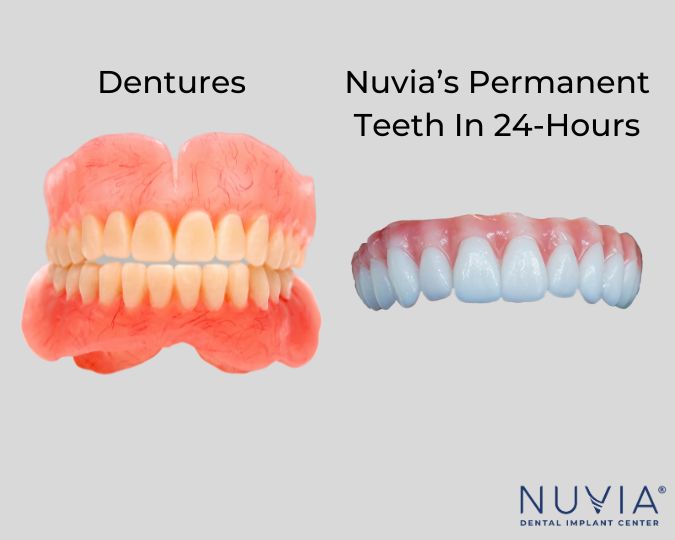
As we have taken a deeper look into the advantages and disadvantages of dental implants and dentures, you may have an idea about which is best for you.
Dental implants offer numerous benefits, including
However, they may not be suitable for everyone, as factors like overall health, bone density, and financial considerations are crucial components.
Dentures can offer some benefits as well such as
However, they may not offer the same level of stability and comfort as dental implants, and they require more maintenance, such as regular cleaning and periodic adjustments or replacements.
Due to the material they are made with, they may also require replacement or maintenance that will add to their cost overtime. Although they may seem cost-effective at first, they could end up costing you much more than you thought.
The cost of tooth replacement is often a significant factor for patients when choosing between dental implants and dentures. Dental implants tend to have a higher upfront cost compared to dentures, as they involve a more complex surgical procedure and use high-quality materials.
However, when considering the long-term durability and low maintenance requirements of implants, they may prove to be a more cost-effective solution over time.
Dentures, while generally more affordable initially, may entail ongoing costs such as adjustments, relining, and regular replacement.
Additionally, the lower stability and potential impact on oral health and bone loss may lead to further dental expenses down the road as the facial structure may change significantly.
Sources: American College of Prosthodontists. (n.d.). Facts and figures. Retrieved from https://www.gotoapro.org/facts-figures/


Dentures are a removable device that can be placed inside the mouth to appear and function as teeth would. Although they are significantly limited in the amount of stabilization they can provide, often making it difficult or even impossible to properly chew food and talk normally.
Dentures are made up of acrylic that has been shaped into teeth and attached to a base that fits over the gums. There are different types of dentures, like complete and partial dentures, depending on what a person needs. For purposes of this article, we will be referring to dentures as complete dentures, or full arch dentures.

Meet Michael, a patient from our Salt Lake City location who was in a denture when he came to see us. Can you see the difference between the time he came to see us wearing dentures and when he got his dental implants? Immediately there was a difference in lip support and face shape that some people say made him look younger and more energetic. What do you think?


#6 Hidden Costs later on
In addition, the cost of dentures may not be as budget-friendly as initially perceived. Although the upfront cost may seem lower than dental implants, dentures typically require regular adjustments, relines, and replacements, among other costs which can add up over time. This ongoing maintenance can make dentures less cost-effective in the long run, as patients may need to pay for multiple sets of dentures, adjustments, relines, and additional dental visits throughout their lifetime.
Minnie, one of our denture patients who came to Nuvia for dental implants explained her experience with dentures vs dental implants. Watch her story below.
**Actual NUVIA patient(s) who may have been compensated for sharing their story. Not all those who come in for a consultation are eligible for this treatment. Results may vary in individual cases.
It is also important to consider the potential impact of dentures on a person's bite or alignment. Since dentures are not fixed in place like natural teeth or dental implants, they can shift over time, causing issues with the wearer's bite. This misalignment in the jaw can result in uneven wear, potential jaw pain, and difficulty chewing food properly. It can also make it challenging to find a comfortable resting position for the jaw, leading to increased strain and potential discomfort.
Feeling trapped by dentures? See if you may be a candidate for dental implants with the 60-second quiz:


This guide is designed to walk you step by step through the dental implant process and each dental implant type with their associated costs.


.jpg)



After reviewing top dental implant companies in the country, the Healthcare Business Review names Nuvia 2024, 2025 & 2026 Dental Implant Restoration Company for three consecutive years for its innovative permanent teeth in 24 hour process. Find out what is shared by the best dental implant companies here.
Biztech Outlook has awarded Nuvia Dental Implant Center placement on their 2026 list of the top 10 best companies to watch for their innovative approach to restoring smiles. Check out the full article here.

The traditional dental implant process can be outdated, inconvenient and long. Nuvia’s 24hr permanent teeth process is safe, convenient and fast.

Permanent Teeth Delivered in 24hrs


Up to 10+ months wait for permanent teeth
Eat Soft Foods* Immediately
May be on liquid diet for up to 6 weeks, then soft foods for up to 8+ months
Only 1 Appointment to Get Permanent Teeth
Up to 9+ visits required
Zirconia* Material
Delivered in 24hrs
Varies; delivered up to 10+ months after surgery
Digitally Mapped for Precise Fit
Multiple, manual wax mold adjustments. Dependent on skill of provider
Slim Design for a Natural Feel
Temporary denture can be bulky and feel less natural
Teeth Created By In-House Lab
Saves you time and cost
Back and forth with 3rd party labs can cause delays & added expense
Comfortably Asleep During Procedure
Sedation included at no extra cost
Varies; may not be offered or can be an extra fee
Team of Surgeons, CRNA’s & Restorative Doctors for Every Procedure
Included at no extra cost
Varies; single dentist may handle multiple roles
Permanent Teeth Delivered in 24hrs
Up to 10+ months wait for permanent teeth
Eat Soft Foods* Immediately
May be on liquid diet for up to 6 weeks, then soft foods for up to 8+ months
Only 1 Appointment to Get Permanent Teeth
Up to 9+ visits required
Zirconia* Material
Delivered in 24hrs
Varies; delivered up to 10+ months after surgery
Digitally Mapped for Precise Fit the First Time
Multiple, manual wax mold adjustments. Dependent on skill of provider
Slim Design for a More Natural Feel
Temporary denture can be bulky and feel less natural
Teeth Created By In-House Lab
Saves you time and cost
Back and forth with 3rd party labs can cause delays & added expense
Comfortably Asleep During Procedure
Sedation included at no extra cost
Varies; may not be offered or can be an extra fee
Team of Surgeons, CRNA’s & Restorative Doctors for Every Procedure
Included at no extra cost
Varies; single dentist may handle multiple roles
*Not all those who come in for a consultation are eligible for this treatment. Results may vary in individual cases.