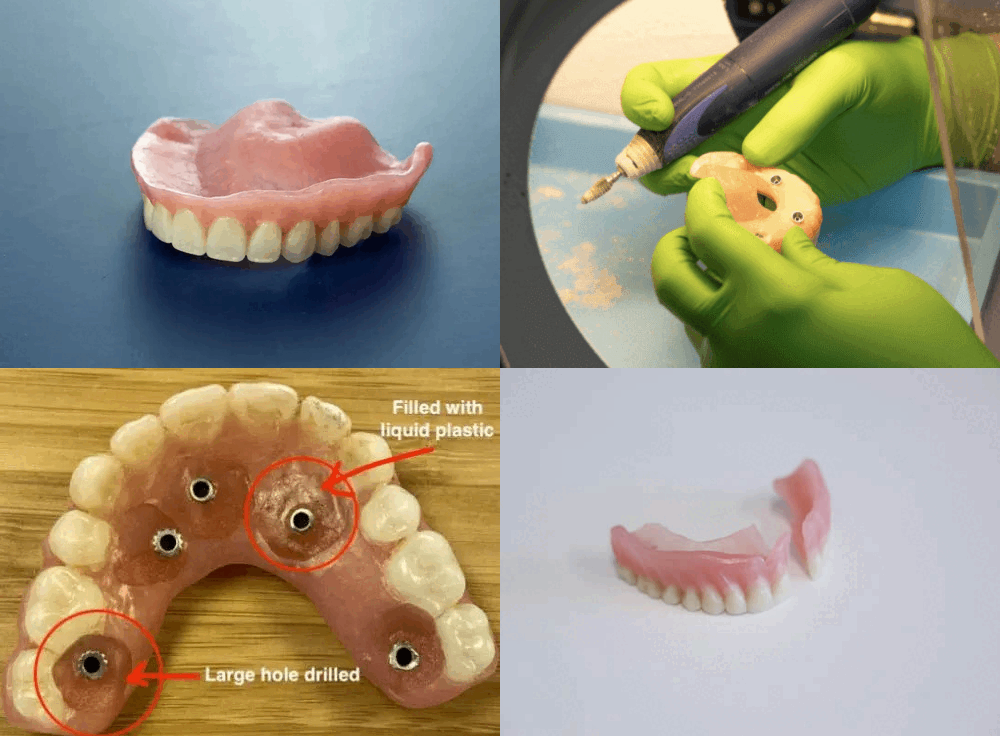
How painful is it? Oh, buddy. If permanent teeth in twenty four hours is legit, why isn't everybody doing it? If it was that easy, everybody would be doing it. Our bodies don't heal in twenty four hours. Is this safe? You have to respect the body. The body takes time to heal. How often do dental implants fail? That's a tough one. We're both doctors at Nubia, and today, we're gonna answer some of the top controversial questions that people ask online about the twenty four hour process. You ready? Yeah, let's do it. Alright. So first up, what does permanent teeth in twenty four hours actually mean? Doctor Park, you wanna take this one? Sure. So what permanent teeth in twenty four hours means that patient comes in for surgery, we'll remove the remaining teeth, we'll place four, maybe six implants on top bottom, patient will then go home, sleep off the anesthesia, come back in next day, and we'll have their permanent teeth ready for them. The process itself I think is really cool because I mean there's certain situations where a patient will come in on a Monday, you know have their initial visit with us as far as like measurements taken and you know the design process started. We get to take it to about eighty percent of the finish line. The surgery happens the next day. We use these records to fine tune our design and then from surgery to when the teeth are in their mouth. Twenty four hours. It is kind of pretty awesome. I mean it's pretty cool. I mean the technology that we're using, you know, the old school version, I can't believe this is still something that's being done. This is a conversion denture, same day smile. And it's just crazy that this is still being done versus using the technology today to create something where we have some of the strongest materials, zirconia, teeth, being able to provide that to the patient is amazing to be able to do it in twenty four hours. Totally. Sometimes I look at this kind of old school way of doing it, and I'm like, this is essentially choosing to type on a typewriter as opposed to using a computer nowadays. Yeah. Yeah. Yeah. It's pretty crazy. Alright. Next one. Let's do it. Okay. I have not seen these questions. We neither of us have seen these questions yet. These are pulled from online, so let's see what the next one is. Other places say you can get teeth in a day, so what's actually different here? Okay. I mean we kind of dived into it. It's a bit of a history lesson again. This is the original techniques of creating an all on four prosthetic that was designed like in the late 90s. Right. And so as you can see, you've got different materials here. You've got the beige acrylic, you've got the pink acrylic, you've got metal And they all flex at different points. And obviously they don't, you know, there's a transition period between the materials, very prone to breaking. I would say this isn't like a it's not like, you know, flimsy, right? But the kind of movement that talking about with these, it's these micro movements that can really kinda shoot the integration process for the implants themselves. Right? Back in my day, pre my pre Nuvia days, I remember having to repair so many of these. And it was just like half of my time was taken up in the lab in the back, just kind of acrylic and, you know, the molds and all the things. So it is nice to not have to do that anymore. Yeah. It's pretty crazy. Of course, the other thing with these is the wait time. Right? I mean, these teeth in a day give you a temporary that you are in for several months. I mean sometimes depending on what was done for the surgery itself, we're looking at six, eight plus months. With Nuvia, these permanent teeth twenty four hours next So yeah, the timeline for the patient improves dramatically for sure. Yeah. I think some patients, you know, they look at this, when it first came out it was you get that instant gratification. You come in for surgery, you get teeth same day. And they're like, woah, that's pretty cool. But when you take a deep dive into it, you realize that now you're in this transition period with a repaired denture. Totally. For six to eight months, And so it's a tough period, it's a tough transition period before you get to the final. And so it's amazing that you can take today's technology and make this prosthetic where you're using some of the strongest materials we have in dentistry, and we give it to the patient twenty four hours after surgery. It's pretty cool. Yeah, it is. It's pretty revolutionary. Yeah. Okay, next question. Doctors online have said our bodies don't heal in twenty four hours. Is this safe? What do you think? Well of course I believe our body cannot heal in twenty four hours. Yeah, we're in agreement. Dogs, we're all We agree. You know you have to respect the body. The body takes time to heal. We're not making this prosthetic fast and unsafe. Right. Right? You know it kind of goes back to your point of microbe movements. Would you rather have an acrylic material that's providing stability or zirconia and some of the strongest materials that we have to create that stability? It's kind of like a stent, the way I look at it. I mean, through the osseointegration process, that healing process where your body's creating that new bone that grows into the implants cell by cell. In my personal experience, I don't know if you've had the same experience, but I have found that this stronger, more rigid material has actually improved healing in patients and integration. Like I see I have seen a much lower failure rate in implants since I started with the Nuvia process than I did with the traditional method. Yeah, I mean for sure. There's definitely research showing that the failure rate for this, you know, can be between five, ten percent. Yeah. And you know, with Nuvia, we're, I think we're less than one percent. Yeah. Yeah. It's pretty cool. I mean. Totally. Numbers don't lie. Numbers don't lie. That's right. Alright. So yes, it is safe. Safe. If permanent teeth in twenty four hours is legit, why isn't everybody doing it? This is a good one. Yeah, mean, if it was that easy, everybody would be doing it. Of course. But it's crazy the amount of hours, time, the large team needed to do this. It's crazy. I mean the lab works around the clock twenty four hours. Totally. I know every patient that walks in from consult, that's the beginning of it. We're gathering information, that information being used to create this prosthetic. And so you know, we have people that are behind the doors, you know, making this It's crazy to once you get to understand the process, understand that it's taken years and years of development to create mean, you've been here since right after COVID, right? Yeah. With Nuvia. I've been here since twenty twenty three. Even in the time that we have been here, like obviously, Nuvia had done a lot more r and d even prior to your joining, but the process has continued to fine tune become better and more efficient. You know, it's not like we've we've just figured it out and we're done innovating. Nuvia is constantly trying to find ways to make things more efficient and better for the patient using the technology that we have, and so yeah, I think that is a quite a unique offering that we have. Does getting this done so quickly mean that the price will be higher? You'd think, right? I mean, it's I mean that's what you would think, right? Yeah. Yeah. But it's not the case. It's definitely not the case. Nubia is definitely below the national average. And so we're able to create this process. We've developed this process where the savings can be passed on to the patient. Totally. I mean, again, personal experience. I, for just the prosthetic aspect, was charging just as much as we charge for the entire Surgery Plus prosthetic at Nuvia prior to coming here, like with this with this. So the fact that patients are getting this for about the same amount that we were charging for that, like just the prosthetic aspect, it's pretty pretty cool. Yeah. And then the chairs the chair time. Oh, the chair side time For this one is extensive. It is. A lot more than this. Yeah. You know? For sure. So I think that's obviously where we're getting a lot of the savings, and then we're able to pass it on to the patients. Yeah, it's a better use of our time and more importantly the patient's time. Yeah. And the coolest thing of course is that Nubia offers so many different options when it comes to you know financials with payment plans and whatnot. They actually put together a cost guide and it will be available in the description if you want to check it out after this video. Sounds good. Cool. Next up. Are patients awake or asleep during surgery? How painful is it? Oh buddy. It's so nice to be able to offer sleepy time for our patients while they're getting this done, for Yeah, mean general anesthesia, it's great. Patients go to sleep, don't feel anything. We have our CRNAs that make sure to take care of the patients, very comfortable during surgery. I'd say about ninety percent of the patients, they just need ibuprofen. Like alternating with Tylenol? Yeah. Yeah, I've found that too. Like definitely some patients use the pain medication that we do prescribe just so that you have it if you need it. But for most patients I would say it is definitely pretty smooth sailing through the I will add, you know, it is so nice at Nuvia that we have a CRNA as part of our surgical team. A lot of different places will have the surgeon themselves put the patient to sleep, which surgeons are definitely qualified to do, the extensive training they do at the hospital and everything like But you you can ask surgeons right? Like it's very different putting someone to sleep for fifteen minutes while you take out their wisdom teeth to like when you're doing a major surgery on a patient and having to you know, be very engaged in this surgery for hours and also managing the anesthesia, it's so nice that we can keep the patient very safe with a separate provider also helping to manage that and monitor everything so that the surgeon can focus solely on the surgery. Yeah, I mean it's very difficult. I've done it. I've had to provide anesthesia and do the dentistry and it's a lot because you have to make sure that the patient's comfortable and safe while you're doing the dentistry. So your eyes are moving from surgery, from the mouth to the vitals, it gets tricky. It's a long time. I mean oral surgeons are among, I mean correct me if I'm wrong, I think the only surgical specialty that is able to do their own anesthesia. Anything else like cardiology or neuro or anything like that, they have a whole anesthesia team So yeah, nice to have the surgeon focus on surgery for sure. Are patients prescribed pain medication? Yes. Yes, they are. Yes, they are. Like we mentioned, not everyone needs to take it. It's certainly available for you if you need it. But yeah, again in my experience I really haven't seen patients either need to take it to its full extent and very rarely need like any kind of refill or anything like that. I mean it's it's typically pretty smooth sailing. It is a major surgery, like you're still recovering, but you know if you take it easy and ice really well and keep ahead of the pain with ibuprofen and Tylenol alternating, most patients are in good shape. That what I'm good with that. Is it painful to get permanent teeth the day after surgery? Oh that's a good question. Alright, yeah I'll take that one. So you leave surgery with little buttons over these connectors that screw into the implants. When you come back the next day, since we do it the next day or in some very rare cases like if a patient has surgery on a Friday and they come back on a Monday, the swelling is not peaked when we deliver, and so you know in our office we've found it's very rare, I could probably count on my hand the amount of times that I've had to give anesthetic for the delivery because these teeth are molded or created to what the tissue looks like fresh out of surgery. And so you know they typically go in quite comfortably. Yeah. I agree. Yeah is that what you've seen at your practice as well? Yeah, I mean patients come in, yeah of course, it's major surgery, so there's a little achiness to it, but the excitement to see the teeth and put the teeth in and then get the reveal, like you said, very rare that you need to provide local anesthesia or anything for the delivery. Yeah, that delivery is so fun too. Like that's probably one of my favorite parts of being a doctor here is just actually getting to see the patient turn the mirror around and just see their smile. And if they bring family members or friends, it's so emotional and just special. It's a special time. It's kind of like the analogy is kind of like a flower. You have patients that come in for consult and they are so quiet, no personality, they're just a wallflower. Totally. And then they get the teeth, they're crying, they're smiling, their real personality start to come out. And it's just amazing that we can do this in twenty four hours. Yeah. Yeah. We had a patient, gosh, this must have been like two and a half years ago, who came in for his evaluation visit. And we we were all just like trying to, I don't know, talk to him, chat with him, get him to like engage and one word answers wouldn't really show his mouth. And the moment this man got his teeth in, I mean tears streaming down his face, smiling, so chatty, just like, guys thank you so much. And it was just like, oh my gosh, your family and friends haven't gotten to know your real personality for how long? Like this is a real new beginning. So anyways, he sticks out on my mind quite a bit because that was a very impactful one for us. Yeah. Amazing. Alright, let's see. Long does healing take and when can patients return to work? Healing, I feel like there's multiple layers to that, Like you've got your initial gum healing and like the bruising, if you have any, or swelling, that's like a two week mark. Right? And then the actual implants, if you could speak to that. So the integration of the implants, they do become weaker at the two week mark. And so it's very important that throughout the whole process you're keeping things as clean as possible. They start to integrate more and by the two to three, four month mark, that's when you're getting some solid bone development around the implants. And that's at that point where we'll come in, we'll take a look, make sure everything looks good, and if you're ready for the next step. Cool. Yeah, I would say I would add to that as far as the initial healing process and returning to work, I think it's job dependent, right? Like if you have someone who is a mover and like taking boxes out of a truck something like that, want them to take you know at least a week if not two from that kind of strenuous activity. But if you have someone who's kind of like working at a computer or like not really a lot of face to face interaction or are not on their feet too much, I've seen people return as soon as like a couple of days. Obviously, you know, everyone heals differently, so some patients come in looking like nothing happened and others like With a lot of bruising and swelling. And I go over that with my patients because you've got to know what to expect, right? Like everyone's body heals differently and there's a really broad range of normal. So part of it is listening to your body, part of it is you know, just giving yourself a chance to heal from this surgery. Yeah. Yeah you just definitely wanna take it easy after surgery. It is major surgery so just take it easy. Yeah. And hey if there's a lot of people that work from home, they don't have to take calls. Totally. You don't have to talk, That's great, you can return to work immediately, however you feel. Get back on that keyboard. Was gonna say like don't be on any of the pain medication when you do that. Don't make any major decisions. Yeah. Don't need you online buying a llama or anything like that. But but yeah. You know, use your judgment. Yeah. Common sense. We got it. Totally. Alright. Let's see the next one. Oh, yes. This is this is my favorite question. Like and subscribe. Tough one. Alright. Here you go. Does a gap form once healing is done? Oh, man. The gap is my friend. I don't know about you. Let's let's talk about how and why it forms first and where it is. Right? Mind the gap. Mind the gap. Alright. So fresh out of surgery Swelling, tissues are stitched together. That's how we create these. Tissue over the course of the four month period remodels, pulls back. For us, I would say probably ninety five percent of the time the gap that forms is less than a millimeter. Kind of, mean just very small. And that is my ideal for a patient because that way they can floss between it, water pick easily, swish Yep. Food out of there and keep it really clean. How do you feel about the gap? No, I agree. It's very important to keep things clean, and if you've a tiny bit of a gap, it makes it easier to floss, to water pick, to get those bristles in there and brush, and kind of stimulate that tissue. And stimulating the tissue will help keep it nice and firm and snug to the prosthetic. And that's like the key. So have you had a situation where a patient has come back and the gap that has formed has been like very intense for one reason or another? Like let's say their tissue healed in a weird way or something along those lines? Yeah, every case is a little bit different, but yeah, you can definitely have cases where you'll have a bigger gap. Not a big problem. It's you know, everybody thinks, oh you're gonna get teeth, permanent teeth in twenty four hours. They don't do anything about the gap. Know, it's like wham bam, thank you ma'am, done the surgery. No it's not the case. It's not the case. You come back in the four months and we'll take a look at that gap and we'll add additional material to make sure that it's nice and snug. But yeah you'll have some cases where like you said you'll have like a millimeter gap and some you'll have like three millimeters and stuff like that. You know it just happens. Every case is a little bit different. And if it doesn't bother the patient honestly, like I've had some patients come in where on the lower let's say they'll have a bit of a larger gap But they'll be like no, no, I don't mind. I can use a proxy brush in there and I'm in a good place. That's music to my ears because I'm like if you can keep it clean at home, your annual visits with us are going to be so smooth for Yeah. No, that is great. Like from what I've seen in personal experience, when the prosthetic is touching the gum or adapted to the gum, it is so much harder to clean. Like those patients, they can't floss, they can't even swish liquid between the prosthetic and the gum. So if they're out to eat or something like that, it's a lot more difficult for them to clear any debris that they may have than if they did have the space for it. So sometimes I actually create space for the patient if they can't floss, to be Yeah, I mean a lot of our patients are older, so it takes some manual dexterity to be able to clean So yeah, those are critical pieces in terms of oral hygiene. Cool. Cool. Love it. How often do dental implants fail? That's a tough one. Let's talk national averages first. Yeah. National average for single implants, implant prosthetics, and stuff like that, we're looking at a five percent, ten percent implant failure rate. And that's personally what I had seen prior to coming to Nuvia. Yeah. Awesome. Nuvia, this process that's why I feel so passionately about this cross arch stability that this rigid prosthetic provides. We have less than a one percent failure rate. So over ninety nine percent success for these implants. And it's just it's very cool to see. I mean, it's nice to not have to redo work. Or repair. Or repair. My goodness, that's so time consuming. Even if there happens to be any kind of issue, we can typically identify insulting factor and then come in with like a very simple straightforward process. Yeah. We're not going leave the patient high and dry. We're definitely going help them out. Totally. Yeah. Are they hard to clean compared to regular teeth? Okay. It depends on how we're cleaning the regular teeth. Okay. So regular home care. Well, you're not cleaning them. Yeah. Right. Yeah. Yeah. Totally. So normally, you're flossing between all of your teeth as we all are. Right? Yes. But so we're flossing, we're brushing. If you have a bridge or an implant or something, you may also be using a water pick. Talk to me about cleaning these. It's like anything, you need to keep it clean. Right. You know, water picking all the things that you've mentioned, the water pick is critical. Yeah. The floss, so you will be flossing underneath. We'll get into it a little bit more. Using a toothbrush, yeah, you definitely have to brush it. You want to keep any debris off of the prosthetic and the tissue underneath. You know, you can brush here on the palette, and then kind of get into super floss. Right. Obviously, in the mouth you're not going be able to do this. Right. But that's why that gap is so important, right? Yeah. Yeah, I Oh, wow. Magic. Just Amazon Prime. Hey. So did you order it like five minutes ago? Because that was really impressive. Amazon reads my mind. Wouldn't that be something? That's next. So we've got this kind of super floss. It has a firm end on one end of it. Actually this one has it on both ends which is pretty cool. And then this kind of expandable floss. So flossing, as I explain it to my patients, flossing brushes where the brush doesn't reach, right? So it's not just about oh we brush and the water picking gets everything, you still have that biofilm, the plaque, the bacteria. So threading it through that gap, this is what we were talking about when we were saying that it's important to be able to clean underneath the prosthetic. If you can thread it through the gap and pull it through, you kind of windshield wiper it between the implants and you repeat that in between each segment. That, honestly, I've seen patients come back now for almost their three year follow-up and patients who are consistently flossing and brushing well, I mean it's pristine. There's nothing that, you know, in some cases where patients don't do that, we might have to take off the prosthetic and clean it for them and everything. But it is nice, you know, to see when patients really take care of their investment and their health, right? So yeah, that's That's probably one of the biggest, most important hygiene instruments that I Something simple but very And the other thing that I wanted to highlight, we talk about that healing period and how crucial it is. I mean you think about it, the gums have just been, you know, not to be graphic, but cut open and then stitched back together. This surface underneath being you know, like a flat, smooth, highly polished surface, I think offers a much more stable environment for the gums themselves to heal. When you have something with so much like different materials, anatomy, porosity, this is a food trap. It attracts plaque when you look at it microscopically, it's rough. And so you know, you think about as you're healing, as those tissues are healing, do you really want to have this like pit of bacteria up against the tissues themselves? So yeah, that's another thing that I really appreciate and value about our prosthetic delivery. Yeah, I mean with what you mentioned, the porosities and everything, denture, people that wear dentures, you know, you're prone to bacterial infections, fungal infections, Candidiasis. Yeah, fungal. It's the same thing with a prosthetic like this. Acrylic, that's porous, but this one, the materials that we use, they're nonreactive, non porous. Has anyone had this for years and how long is it supposed to last? I mean, in an ideal world, right? These are designed to last a lifetime. Yeah, mean that's the hope, right? We want to make sure that these last for the patients the rest of their lives. Obviously the dentist, all the providers that we can do, we get you halfway there. We provide the clinical work, the prosthetic. The other half is making sure that you know you're doing the super floss, the water pick, keeping things super clean. Yeah. That's a major part of it. Yeah, for sure. I mean I would say almost like most failures that you're going to see are going to happen within that like four to six month healing period. Definitely within the first year. Like beyond that something maybe like trauma or you know, really poor hygiene and home care could contribute to failure. But once the implants are integrated and are part of the bone, like they're a part of you. You know, it's like a hip replacement, right? That's not just out of the blue gonna fall out of you, I guess. Yeah. But yeah. Yeah, I mean and plus you wanna baby these as much as possible. Totally. You've spent all this time and money, you've invested in your health, you wanna take care of it. Not gonna go out there, start MMA as a Right, right, right. Well, okay, so here's that's the thing about this, right? Let's talk long like trauma after the first year, right? Let's say you do take up MMA as a hobby. You think about the zirconia of the teeth, that ceramic that's as hard as metal. You think about the titanium of the implants themselves. And you think about your bone. Which of those three is the weakest? Right? It's the bone. If heaven forbid some kind of crazy accident or something like that, it's not like you're gonna chip a tooth. It would be like bone problems, right? And so the materials themselves are made to last. We just have to make sure that we are protecting your health, your environment, your oral hygiene as much as possible. Like bite into that apple, have a great time after the four month healing period, obviously. Four months, four months. But the same way as with natural teeth, any kind of risk or trauma that you may expose yourself to could potentially lead to an injury, right? That same kind of way. Yeah, use your common sense. Yeah, common sense is our friend. But if you want to learn more about personal experience with nubious teeth, you can check out Ricky's video. He got his teeth done, I think back in twenty twelve? A couple years ago. No, I'm sorry, twenty twenty two? Yeah, a couple years too. Yeah. Two, three years ago. Yeah. And he did that video where he kind of went over the good and the bad and like what his experience been. So that would be a great one to check out. Yeah. I mean, that's gonna be invaluable in helping you make a decision. And if you are interested in learning more about what this could cost you, definitely download the free cost guide in the description below. So until next time. Keep smiling.








.jpg)