
This website uses cookies to ensure the best experience on our website. We may share your information with our advertising and analytics partners as outlined in our Privacy Policy.
Watch as real patients experience the shift from dentures to dental implants: From first conversations to final results, these stories and demonstrations show what actually changes when dentures are replaced with a fixed, permanent solution.
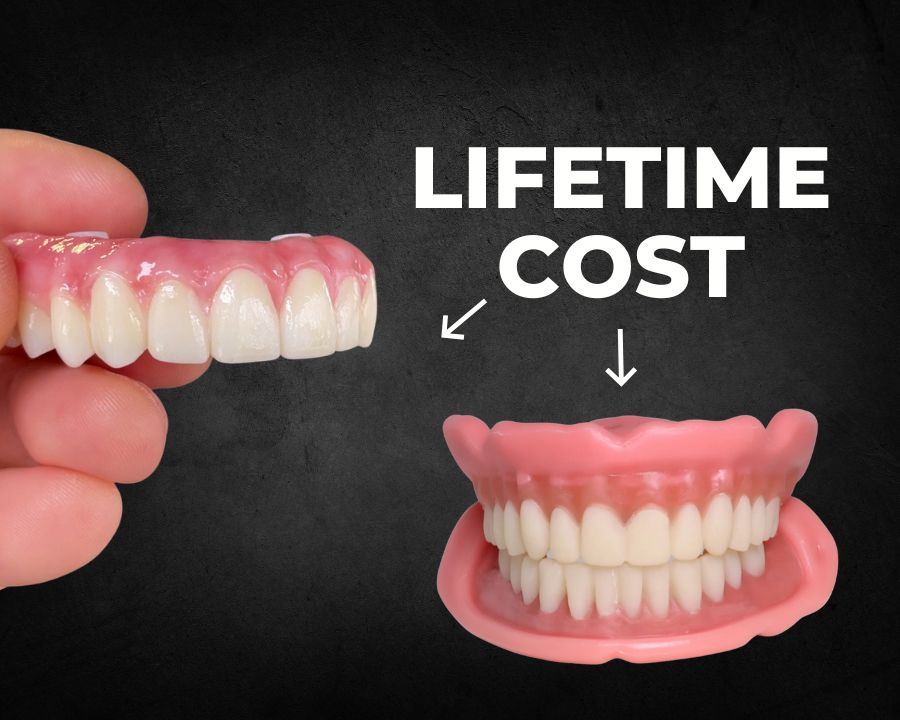
Before getting dentures or implants here's five things I wish I would have known before getting them. And I know you're worried about cost, but we're going to talk about that a little bit later. So my teeth were pretty bad. They were cold sensitive. I would cover my mouth when I laughed or I would just laugh with my mouth closed. And if you're watching this video, you probably are there too. I had the wiggly teeth. I had to have root canals. I had to have crowns that would keep falling off. It was a nightmare. It was a dental nightmare. I didn't realize how much dental anxiety I had around my teeth and the insecurities that it was causing me, the selection I had to make when I was finding what I could eat and what I couldn't eat. So if you're like me, I wanted to gravitate towards something that was a quick fix and economical. So I went to a denture. And it was great because the next day I had a brand new smile. However, you're just trading one problem for another because if you're in a denture for too long, you're gonna notice that you can't taste food. You're still having trips to the dentist because you've gotta do a reline and a liner and an adjustment, and you have denture sores, and the list just goes on and on and on. And you just trade one problem and you start to spiral this other complete way. And actually, if you're wearing it for too long, you're going to end up with bone loss. And that's a bigger problem for down the road. The cool thing about dental implants is that the palate is open and you can actually taste your food. The difference between that and a denture is this covers your palate and it literally rests on your gag reflex. With a denture, you have to have the palatal part because that's what actually keeps the denture in your mouth. But it also rests on your gag reflex, and a lot of people just can't tolerate that. With a dental implant, these are anchored into your bone so you don't have that problem that you do with this. So you guys can see the difference. Realistically, which one would you want in your mouth? And you probably don't know this, but if you're in a denture for too long, your bone is gonna shrink. And ultimately, when you're ready to go get dental implants, you're not gonna have enough bone, and you'll be disqualified. Even if you have all the money in the world, if you don't have enough bone, you won't be able to get dental implants. I've heard and I've seen many people be turned away because of their severe bone loss, and I don't want to see that happen to you. So if you're thinking about it, don't procrastinate. Get in there, check your bone, and see if you're a candidate. Luckily for me, I did have enough bone to get dental implants, but I wish someone would have told me that the clock was ticking. If you're watching this video, then you probably already know how much time and money you've spent going to the dentist only to be having root canals and crowns and fillings. And I personally had a broken file in one of my teeth. Like the the dental trauma goes on and on and on and on. You've probably been out to dinner to eat and you've had a piece of bread and a piece of your tooth is chipped off. Or you've gone to the dentist with an abscess and you go in and you have to have a root canal, but he only temporizes it. Then you have to go back for the actual root canal. And then you have to go back for the crown. And then it's just one cost after another, after another, and it's just endless. It just piles up. And then you have children that have dental work or braces, and it just goes and goes and goes. And it's like an endless cycle of how much do I have to pay for actual dental care. If you think about it and you add up all the money you've spent on temporary fixes for your dental care, if you're anything like me, it's close to six figures. I started having root canals when I was fourteen years old. So it's a lifelong, endless hole of debt. With dental implants, like the ones I have in my mouth, it's one and done. You don't ever have toothaches again, no root canals, no abscesses, No surprise bills. No emergency visits. These are the real deal, and they're awesome. And if you're worried about cost, Nuvia does have a cost guide that can potentially save you thousands. I'll leave the link for you below. And if you can do me a favor and hit the like and subscribe button, I would love for this video to get out and help as many people as it can. I wish I knew I could get dental implants in twenty four hours. So I've actually had this done twice. The first time was the traditional way, which is the long way. It took months and months and months. It was not done by Nuvia. I had to go through several try ins and healing and shade changes, and was really just on the labs time. And during all of that process, my temporary actually cracked and it was so scary because I was worried that my implants were going to fail And I would not recommend going that way to anybody. I mean, let's be real. If you're going to have a major surgery, do you want to sign up for something that's going to take months and months and months? Or do you want the one that just takes twenty four hours? So ultimately, my dental journey inspired me to want to work in dentistry so that I could help other people with the same problems that I struggled with. I now work at Nuvia, and they were able to give me my teeth in twenty four hours. And now I see it on a daily basis. People get permanent teeth in twenty four hours. I wish I knew how life changing this was. So when we have patients come in and they're so insecure and they have no confidence, they're not even confident that we can help them. They just go ahead and take the jump and choose us to go on the journey with them. And we are so fortunate on a daily basis to be able to change people's lives in twenty four hours from surgery. It's amazing. It's rewarding. And I personally, since I have dental implants, I know how that changes a person's life. And so I feel very fortunate that I get to do that on a daily basis.
Hi. I'm Dan. Six months ago, I got these. So I'm gonna share some things about them that I love about them, and some things I absolutely hate. So let's start with the bad, because that's what everybody really wants to know anyways. The first time I put these in my mouth, instant gag. Now yeah that's normal for a lot of people, because it's not something natural what's in your mouth. It was so extreme that I wasn't sure it was gonna work. I looked on the internet to see if this is something completely out of the ordinary and it doesn't seem to be it was pretty common with a lot of people. One of the times I actually had it in position, what felt like perfect, it was suction to the roof of my mouth like it's supposed to be, and all of a sudden, I had to rip it out of my mouth basically to to curb the gag reflex. And I gagged. And in the process, I actually tore the the front of my gums pulling it out of there. That made me a lot less likely to want to try it, but I kept trying. Now let's talk about the good. Like a lot of you I got to the point where I had a lot of broken teeth, a lot of problems inside my mouth, where I was getting infections and I felt like crap most of the time because with the infection and the broken off teeth, I thought well the best thing I can do is fix that problem. So I went in and got the extraction, and it just made my whole life a lot a lot better. I felt better physically. If you think about it, when you've got bad teeth and you get infections, you're actually poisoning yourself every day. So the best thing you can do is eliminate the poison. Those might not be a big deal to a lot of people but I'm an avid sportsman, I like hunting. This is the time of year where turkey season's coming upon us and a lot of guys use mouth reeds. I'm one of them. When I put my dentures in and try and put a reed in and try and make turkey sounds, it's not good. Let me let me demonstrate. Therein lies the problem. If I can't do that, I can't hunt. For me to not be able to do that with dentures to me is a huge bad. Now another good thing about dentures, it did give me a lot of a lot of my confidence back about my smile and how I looked Because when you're missing teeth you always have that in the back of your mind that are they looking at my teeth and and judging me? And once I got them you know I was able to talk more to people and just feel like I didn't have that burden of the missing teeth in my mouth. That's that's probably the biggest good. In my job, I talk to a lot of people during the course of the day so having a smile that I could put out there you know really instilled confidence in me and made me feel like they trusted me because I had a full full smile again. So here's another bad, the hassle of constantly taking your dentures in and out, re gluing, realigning, and then you think when you get these fit right it's going to be just as simple as can be. Just plop them in, you're good to go. That's not the case because your mouth is constantly changing. You heal up, or you get maybe a seed underneath them. It causes an abrasion. Well now you've got to take them out, clean them, realign, or re glue. Put them back in. This could be, you know, once a day, could be three times a day. I wasn't ready to take that hassle and make it my daily life. So one day I was scrolled through Facebook like many of you probably are, and I came across an ad for a place called Nuvia. They claim teeth in twenty four hours, one and done. And I thought to myself, well, that seems a lot easier and more permanent than what I've been going through with these dentures. So I'm gonna take you along, I'm going in in the morning, I'm gonna get the surgery, I'm gonna get the implants and I'm gonna get my teeth in twenty four hours. Oh, yeah. You're probably wondering, what's this all cost? I was thinking the same thing. When I went in for my consultation, they gave me a cost guide. We've got the same cost guide put in the description, so you don't even have to go to a consultation to get it. One of the requirements for this procedure is that you have to be clean shaven. Well, this should be interesting. I've had facial hair for about thirty five years. So surgeries in the morning, here we go. See you then. Alright. We're here. So I'm gonna walk in and show you guys the office. So here we are. Well, they called me back, so let's go see. Hey, Dan. Come on in. You can have a seat here. Okay. Can I have a seat? I'm gonna have doctor Frey come in and chat with you before we get going. Okay? Sounds good. Okay. Hey, Dan. No. How's it going? Good. Good to see you again. Good to see you too. Awesome. Can you tell everybody what's different about Nubia? Sure. Well, hi, everyone. Doctor McCray. As, you know, compared to all other, centers that do, all NX, Nubia is a center that give you your permanent teeth in twenty four hours. No need to wait six months or any of that. And I'm gonna be putting four implants on the top. Okay? Okay. And then tomorrow, you'll get your your permanent teeth. How's that sound? Oh, good week. It's amazing. Alright. Well, let's start the surgery. Well, it's been twenty four hours since surgery. Sorry if you can't understand what I'm saying because I got an old teeth. Just a little update on how surgery went. Everything seemed to go good. Before I go in there, you wanna know what it looks like before they put the teeth in? Little weird. They got them pretty caps on there. So I'll go in there and we'll get started on putting the teeth in. Perfect. Perfect. That. You actually look really great. No. No. No coffee. No coffee. No protein at all. Nope. So we'll give you the mirror, and then we'll do a countdown. Hi. How are you? I can't even. Okay. Congratulations. Hey. You got it fixed. No harm to rotted ginger. Yeah. I heard what you did to potential me. I was like, man. Uh-uh. We need to give you something fixed. Okay. Yeah. It looked great. It looked great. I'm happy for you. You have to say how you're feeling right now in one word. What would that word be? Create. That's a good word. Mhmm. Smell right to the kitchen. Yeah. I'm so happy for you. Well, I'm starved. So I guess I'm gonna go get my first meal with my heat tea right up here at Oak If you're thinking about getting dentures, you've seen my story. You know what I went through. I'm not saying it's gonna be the same for you, but if it happens to me, I'd say contact Nubia. They're they're great to deal with, great group of people. Every location has got great people in it. If you have any questions about it, I know I've watched a video from Ricky, and we're gonna link that. And you'll be able to watch he's in on a he's in two years into this, and he can answer a lot more questions about it in his video than you're probably seeing in this one. So just wanna let you know I'm feeling great. Everything went smooth, and that first meal was like a treat. I want you to tell them what you just told me. Just to see your smile again. See you. And it's just great. Smiling and ready to enjoy life. Showing people just how wonderful you are. That is the ice noodle in the cake right there.
I'm talking with doctor Anoni, a restorative doctor, about every major tooth replacement option. So doctor Anoni, how are gonna break this down for us today? Alright. Well, we're gonna start off with single tooth replacement, and we are going to go all the way to full mouth tooth replacement covering both temporary options and ones that are more permanent. Okay. Sounds good. So what is up first? Okay. So up first is these temp tooth wax beads. Okay. Okay? So these work by melting them, basically, and then you mold them into a tooth. So let's say that you have a tooth knocked out or a crown completely broke off and you need a quick replacement because you cannot access your dentist. It happened on a Saturday afternoon and you are in the wedding party, my friend. If you need a very quick fake tooth, you melt these down, you mold it to the area, then you put that back in water, like cold water, so it'll set, and then you can kind of put it in and out. Certainly not something that you can eat or function with, but really good for if you're in a pinch. Okay. Okay? And what is the cost range for something like that? This, I mean, online you could probably find something like this for like ten dollars to twenty dollars something like that. Okay. Okay? So super temporary at home, no dental work needed. Gotcha. Then we're moving on to a more permanent tooth replacement. Okay? So this here is a dental bridge. Now, you'll notice you have a natural tooth, missing tooth, natural tooth. The thing about a bridge is it replaces, I don't wanna extract anything here, it replaces a missing tooth with what's called a pontic. So it looks like a real tooth but there's no root connection. Okay? Pros, this can be done within, let's say a two week turnaround period. You go into your dentist, they shave down the teeth next to the missing space, they take an impression, whether that's a digital or a physical impression, they send that to the lab, the lab will create a ceramic bridge, and then two weeks later, that gets cemented on. Like I mentioned, I think the biggest pro for a bridge is turnaround time. Another case where a bridge might be a really good option is if this missing tooth has been gone for a very long time and the bone has shrunk down to where it's not thick enough to hold a dental implant, this might be a good option, okay? Additionally, if the patient has received any kind of head and neck radiation or has been on a medication called a bisphosphonate, basically if they have osteoporosis and they're taking injectable bisphosphonates, that might predispose the bone to not heal well with an implant. Okay, so this option is great. So let's use a practical example here. The anchor teeth are like these land masses. Okay? They do have to be prepared or shaved down in order to hold the bridge. Good. That fake tooth in the middle is this bridge. Think about the stability required for this. So we wanna make sure that the span of the bridge is not significantly greater than what these land masses are able to hold. So a three unit bridge, meaning there's one fake tooth and two real teeth or two land masses, that typically can hold with good stability, especially if it's a back tooth, if you're chewing, you have these stable land masses. The longer this bridge gets without reinforcing, the more at risk the bridge becomes. So if you have just these two anchor teeth, but in between you have three pontics, let's say, and you are putting a lot of pressure on that as you're chewing, that bridge is not gonna hold well and is at a high risk of fracture. So if you're replacing a single tooth, this could make sense. If you're replacing many teeth and you're looking to do this bridge part with just pontics and no other stability, you may wanna evaluate other options. Okay. So let's get these guys out of here and talk about a different replacement for a single tooth. So this is a dental implant. A dental implant is typically titanium screws, some of them are ceramic nowadays, but that implant goes in to replace a tooth root Like that. Now we have individual crowns if you need crowns on the surrounding teeth. Right? You have individual crowns there and you have an individual crown on that implant. Advantage here is as opposed to a bridge, you can treat these like individual teeth. Right? So whereas with a bridge, you're cleaning around this guy and you really have to make sure you get under that. Waterpik is a great tool for that. Here, you can floss and treat this like a really unnatural tooth. Okay? The other advantage to getting an implant placed is with a bridge, if something were to happen to either of those anchor teeth, the whole bridge is compromised. You have to replace the whole thing. Let's say you end up needing a root canal on this tooth. You have to drill through the bridge to get there, and that can compromise the whole thing. Wow. Okay. With dental implants, you don't have to shave down these teeth if you don't need to. And if anything does happen to either of these teeth individually, the rest of the teeth are not affected, right? So you do have to be a candidate for dental implant. And if you don't have enough bone in that area, there's always grafting options, meaning the doctor can place bone there, allow that to heal, allow your body to create new bone, then place a dental implant. But I will say a single dental implant oftentimes, especially if it's in the back, will take more time before you can have this final restoration. Okay. Because you do want it to heal and integrate completely before you're putting pressure on that implant, because you don't want to interrupt the integration process. Okay. So that is a bridge versus an implant. Any questions there? What does the cost comparison look like? Great question. So with a bridge, you're looking at typically between, let's say, fifteen hundred minimum, typically for the individual crowns, maybe a thousand here, but that ranges. I mean, I know providers who will charge two thousand five hundred dollars per crown depending on the work that's needed to be done underneath those teeth. So we could be looking at anywhere between, let's say, four thousand to seven thousand dollars depending on the work that needs to be done underneath these teeth, okay? For a dental implant, you've got the implant itself, which is the blue part. You've got the connector, which goes into the dental implant and allows for the crown to be placed, so that part sticks up over the gum. And then you have the crown. Honestly, the price range is gonna be pretty similar. We're looking at like between four thousand five hundred to maybe six thousand five hundred, depending on where you are. Geographically, that can differ. I've certainly seen implants go for less, but it is important to note what kind of implant is being placed, right? So you do want to make sure that you're getting an implant from a reputable implant company, not some knock off that's not going to integrate well and might give you problems down the road. So that's something that it's important to ask your provider about and really educate yourself on. Okay. And when would you suggest somebody getting an implant over a bridge? So an implant, in my opinion, is a better long term solution. Okay. With a bridge, you are looking at replacing it every ten to fifteen years. You've really got to evaluate if these margins along the tooth, so this margin here can sometimes have an opening and you might get decay in this tooth. And so regular x rays are really important. So yeah, a bridge lifetime wise might end up being more than an implant because you may need to replace it, you may need to expand An implant, once the actual implant itself integrates into your bone, that should last a lifetime, right? If you are taking care of this well, meaning you're flossing, you're water picking, you're cleaning at home, there's no reason it shouldn't last you a lifetime. Okay. So I think longevity wise, the implant makes more sense. But again, not everyone is a candidate for an implant, so it is really patient specific. I mean, the goal here is to go over all these options, educate you guys out there as well as you, for anyone who does need a tooth replacement, And then once you're armed with all of this information, you can make the best choice for yourself on what is going to fit best for your lifestyle, for your budget, for your goals. Okay. To provide a good example of what kind of bone may make a patient a good candidate versus not a good candidate, let's use a real world example. So an implant is much like a screw, right? So we've got a dental implant right here. That screw underneath this is that connector and then the crown on top. When you are doing carpentry, you can have different kind of wood. Right? We wanna make sure that that screw, to give us the best stability, is going into nice solid wood as opposed to wood that's very porous or soft. You know, it's not to say that an implant won't stabilize over time if it goes into softer wood or softer bone, if you will. But that we might wanna allot a little bit more healing time. What happens during the healing period is that implant is inside of the bone. Under a microscope, that titanium is actually porous. Okay? So your body has bone breakdown cells and bone buildup cells. Immediately when an implant is placed about two weeks later, the bone breakdown cells are in much higher concentration because your body is remodeling the bone around that implant. Between weeks two to about six or eight, the implant is actually weaker than it was when it was first screwed in. Then the bone buildup cells start coming into higher concentration, meaning that cell by cell, your body's creating new bone that grows into that porous titanium and actually integrates with the implant. Okay? So, that is why allowing more time in particular if the bone is weaker can still give us a really successful long term implant solution. It's just really dependent upon that quality of the bone. We'll talk a little bit more about how this comes into play when we're talking about full mouth solutions, because sometimes individual implants can be what's called immediate load, where your provider might make a temporary crown for that implant if it has really good stability and there's strong bone. Typically, you do want to wait for that integration to happen because the strength offered by one implant is not always enough to withstand the really strong forces of chewing or biting. Okay. Okay? So what if somebody is missing more than one tooth? What would you, you know, say would work best for them? That's a great question. So as we talked about with individual implants, sometimes patients might be missing two or three teeth. You can do more than one individual implant to replace missing teeth. Okay. You can also incorporate implants into a bridge. Okay? Not with natural teeth. They have An implant has a different relationship with bone than a natural tooth. But you certainly can place an implant. If you're missing, let's say, a span of three teeth, you can have two implants here. Crown, crown, pontic. So it's still a bridge, but now it's held together by implants. Right? So that's another option if someone's missing, like, let's say three teeth in a row or something along those lines. Individual implants or implant bridges. Right? So let's move on to removable solutions for multiple missing teeth. Okay. This here is called a removable partial denture. This one is cast in metal. This is a good solution if somebody wants something removable that is going to be more of a long term solution for them because this is all cast in metal, so it's much less likely to break on you. This removable partial denture is more of a temporary solution because you can see it's not cast in any metal. It does have these little metal clasps to fit around the teeth, but it's it's certainly much more of a temporary solution. A removable partial denture of this kind of quality and material, this plastic acrylic with no metal casting, can run you maybe several hundred dollars, let's say, between five to eight hundred and fifty. Okay. Something that is cast in metal is going to be in the low thousands range. Right? So let's say between fifteen hundred to three thousand dollars. Okay. And what would be maybe some pros and cons for these partial dentures? Sure. A pro for a temporary partial denture like this is, let's say you do get that individual implant, and you need to wait several months until you have your crown. A removable partial can help you replace that missing tooth so you can function and aesthetically look right, right, like you're not missing a tooth, until you're able to get that crown. It's also oftentimes a more affordable option depending on how many teeth you're missing than getting some sort of restoration. Okay. Okay? And again, if your bone quality is not one where you can receive permanent restorations, if you have had radiation for cancer of the mouth, if you have had bisphosphonates IV. It's not always an automatic disqualifier because now there are things like hypobaric therapy and different things that we can do to help revitalize that bone. But something like this may be a better option for someone who just isn't a candidate for dental implants. And what are some things that people should consider maybe before going this direction? So putting a prosthetic, a removable prosthetic in your mouth can be uncomfortable. Right? Anytime you put something new in your mouth, it's going to take some getting used to. But the thing about a removable prosthetic is that oftentimes, it's not the most stable. So you might be chewing and having some rocking. That can cause some sores or, you know, difficulty actually processing the food. Additionally, this kind of material wears over time. The amount of patients that I've seen come in who have had a partial denture for a couple of years and have had it repaired and cracked and broken and, like, the teeth pretty much worn down to just these flat little surfaces. That's, I would say, most patients with a removable partial denture. In my opinion, the proper and best use for them is as a temporary solution until you're getting to a more permanent solution. Of course, sometimes the financials make more sense for a removable partial denture for patients than they do for, you know, something more permanent. Everyone's different. Everyone has a different situation, so this is a really it can be a really good solution for someone who's looking to replace teeth but not able to spend a little bit more on something that's more permanent. Okay. That makes sense. Yeah. Well, what if you're missing even more teeth and you're looking for something maybe quick? Okay. So let's say that you have, a bridge on your front teeth and that bridge snaps off. You can't go see your dentist for a couple of days for some reason. This instant smile is available on Amazon for like twenty dollars. It's a really good solution for short temporary fixes like that, but it is a one size fits all type deal, and so it certainly might not be for everyone. Right? We actually did a video on this where my assistant and I tried these on and did a full blown review. We can put the link in the description below if you wanna check that one out. It certainly has its use case, But on me, I dare say it was borderline comical because I I have a unique smile in that I show a lot of gum when I do smile. And so for people who have that hypermobile lip like me, even if you are missing a few teeth, it's something that you have to be very mindful of because when you smile, you show the transition between the, you know, the the fake gum and your actual gum. Alright. Cool. What would you categorize that as? Like a veneer? Like a This product is similar to these kind of like wax beads in that you're dipping it in hot water, you're molding it to your teeth, it's something removable. This is very much exclusively aesthetic. You cannot function with this. Speech is gonna be really difficult with this. But again, if everything fails on you on the front, in particular, because this doesn't go all the way to the back. If everything fails for you on the front and you need to, you know, have something when you're interacting with people, great little temporary fix. Okay. Well, what if somebody is looking for a full mouth restoration? Can you kinda walk us through what those options are? Totally. So in this same line where something that you can buy online and then mold at home, This is an easy denture. Okay? This is similar to the instant smile that we just talked about because you can buy this online, hot water, mold it to you. This online will run you between two to four hundred dollars. Wow. Okay? But again, pretty decent solution if you have a full denture and it happens to break on you and you need something quick. Now cons to this is it is kind of a one size fits all. They do have a male or a female option, but as far as the arch size goes and the palatal anatomy or like the roof of your mouth, there's not a lot of variety here. So again, in my opinion, pretty decent temporary fix. But if you want something that's really customized, that's gonna stay in your mouth and have really good long term suction and fit for your face, this might not be where you wanna put that couple hundred dollars. Okay. Okay? As I was discussing that palatal anatomy or the roof of your mouth, some patients have what's called a palatal torus, right? That's a bony protrusion on the roof of your mouth. Okay. I have one. If you feel with your tongue, you may or may not have one. I do. I do feel it. Okay. Cool. So this would be rough for you. A traditional denture can account for that because your dentist is gonna be taking an impression of your whole mouth and then customizing the denture itself to that. Right. This is a replacement for a full arch of missing teeth, and on the upper, it's held in typically by suction. Okay? A full denture can run you anywhere from eight hundred to three thousand per arch, depending on the kinds of materials that are used, the kinds of individual teeth that are placed, and on, you know, the city you live in. Okay? A big con to dentures is the lifespan of this kind of acrylic plastic material is oftentimes not great because through chewing, through normal function, you are going to have breakages, wear on the teeth, and the need for replacement over time. Additionally, this full palatal coverage can be really difficult to get used to. Speech, even the way that food is chewed and tastes is going to be different because part of that experience of tasting food is your tongue kind of mashing the food up against the roof of your mouth. You even have something called palatal rugae, which are these kind of folds of gingiva or gum tissue behind your front teeth. So again, if you feel with your tongue, you'll feel kind of like a rough patch behind your front teeth. Dentists don't account for that, and so again, chewing changes a lot when you have these. Last thing I'll say is when there are no teeth in bone, what we see is resorption. So what is resorption? Right when you have teeth taken out, you still have bone height. Right? As the years go by, if there are no teeth and no implants or structure holding that bone level, what you start to see is that bone decreasing in height and in thickness. Right? After several years of that scenario, what you start to see is severe atrophy. Right? So here, we see bone loss after several years with no teeth, no implants holding on to this bone. The way I like to measure this is by looking at what's called the mental foramen. This is where a nerve comes out and it's on both sides of your jaw. Okay? As this bone starts to atrophy, we can see that it's getting closer and closer to this. I've seen patients where the bone loss looks like this. Wow. I mean, everything's completely gone. We have barely, like, millimeters, that's half of a centimeter of bone height. Okay? And the biggest culprit of that is not only not having teeth or implants holding that height, dentures on top of the bone not having anything to hold the height, every time you're chewing, it's putting pressure on the bone and it's causing it to resorb more. So oftentimes we'll see patients, maybe they've had dentures for like twenty years, and we take an x-ray, and they have no bone left. I mean, at that point, it's kind of, it's a disability. Like, you really, dentures won't stay in because there's not enough bulk of bone, and also it's very difficult to place implants to replace those. Now, there's advanced techniques for implant placement, like placing, you know, let's say the upper arch has no bone left. You can place implants that anchor into the cheekbones. Those are called zygomatic implants, and they are longer. But they offer us different options in implant placement that can still give these patients who have been told like, hey, you don't have enough bone for implants, okay, but what about these advanced techniques? Zygomatic, transnasals, pterygoid implants. All of these sound like complicated words. They are complicated procedures, but if you find a surgeon who is well versed in this, who, you know, does these kind of complicated implants day in and day out, that's the only thing they do, you're gonna be in good shape. There is still hope even if you've been told that you don't have enough bone for implants. Okay. So speaking of implants, there is kind of a hybrid situation between a complete denture and something that's fixed across the full arch, like an all on four or all on six. Okay. This is the snap in denture. Okay? Patients will have implants placed into their bone, but remember that connector that I was talking about here? That connects the implant from below the bone to above the bone restoration? The attachments or abutments that they will have above the gum correspond with little housings inside of a full coverage denture. So those will actually just snap right in. Okay. So with snap on dentures, you are still looking at a full palatal coverage denture for the upper. For the lower, it is also going to have a denture look to it because you'll have what's called the flange or the part that goes over the gum tissue to provide more stability. These can run you anywhere between, let's say, eight thousand to fifteen thousand depending on your provider and the amount of implants that are used to hold things down. The most common setup that I'll see of these is a complete denture on the upper, and then, like, two to four implants on the lower that a denture can snap into. Because on the top, your palate or the roof of your mouth can provide some suction to provide stability and staying power to the denture. On the bottom, you have your tongue, your cheeks, your lips constantly moving, and there's nowhere for the denture itself to suction to. And so what patients oftentimes see with a lower denture is like, when they're speaking or when they're eating, it will pop out on them. An option, of course, is denture paste, but the amount that you have to use to keep those in is pretty aggressive. So yeah, this option is available. I don't have a good scenario for why a patient would go with a snap in denture if they are able to get four implants in, because that's typically the minimum that we need for something that's more fixed or screwed into the implants. But again, everyone chooses their own adventure, right? Sometimes a patient might say, no, I wanna be able to take these teeth out. I want to be able to clean them. I want to be able to, you know, get underneath them because I don't have the manual dexterity to take care of fixed restorations in my mouth, then maybe this is a great solution for you. And what are some things to maybe consider with this option? Like a denture, it's made of acrylic, okay? Similar to what you have on your nails, yes. And acrylic itself is prone to breakage, especially through repeated use and function. So what I'll often see with patients who have these kinds of restorations is maybe the implants look fine, maybe the denture has been repaired like three, four times, and they're frustrated and they want something that provides more stability. Additionally, since the support for this kind of restoration is not only these implants, but also the tissue, what you can see sometimes is wear on the bone and tissue. What I mean by that is you recall the bone that we were just looking at, and I showed that lower arch with like the very large dip. When patients have just two implants on the front, and then the whole rest of the denture is hanging off on the back, These housings are not completely rigid. They have some move to them, and so when the patient is chewing, the denture is bouncing up on the bone and the tissue, and over time it can really wear away that bone. So you will see that like serious dip behind that mental nerve, which makes the bone a lot weaker. You know, I've seen, I guess in my years of practice, patients who have maybe had a pathologic fracture of the lower jawbone in attempting to get, you know, different restorations with providers who maybe are not prepared for that thin level of bone, or, you know, who have to keep getting these snap ins replaced over time because the anatomy changes so much in the bone. So, yeah, I think it's important to consider what all the options are and what they are available to you because some providers might only offer this kind of prosthetic as opposed to a fixed because they might not be well versed in fixed prosthetics, and that might not be something that their practice offers. So, you know, you're going to offer what your practice has available to them. So if that is something that you are considering, make sure that you get a couple of different opinions from different dentists on what options are actually available to you and what's going to be the best for you in the long term. Because if you're already investing that much money in something like this, you wanna make sure that it's gonna last you. Absolutely. Well, let's talk about the fixed solutions then. What do we have going on over here? Okay. So when it comes to fixed solutions, we are looking at a couple of different options. One of the options that's not pictured here, but I do have an example of, is called three on six. So I'll walk you through kind of the levels of restorative options. Okay? So this is what I would call an f p, fixed partial, one. Okay? Three on six. So that means three bridges on six implants. Okay. Okay? This option only replaces white tooth structure, not gum. So case selection is super important. You need to have enough gum tissue and enough bone height to be able to mimic what natural tooth size is going to look like in your mouth. What do I mean by that? If your bone level is up here and you've had a lot of resorption over the years, these teeth are not gonna look like that. Yeah. They are going to look like horse teeth. Okay? And also, the timeline for a three on six is very different than from an all on four or all on six. Because if you have an experienced provider who actually wants to help make this look like a natural restoration, they're gonna take the time to shape the gum tissue. That means several rounds of temporaries that expand the gum tissue to house all of these pontics. Remember we talked about the pontics? To house all of these pontics and scallop around them in the way that normal normal gum tissue would. A pro is if this is done correctly, case selection, both the patient and the doctor are willing to put in the time to properly shape the gums and the bone is stable enough to hold this setup, it can look very natural. It does, however, pose an interesting situation when it comes to cleaning because you think about the gum tissue, let's say it's right around all of these. You need to clean around all of these individual anatomies. Right? So when you are flossing, you are going up and down over them and in between all of these implants in order to make sure that you're not accumulating any plaque or bacteria underneath there that can cause inflammation to the gums. Additionally, over time, your gums starts to pull back if it's not properly stimulated. So another thing that these patients may or may not notice, depending on the design of the actual teeth, is the black triangle. So when the gum pulls back and you have kind of a hole in between Right. You may or may not have seen that, like, with, you know, in in your own life or with someone in your life. So you'll be able to kinda see through, and then it'll stop looking natural in the long term. Okay? So case selection is super important for an f p one. An f p two, fixed partial two, is similar to an f p one, except that it also replaces some of the gum level. So let's say we've got our teeth here. An FP two is going to replace some of the gum level. Okay? The amount of implants in an FP two can vary dramatically. Like, you can have some of setup like this or you can have more of an all on x type setup. I don't know many people who would be a great candidate for this because when you smile, if you show any level of gum, your smile is going to show where that transition line is between the the fake gum and your natural gum. And so, I guess if you have a smile that's like this, you could consider something like that. But again, it can pose difficulty for cleaning because you're still dealing with a lot of anatomy there. Okay. Okay? An FP three, fixed partials three, is going to be something like an all on four or all on x restoration. Okay? So this here shows all on four. Meaning, all of the teeth are anchored to four implants in the bone. Okay? Sometimes you'll see all on six or all on five. It really depends on the patient's anatomy and bone structure. So if someone has a really large arch, you may see more implants placed there because the goal is from the front to the back, like the front most implants to the back most implants, you wanna have good spread. What that's going to offer is great stability when the patient is chewing. Great stability for the implants because implants are wonderful devices for withstanding vertical forces. But once you start applying shearing forces to them where they're having to put pressure against that, you know, bone that's been integrated into them, in the long term, they might fail. So, yeah, that's kind of a little bit of theory behind that. But again, one of the big advantages here is when you're looking at the surfaces that you're cleaning, we go we start with f p one, all of this anatomy. We get all the way to f p three. It's flat surfaces that you're cleaning in between the implants. So in my opinion, the hygiene is a lot easier to maintain. Okay. Okay. So in talking about FP threes, let's look at the different options that are available to us. So let's talk about this that you have here. This is a temporary full arch. Okay? So when you hear things like teeth in a day or same day teeth or, you know, full arch options like that, this is usually what they're referring to. So once the surgery occurs and the implants are placed into the bone, they will put cylinders onto those abutments, right? Abutments. Okay. And then they'll take a denture like this that has been hollowed out in the middle, and they will attach this set of teeth to that using flowable acrylic. Okay? So that's why you see these different colors here. Remember that spread I was talking to you about from front to back? This particular case is a tough one because this spread is not not ideal. But but yeah. So so a patient will be sent home with something like this. Pros, it's done the same day in the chair. Cons, This technique was created in the nineties and was revolutionary when it was. One of the big problems with this is this acrylic and all of these margins that are in between the new acrylic and the, you know, the acrylic that's native to the denture, they are bacteria traps, food traps. And so it becomes really difficult to keep this area clean. It absorbs and attracts bacteria and plaque into its pores. So even if you have the ability to brush it out of your mouth, it's still going to be a trap for for bacteria. Now the implant survival rate for a temporary solution like this is not bad. I mean, it's somewhere between ninety to ninety five percent. But things that can complicate it are the microflexure that exists in something that's acrylic. Like we talked about, over the healing period, implants are integrating with your body. That process is called osseointegration. It is a delicate process. Your body's creating this new bone cell by cell. If anything interrupts that process, implant won't integrate, it will fail. What I had seen personally in my practice prior to my Nubia days is these can fracture at a pretty high rate. I was repairing things often in order for the patient to be able to just get through the healing period. After they're done with the healing period and these temporaries, then we start taking impressions and doing a wax try in, and it's several visits for the patient, and several months, it can be anywhere between six to eight, ten months even, depending on the kind of procedure that needs to be done for the patient, until you get your final teeth. Okay. Okay? And in between, between this very old method and the, I would say, most cutting edge method, is it'll still be same day, but as soon as the surgery is done, the restorative doctor will come in, take a series of impressions. Sometimes that will involve attaching something similar to this to the implants and then breaking it off. That can have a pretty negative impact on the survivability of the implants because when the surgeon places the implants into the bone, he or she is gonna be measuring how stable those implants are via torque value. It's important that we measure the individual torques of all of the implants as well as the cumulative torque in the whole arch. Okay? There's a minimum threshold that we wanna hit that will give us the green light to, you know, actually load it or screw the teeth in without compromising or risking the implants in the long term. And so if you're putting something on there and ripping it off or you're, really manipulating them a lot, it can compromise their survivability for sure. But in that model that I'm talking about, they'll take those teeth and then mill something out of a similar material, a temporary material that's not reinforced with metal, And then they'll screw that in later in the day. It is same day teeth but still a temporary version because several months later you're coming in and starting that whole process of a new prosthetic. Okay? With any prosthetic in the mouth, there's always a risk of a change in speech, difficulty chewing or closing your mouth in the proper bite, or just it feeling weird. I like to compare any of these to an amputee getting prosthetic legs. Right? That patient is relearning how to walk, sit, stand. These patients with these oral prosthetics are relearning how to speak, chew, swallow. If you're doing that with a temporary set and then several months later, you're starting from scratch with the final set. Right? So it it is it's multiple steps until you get to the place where you're like, okay. I feel good about this. Right. Okay? Now at Nuvia, we do something a little bit different. We actually deliver the final permanent restoration twenty four hours later from the surgery date. Like the final set? The final set. The set that is intentioned to actually last you a lifetime. Okay? So these teeth are often made from zirconia or a ceramic that's harder than metal. There are certain circumstances where we'll use a different material called g cam. The beauty of having these two options as final restorations is it gives us flexibility on what's best for the patient. Right? So if we're doing a single arch, like, let's say just the upper teeth and not the lower teeth, and the patient has natural teeth on the bottom, GCAM is oftentimes a great fit because it's more similar to the hardness of natural teeth. So we like placing like on like so nothing is damaging each other. Right? When you're doing the full mouth, so, you know, upper arch over lower arch, or if you're doing a single arch and you have crowns or other ceramic work on the bottom, 24Z might be a great fit for you because it's not at risk of grinding away or deteriorating anything that is softer than it, okay? The way this works is a patient will come in for their evaluation. We, as restorative doctors, will take a ton of measurements, we'll take digital imagery. We combine all of that into the design process, and then the next visit is surgery day. The patient will come in, be put comfortably to sleep, and we will be taking our measurements after the surgery to fine tune our design that we already started. The lab works tirelessly overnight, and the next day, the patient has their final permanent restoration. What does this mean? You don't have to get used to multiple different sets Right. And retrain your mouth, your tongue, your lips to to something new over and over and over again. The tongue is a muscle. As with any muscle in the body, if you wanna train to do something new, it doesn't happen overnight. But having the ability to start from start from zero and get to the finish line in one go is really valuable to the patients. The other thing that is really of note in the ability to deliver the final teeth the next day is the strength offered here. In my experience, it's actually really helpful to the healing of the implants, right? So we talked about that osseointegration, right? We're already experts there. We're already experts there, right? Osseointegration. What happens is when there is microflexure or breakage of a temporary, the implants get impacted, of course. When you have this super resilient cross arch stability from the beginning, they're not getting forces applied to them that could be negative in the long term, right? So that leads to my next point here, which is our success rate in comparison to the national average. At Nuvia, our success rate is actually over ninety nine percent when it comes to implants. Wow. And I attribute that to this super rigid cross arch stability that's given from the beginning. So, you know, everyone has different options, but from my experience, you know, in having treated literally thousands of these, I've seen really great success with this kind of option for patients who are wanting to get dental implants and find a solution that is going to presumably last a lifetime. Can I actually test those out, see how strong they are? Oh, absolutely, my dear. You know, we've run over them with a literal car before. Oh my gosh. Yeah. That's actually crazy. Yeah. So how much would something like this cost in comparison to some other stuff we talked about? That's a great question. So once you start getting into this range, the cost varies dramatically. I've seen studies that have said that an average person is going to spend somewhere around ninety seven thousand dollars on their teeth in their lifetime. Wow. Whether you choose any of these options. Okay. Replacing these over and over again, you know, getting individual crowns, like patchwork all over your mouth, or getting full mouth of dental implants. The cost of Nubia's in particular is certainly well below the national average, which is great. But for more details on the actual pricing, Nubia's created a cost guide that actually breaks everything down and answers so many questions that we've heard over the years of this treatment, and that is available in a link in the description. So hopefully that's really helpful for you. Awesome. So what you're saying is you could either be replacing stuff over time, or you could go ahead and go with a permanent solution and then Correct. This is certainly much more of a one and done type scenario, and so, you know, I see this often. Patients come to me and I look at their x rays, and I'm like, man, you've been living at the dentist your whole life. They're tired of going back and forth. They want something that is going to last them, and that they know, you know, the investment I'm putting in here, I'm not gonna be continuing to take care of like one fee here, one fee here, a single crown here. That's what I'm doing for myself, for my health, for my longevity, and my my functionality. And so it is a really, really great option for people who are candidates. Awesome. And as I mentioned before, not everyone is a candidate for dental implants, but an easy way to kind of take one step and find out if you could be a candidate is to take our sixty second quiz. We can also link that in the description, so if you're interested in finding out more, definitely check that out.
A smile restoration changes more than just how your smile looks. It can change how you feel about yourself and how you show up each day.
.jpg)
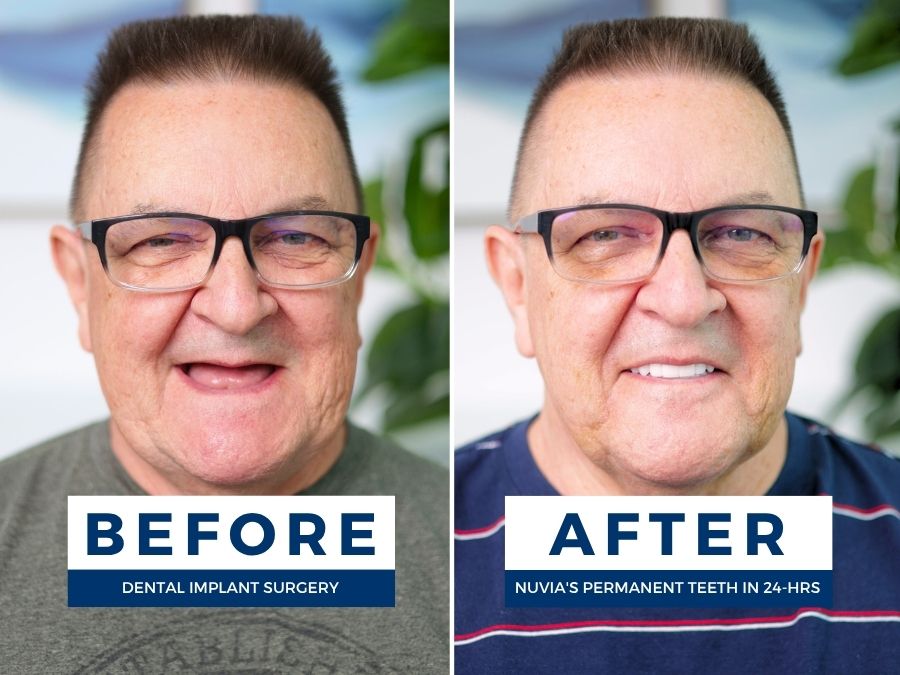
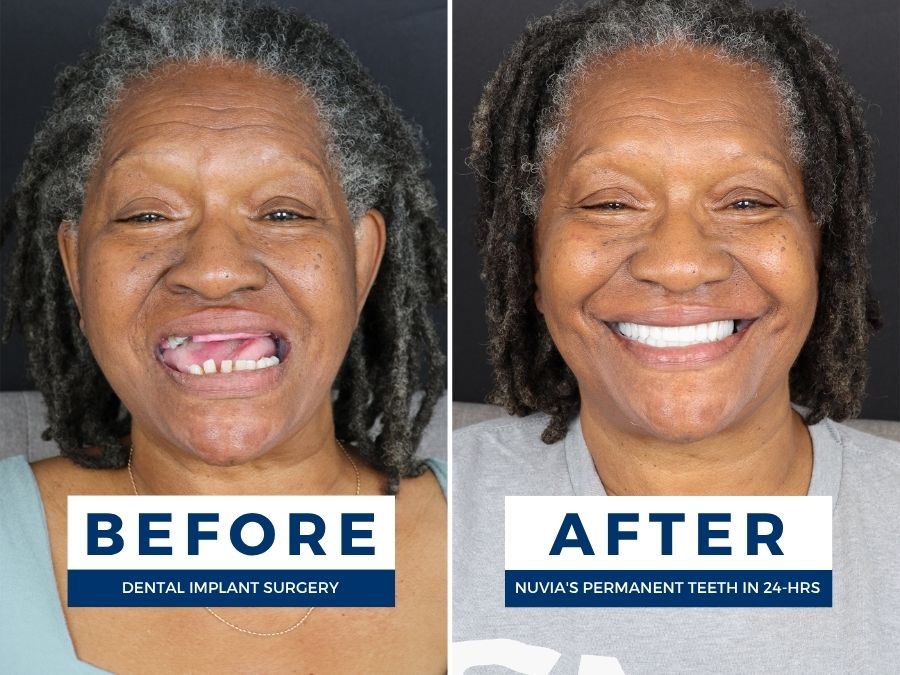
These conversations from the Real Talk: Dental Implant Podcast go deeper—what patients struggled with, what held them back, and what changed after finally replacing their dentures.
When you did start, you know, looking into the dental implants route, did you ever think, is this something that I can realistically afford? I live on a specific income a month, and that doesn't change. So I was real concerned about that. So how did you actually afford this? What I didn't anticipate was that there were gonna be options. I was not letting this opportunity get past me. Randy thought paying for full mouth dental implants on a fixed income would be impossible. But somehow, he made it work. And now, two years later, he's back to share how he pulled it off and whether he has any regrets. And this is the first time I've ever told this. I'm a pretty private person, but I want people to know that there are options. Alright, Randy. Before we get into actually how you made it work financially, I have to ask, why even get something like dental implants when there are cheaper options out there? I know you had mentioned to me that you had dentures before this, and you were actually getting them for free. Right? Yes. Absolutely. I had been in dentures for nearly ten years. And I had all my dentures, all of my appointments, and all of my care related was absolutely free, being a disabled veteran. It was all provided to me at no cost. So it just didn't work. I'm curious though, like, why like, what was, like, maybe the biggest reason of, like, hey, even though I'm getting this for free, why would you seemingly get something that's, you know, not cheap, like dental implants? What was your motivation there? Why were you willing to, like, go make that decision? Well, it was actually pretty easy for me because I I could not get the dentures to work for me properly. I was in them, as I said, almost ten years, and I had new sets made, you know, I tried all of the glues, all of the products, you name it, and they just would not stay in. And when I put them in, they would pinch and hurt and cause my mouth to bleed in certain points. And that would be whether it was a new set or not. Free doesn't always mean the best. Free can be helpful. Free can work, but it didn't work for me. And there's a lot of folks that it doesn't work for. If if it does, then, you know, good for you. It just doesn't, in reality for many of us. And I just made that decision at my age, and I was just barely over fifty, you know, still young. And I'm hoping, you know, got another forty to fifty years in me, and I'm like, this is this is ridiculous. I want the best for my health because my health was bad, my, you know, mental health was bad, all of those things. Sometimes you have to go for the best, and the best isn't always free. And I was actually okay with that because it was my life and my health. When you did start, you know, looking into the dental implants route, did you ever think, is this something that I can realistically afford being on a fixed income? Or what concerns did you initially have about the cost of dental implants? I had actually gone to several consultations with some local places. You know, I live here in Vegas, so we've got lots of options, some national places. And the cost was there, it was high. I wasn't sure I was gonna do it. There were a lot of things going on in my personal life, you know, financially, personally, all of those things that were going on. So I was in kind of the worst spot I could have been in to decide to call Nuvia that day. And I just knew that it had to be something permanent. I don't know how I'm going to, but let's do it. Let's figure out. What stood out to you about Nuvia's process? Like, how was it different compared to these other places that you had gone to or researched? Was it like, was their timeline different? Or what did that look like? Well, the teeth in twenty four hours was absolutely by far the biggest catch because I'm like, how is this possible? Which is what caused me to then dig further. And the whole twenty four hour thing was, I had never heard of such because my best plan of action when I was looking at the dental implant route, it was gonna take me nearly a year and a half due to gum loss, bone loss, dentures so long before I would be in my permanent teeth. And there were gonna be appointments throughout that I had was gonna have to sign a paper saying, yes, I know these may be there. Yes, I will pay for these if they do come up, but I won't don't know until I'm told. And none of that even remotely would fit within my budget. When I'm trying to plan something, you know, you can't plan if there's a lot of unknown because I can't change my income. And the second that I was told that, you know, I was a good candidate and everything, I I was not about to miss this opportunity because I was I felt as if I was, you know, playing on borrowed time with options running out pretty quickly, and they were. Right. But I was pretty lucky and I'm blessed that Nuvia actually didn't have to do any anything extra. No bone grafts, no anything. And I had been told I needed all of this craziness. And here I am almost two and a half years later, and I'm like, I just had a almond pecan and peanut bar for breakfast. Incredible. I think I'm okay. I think I'm good. I think I'm good. Oh my goodness. Well, okay. So you made the decision to go with Nuvia. You're like, alright. I'm gonna try to make this work. But I'm on a fixed income. So Yes. Here's the big question. You know, how did you actually pay for it? Right? So when you got in there, what did the payment process how did it work? You know, what did it look like? Did you need to pay everything up front? Or what options did Nuvia, like, say that were available? So for me, that was obviously it was kind of tied in first as the big question because even if I was going to be able to qualify, could I even afford them? And I was also in a very, again, very personal situation. It's in the middle of a divorce. So your entire world's flipped upside down financially, legally, all of that. And my hands were very tied at what options I had. So it was very scary, but I just felt like that I saw that that ad that day. And again, I lived my life when things happened for a reason. And I kind of just put it out there, you know, into the universe. I manifested like, this is it. I saw this today because this is what I need in my life, to to become whole and happy and healthy. So going in, you know, once I got through the consultation, right away they told me that I was a good candidate, and I was so ecstatic, And then it was like, okay, you know. I had that immediate flush of, now what am I gonna do? I, you know, I I know where my situation is right now. What do I do? What are my options? And what I loved was right then, right there in the office, everything was laid out to me, what options were. You know, sure you can pay cash. Sure you can do this, you can do all these things. But I'm not in that situation, that's not my life. Being a medically retired, which equals disabled army veteran, I live on a specific income a month, and that doesn't change. And so I was real concerned about that, obviously. So once they told me everything, told me what my price was gonna be, it's actually lower than some of the places a couple years earlier, so I was not mad at all. It was kind of what I had anticipated. But what I didn't anticipate was that there were gonna be options, because I knew that I was gonna struggle getting a loan, being in my specific situation. And we went through the process, know, takes like two seconds. It's really really easy. And pretty much, they're like, not right now. It's not gonna work for you. And then I'm like, okay. You know, and before I even had a chance for, you know, upset and things like that to come over, he continued on with the sentence, but you have the option because we have the capability if someone else wants to take on this loan and take out this loan for you, it's possible and we can do that. And I'm like, wait a minute. What? What's going on? Say that again? And and mind you, this is about six six thirty PM in the evening in Las Vegas. So, and this is the first time I've ever told this, so a pretty private person, but I want people to know that there are options. So I literally text my oldest son, my son, you know, who wants to go there, Who's in Ohio, three hours ahead. So it's like ten PM his time. And I text him and I said, you're probably getting in bed or already in bed or whatever, but please call me like, right this second, it's very important. I'm safe, but call me right away. And he calls me instantly because I don't normally do that, and he's like, is everything alright? And I said, I just need you to listen. I'm like, son, I'm sitting here right now in this office, they just approved me and I qualified as the candidate, you and I both know this is this is it. This is, it's now or never, and I'm not gonna put this on you, but you know, I can't do this on my own. And I wasn't even completely finished, and this is my, We call him the nerd of the family because he has to think everything through so many times. He didn't even stop to take a breath. He said, what I need to do, dad, you need this. I want you around. Sorry? Don't be sorry. So I basically just took his info as I'm sitting there in the office at Nuvia, and he he rattled it off to me on speakerphone and so I could write it down. And then the smile consultant popped everything in, again, takes about a minute, it was pretty quick. And he's like, he's good to go. And I'm like, Brad, all is good. You know, like, is this something you're sure you're okay with? I don't wanna throw this on you. And I'm like, I don't even know how I feel, but I'm just here, and I'm in this moment. And he's like, there's no question, just do it. And I obviously knew I was gonna have to pay for this loan. I just needed to get my life. And that's all what I needed, he knew that. And to this day, besides right now, no one knows this happened besides he and I. Not even my youngest son. No no siblings, no anyone. And they shot everything over to him from the finance company. Immediately, he signed it all digitally just as if I would have done had I been approved. Everything was approved and done, and my surgery was scheduled for the next week. I mean, it was it was a whirlwind that I was writing, and it was an amazing whirlwind. It was scary, it was confusing, but it was all going in my favor, and I felt so thankful and blessed that I was not letting this opportunity get past me. Wow. Randy, thank you so much for sharing this today because, like you said, no one has heard us before? No. It's tough. It's very tough. I'm a I'm a man. I'm a dad. I'm a, you know, I've taken care of, you know, you know, my children. I raised them well. They're educated. They're good men, know, have two my two sons. All of those things. And here, I am at fifty fifty years old calling my son, you know, who's thirty, you know, because I'm not all that much older than him. And saying, I I need your help. I I don't like to ask you for anything, and I don't ask you for anything. I'm the dad here, I'm the parent. And he was just like, dad, it's okay. This is this is not one of those situations. I need you, and we all need you. And you need to be here for us. I think that's the biggest thing, is like, you wouldn't ask for that help unless you truly knew that there needed to be something, something done, and something done No. And I knew, I knew in my heart at that moment that I had one call to make, and that was my only option. And he knew when he heard what I was calling for, that he knew that I was his only option, or he was my only option, and he knew that he was my only option as well. And, you know, to put that on, that on my son was a lot. And I actually carried a lot of guilt with that for a while. You know, we're past that that Right. That maneuvering time of the process. And, you know, the the loan's there, it's in his name, it's, you know, it's on his credit, it's not even on mine, but it's connected with me. You know, I pay it every month, it comes directly out of my bank account, so he has no responsibility of it. And, you know, which is obviously hugely important because I had to make sure that I even knew how to pay for this in that moment of having to decide within seconds. And I I didn't have to. There was no pressure from Nuvia. I just knew that it was my moment, and I had to make that decision right then, right there, because the stars had aligned. Right. So Wow. Yeah. It it was a lot. It's a it's been a lot. And it's been hard to be prepared to know that I was going to answer these kinds of questions today, and know that I was going to tell you something that no one has ever heard, and that I've never spoken aloud at all. Again, my other son doesn't even know. Oh my goodness. No one knows this, because it was such a was such a tough and embarrassing, in a way, thing for me to do. I'm a very private, personal person, you know, I spent all those years in the army, you know. I can handle things, and I had to stop and remind myself that that was still me handling things. I just had to use different resources, and it's okay. Right. Absolutely. And, man, I'm so glad that I didn't let my ego get in my way in that split second. Randy, I think you did the best thing you knew to do for yourself in the moment, and same with your son, like, he had no second thought about it. Y'all both know what you needed, and I, again, I thank you so much for your vulnerability today, because I think a lot of people out there feel, maybe feel in a similar place that you were before you got this done, where, well, maybe some hopelessness, and maybe like, there's no way I can afford this process, right? But like, there's an option, and you decided to take that option and change your life. Right? So Yes. I think that's super powerful. Yes. I went in, and I was I was believing in what I was being sold, even though no one was selling it to me, by doing my research and reading. And I knew that Nuvia was where I was supposed to have been and that's why it had been such a long treacherous journey of of disappointments along the way and trying to do this and get my life back and become healthy. You know, I just knew that I had to be. And when I went in there and the second they said yes, it was just like, bam, bam, bam. This has to happen right now. I know it. I feel it. And folks don't know that. I didn't know that going in. I went in kind of anticipating, I'm not gonna be able to afford this. Let me find out, and then let's see what my options are. And Nufia solved that because they let me know right then and there, like, wait, here's another option if this works for you. It wasn't forced on me, it wasn't whatever, it was just, here's another option. I'm like, oh my gosh, that's actually the option I'm gonna try to go home and work on. So let's just do this now. I was ready to see, you know, what what Nuvia could do, and, you know, they clearly, they knocked it out of the park. I live I I'm not even that same guy that walked in there in any way. You know, I have happiness, I have my health is back, you know, I I started this journey at the heaviest I'd ever been, two hundred and thirty eight pounds. One forty eight sitting here at night right now. Randy, that is incredible. One forty eight sitting here right now, ninety pounds. Because I can chew my food. I I am not spending ten years swallowing food that was then not processing correctly. It was messing my stomach up. I was I spent a few years, I I mean, I really didn't even leave my house at all because of fear, because of anxiety. If I ate anything, couldn't eat, you know, I couldn't keep my dentures in. There was embarrassment. And then when I did eat things even at home, my stomach was such a mess that I would get sick. And I I spent almost every day, like, literally throwing up. You don't wanna hear that gross, but that's the truth. And I knew that I was really on borrowed time, that my health was not in good good in good shape. And just all of that's gone. So you had this loan that was taken out, but you were still making these payments. So these were monthly payments, right? And was it the same payment each month, or was this something where, you know, you you'd spoken earlier on how you never knew if there was gonna be something added on to the price. Right? So Right. How did it go with with this whole payment plan process? Well, so the amazing thing, was that the, you know, my price that, you know, was for me and my situation, that was that was an all inclusive price. There was never gonna be anything else, you know. I knew what my appointments would be and, you know, Nuvia with this technology and all this, you know, craziness of twenty twenty five, you you don't have all those that many appointments. You've got your surgery, twenty four hours later, you get your permanent smile. Two weeks later, you have a follow-up. Four months later, you're generally generally released. So everything was all inclusive. So I was able to then know what my budget is and what I had kind of anticipated. So they were still rough numbers but they were rough enough that I had prepared and knew, this is in my ballpark. I can do this and be able to live. Because that was obviously very important. And this was very important as well. So finding that fine line, I had to figure that out. So once things were approved, I knew exactly what my payment plan was gonna be each month. You know, it's been nearly two and a half years, it doesn't change, it just automatically comes out of my account, and it's just part of my budget now. You did mention that there are these payments that you were making each month, and people might be wondering, hey, how much is that? So where would you suggest they go to like find more information on that? Well, if you look down below, there's gonna be a cost guide, and it's gonna give you general information, so that you kinda have an idea of what payment amounts could potentially be based on your situation. You mentioned your son took out the loan, but you still had to figure out how to afford it month to month on a fixed income. So how did you actually pay for them? Did you have to make any changes in your life, or how did that go? I don't drink fancy coffees every day, all day. I don't, you know, splurge just to splurge. I don't buy everyone's meals when we're sitting at dinner or, you know, just all these little things that me as a person I like to do and did. I just, I start cutting all that out. And it wasn't like I was missing anything. I just looked at my budget and said, okay, I know I really don't need this. And I'd much rather have teeth than a coffee that I can, you know, I can make coffee at home and I'm perfectly fine with it. Right. Or, you know, I don't need to eat dinner at this particular restaurant, you know, multiple times. You know, it was simple when you really think about it. I know a lot of times, and for me, being on a fixed income, you're always considering that because there there's a top level. You can't do anything beyond that. So it's very important, you know, to know all of those things, and it's a scary situation, which is why I had to kind of gauge beforehand what I knew for sure I'd be okay with, and, you know, what I knew for sure I could not do Right. By any means. And everything fell well within that number, so then I had to get home and put that into action. You know, all looked good on paper, it all sounded good in my mind, but I had to put that in action. And it was so much easier than I thought. It really was. It was just like, I Maybe I do order, you know, from Amazon a little more than I thought I did. It's okay. I can drive down the street because guess what? I can leave my house again. I don't have to order groceries to be delivered. I don't have to pay for DoorDash if I want takeout or don't feel like cooking because guess what? I can get in my car and I have the confidence and this anxiety is leaving me, And I can go do those things. So I can still do those things and it cost half the amount of money because I'm living again. So those are things I think people don't stop and look at. I didn't really until after because I was so set on this is how it has to be. So I got home, really looked at it, and it ended up being a much easier than I even anticipated walking in. Did I have to change things? Yes. You know, I'm not gonna sit here and say, oh, I just lived, you know, life. Right. Put loose and fancy free, as we say back where I'm from. But, but I'm, you know, I I had to have an idea, of course. And then going in, I knew that it fell within that and then it was up to me to implement that and stay disciplined. And it was so incredibly easy compared to what I had anticipated because I just really wasn't thinking that through and adding those things up. So I just had to take a good hard look at my budget and say, okay, well, alright, so you're not gonna upgrade your light bulbs to, you know, fancy light bulbs or you're gonna hold off on a new bed because you do have a place to sleep. You know, as I mentioned, I was furnishing and starting all over. Well, I I bought a, you know, a lesser expensive, you know, dishes. I bought lesser expensive this because I chose myself and this and my health and happiness and my life over those things. Well, you know, and as life is, you learn how to figure things out and you turn things around. And I've since replaced almost all of those very basic bottom of the line things with the ones that I wanted. I just did it over time and took my time and I did it with a smile on and enjoyed going to look at things and pick them out. Not looking on Amazon or online somewhere else going, well, I'll get this one because I'm not gonna get in my car and open my garage door because I'm gonna have an absolute anxiety attack. So there were so many things involved that, you know, I didn't know till after the fact or realize. It really is easier than we think. I can only say that for myself, it was so much easier than I thought it was. And, you know, even talking to my son after the fact, who now knew I, and was in this journey with me, obviously, the very next day, dad, can you do this Because I'm responsible. And as he should, and as I would want him to, you know, we're disgusting, I'm like, yes, I would not put you in this position, trust me. I would not. Is it necessary? Yes. But I would not. And I'll, you know, we'll make sure. And it's it hasn't been an issue. It really hasn't. I just adjusted my budget. It's no different than paying my utility bill. So This is my electricity bill. Exactly. Exactly. Well, I have to ask too, have you ever been worried like, oh, this maybe was a mistake, or have you ever, like, been concerned about that? Or do you feel like these sacrifices, you know, small or big, or have they been worth it? Like, what would you say looking back now, and it's been over two years or Yes. Over two years. Over two years. Yeah. I wouldn't change my mind at all. It's just that simple, like, right to the point I would not change my decision, I would not change the way it worked out. I don't want for anything, I don't miss anything. I just went, you know, then traveled internationally for for for two weeks and never wanted for anything, you know, did everything I wanted and all of that, and I did it with a smile and trust me, everybody was looking. As they should be. Randy, this is so incredible though, like, from you sharing your past today and what point you were at in your life and to today is wow, right? It's like I don't know who that person is that walked in that office that day. I shouldn't say I don't know. I I can't imagine Right. Being in that person again, because, you know, I remember that person, but I didn't know that person, if that makes any sense. Like, I walked in defeated, beat up, deflated, and physically, and and and mentally health, physical health, all of the above, and probably probably the absolute worst condition I could have went in. But I went in knowing that Nuvia was going to save my life. Truly, health, physical, it's gonna allow me to get out, it's gonna allow me to eat, all of these things. So, no, I would I would do it over and over and over again. If I had to go through this same process once a year, I would do it, to just feel like I feel today. And I mean that absolutely with every fiber of my being. I sing all the time. I you know, art was my life. Performing was my life. And not only could I not sing because I couldn't pronounce words or form things, I'm not gonna get on a stage in front of thousands of people, you know? Now I'm in the front row dead center, like, put the cameras on me. My goodness. What a change. What a change. Yes. Yeah. If somebody, you know, for someone who's watching or listening and feels like this is something that might be out of reach, what advice would you give to them, and where where would you suggest, like, they start? Based on how I went through the process and how it worked for me, if you just go and get into your consultation, everything else gets answered, and you know what you're up against. You know if you're a candidate. You know what your price is gonna be. You know if you're gonna qualify for a loan. You know what your payments are going to be. So you're making an informed decision right there. So go in and see what options are, and then make a decision. You can't make a decision if you don't know. The great thing about Nuvia is there's this cost guide that you can download for free, and I'm sure there's probably a link below somewhere. And it's great because it gives a range. And you can't go and be like, oh, I wonder if this would be ninety nine cents a month. If only. If only. I wish. Right. Oh my goodness. Well, thank you so much for sharing your story today. You've kinda proven to us, hey, you don't need to be rich to be able to make this happen for yourself. You just kinda gotta be determined and ready to make it work, and there's options out there for you. Right? So Absolutely. Thank you so much for sharing your story, and until next time, keep smiling. Keep smiling.
In one sentence, how would you describe your experience with dentures? It destroyed my mental health. Today, I'm joined by Christopher. He's counting down the four hidden health dangers of dentures. Dangers that ultimately led him to get dental implants. You stick around for number one because that was the final straw for me. And if you are curious what dental implants could cost you, download the dental implant cost guide in the description below. Number four, poor oral hygiene. So, Christopher, how did your dentures impact your oral hygiene? Where do I begin? In many ways. They don't stay in your mouth. It's not convenient when you go out to eat and keep them clean, keep the food out. You can't really excuse yourself to take them out and remove the food of his very self conscious life breath. Even my kids were like, you know, pay, poppie, your breath's a little, you know, a little scary there. So it does affect you in that way quite a bit. And the, it's just always on your mind. You can't ever just relax and enjoy a meal or go out with friends. And did you have any, you know, irritation or pain with your dentures at all where you, like, maybe wouldn't even wanna wear them? The pain was nonstop. They didn't fit properly. They never did from the day I got them in, but I suffered through it because aesthetically, it looked good, so I can go to work and go through my day and pretend nothing was wrong. Took a lot of advil to get through the day, but it was it was pretty tricky. It was it was hard. Can you tell, like, a short story of maybe, like, what that was like and kinda what was going through your head? It's an embarrassing story, actually. I went to, mother-in-law's birthday, your seventieth birthday, and everyone was at this restaurant. We're all having our food, and my teeth are killing me. I'm trying to chew the meat as best I could. And my son was sitting across the table from me, and luckily, he's the only one that saw it. But as I was chewing the food, the dentures came out and started getting stuck in my throat. They turned sideways, and I was, like, panic stricken. And luckily, he came over and stood in front of me and helped me regain my my composure and dealt with it. But that was really scary. They just came out, and the food went down. Not that the dentures would have gone down, but the food had slowed down. I started to choke. And I had some polyprop on there, but it didn't it didn't really work. So that was a bad that was a bad moment. And and you thought of that right away. So, yeah, that must have been Oh, it was embarrassing, you know, because, you know, for intents and purposes, it was a good event, and everything was great. I was happy, and everyone was enjoying themselves. And it just happened so so suddenly. You know? And oftentimes, the food would fall down, and I would choke at different different times in my life with that. But that was the most memorable because everyone was there and Yeah. No one else did see it, but my son is the one that caught it and came to my came to my side. Oh my goodness. Well, now let's talk about the flip side of that then. You know? So you've had your dental implants for over a year. How do you feel about your oral health now? Do you feel like, you know, are you worried about those things that you were before and, even maintaining them? How has that been? Never. It's weird. Obviously, you can't get things stuck between your teeth, but I think your your memory goes to a place where you're like, oh, there's something in my tooth. And so I just I brush probably my teeth. Every time I eat a meal at all during the day, I brush my teeth. I don't care how many times it is just because I like keeping them clean, keeping them white. Oral hygiene is great. My breath I know is always fresh. My girls have made, you know, a point of telling me what a difference. Seems perfect. And I can eat better things. I I think when your teeth, are hurting you and they hurt, you tend to eat soft foods, things that are quick, things that always leave a good, scent in your mouth probably. You know, a lot of sweet, sugary things, I think, after a while can get a little sour and give you bad breath. I don't know. Yeah. And, I mean, a big part of what you're saying here too is right, they're permanent in your mouth. Right? You're not you're not taking them in and out. So how do you think, you think that's kind of impacted you as well? Oh, totally. They just always feel fresh in my mouth. They feel clean all the time. It definitely has impacted my life because I don't have to think about it all the time. You know, I get up in the morning. I brush my teeth. I have breakfast. I brush my teeth. It's I don't think about it most of the day. You you should just always brush them and be aware that they need to be cleaned and stuff like that. Right. And, you know, with your dentures, you were, you know, dealing with some discomfort a lot of the time. So with your dental implants, like, do you forget they're there or or is it what is that like? Sometimes I forget they're there totally. Other times I feel them because they are, they're something new. They're in my mouth. After a year, I've gotten way more used to them, more than I ever did with my my dentures. Dentures, I seriously different. They were every breath of my moment of my life, I was thinking about them. Because I'm in retail, so talking all the time, I was always worried they're gonna fall out. A few times they had. You know, you kinda, like, put it back up. But I don't have to think about them. You know? And do you think, that compared to your dentures has affected, you know, even, like, your relationships with people or, even intimacy, if you wanna talk about that? Absolutely. The question people need to talk about is intimacy. I mean, I know when when, my teeth were bad, I mean, that's I think if we have a cavity or we have a cold sore, whatever your situation is, with your mouth, it's very, upfront and personal. You don't wanna, you know, Maybe I should lose a piece of food stuck in or two. Can you imagine if you had, like, some something else going on? Kissing is just, like, really, it's real personal. It's real intimate. And when you love somebody, you wanna be able to do that and feel comfortable and and safe in that moment. And sometimes, I don't think a person can. You know? I don't think people mention it enough, but I I'm sure it's gotta be at the forefront of most people. You know? Absolutely. I mean On dating and you have that issue, I mean, are you gonna date, really? I mean, probably not as frequently as you'd probably want to. Right. I mean, it's your mouth. Right? I mean Yeah. Yep. It's it's there. Right there. You know? Yeah. It's in their face. You know? Wow. Well and I'm I'm assuming that that has changed with your dental implants then. Dental implants are great. Funny story, actually. Yesterday, I was walking to work across this little bridge through the parking lot. There's a few homeless people that sit there, and, this woman, when every now and then, I'll give her something that I have or bring something to eat. And she looked up, and she goes, you know, you really have a pretty smile. She goes, I wish I had a pretty smile. And, you know, we take that for granted, I think, sometimes. And because she was so sweet, I, per se, probably didn't notice it, but she was very self conscious. Her teeth were bad, obviously, and had things going on. And, it was a sweet moment, but made me realize how, grateful I am and how fortunate I am to have gone ahead taking care of that problem. What a sweet story. And let's dive a little bit more in then. At number three, we have poor diet. So you mentioned you had a lot of, you know, discomfort with your dentures. You said you had an issue where you were almost about to choke when you were wearing them. So can you talk a little bit more so how having dentures impacted your eating habits and more so maybe your diet, like, what you can eat? When I first got them in, like any surgery, you have to be careful, which you could eat healthier, I suppose. But the pain I was in, I didn't wanna go through the trouble of you know, I had all the protein shakes. I did all that stuff, but I want I wanted more solid food. It was really I found it really hard to make something that was more solid and satisfying. So I think for most people, the most instantly gratifying thing is some chocolate, something sweet, something sugary. You know? I think it always tended to to work. And so I tend to put the weight on. Before I had gotten my dentures, I tend to eat a lot of soft wrong foods because my teeth were so bad. And then once I got the dentures, I found out I couldn't eat anything at all. And then the reverse happened. I just lost a lot of weight. I lost over fifty pounds. I just wasn't eating very healthy because it was just impossible. It just hurt too bad, you know. And then you can only take so much ibuprofen and and pain medication because it's not good for you, You know? So it was just like chasing my tail all the time. You know? Yeah. And, you know, along with the pain, also, the bite force, you know, is significantly less than, you know, what it usually would be when you have a denture. So I feel like does that also impact what you can eat? I have a pair right here. If you look at the teeth, the teeth are flat, so there is no way to actually chew your food. So long come so also, like, what comes with having dentures is when you're not able to chew your food, you're also getting, acid reflux. You find yourself choking because you're not breaking the food down. You think you've chewed it up and you go to swallow. They're big chunks. So you have choking, you have acid reflux, and poor diet, which is just horrible. It's really, really bad. And that, like you said, led to losing over fifty pounds, you said? I did. I went I went from two zero five it was two zero seven. I went down to sixty two pound a hundred and sixty two pounds, which I was in seventh grade. Oh my goodness. Yeah. Now that I have got my teeth and back to my high school weight, you know, my my, you know, my graduation weight, which is one seventy five. Well, wow. That's honestly a lot of things eating wise that a denture can kinda mess with there, sounds like. It ages you. They don't fit properly. You know, we don't have the right fit in your mouth. Your face looks different. I think you look older. I feel made me feel more youthful. I think I look younger than I did when I had my teeth uploaded. I look like a a much older man. I just turned sixty four. So, I think it's really helped boost my confidence. You're sixty four? There's no way. Yeah. After getting your dental implants then, you know, how did your eating habits change from with your denture? You could have anything. You know, obviously, you have this four month window where you have to be careful with you, which totally makes sense. Like any surgery, you gotta be careful. If you have your knees replaced, you're not gonna run a marathon. You know, you gotta do everything incrementally and do it and do it correctly. There's so much good food you can eat when you're had mouth surgery. You know? I got to have hamburger, mashed potatoes, a lot of really good foods, and look forward to the harder foods as I got older, you know, or gone through you know, went through the, the four month waiting period. It's been great. I can eat everything. You know, it's I don't eat, caramel apples. I never did. I don't. I've never been wanting to eat hard foods anyway, but you can. You know, it's been great. I can go anywhere and have anything on menu, which is great. So you did get zirconia, you know, and zirconia arch, zirconia teeth. So I'm sure that definitely helps with the bite force being able to It does. It does help. You know, and I had a full upper arch and a full lower arch done. Again, that four month period helps you adjust to re you know, aligning your bite. And I think what people forget is once you you lose your teeth, you also lose the nerves to your teeth. So we forget that, although we don't feel like our teeth have nerves, your your brain's telling your new teeth to how to to realign and how to bite. So it's a it's a process, but it in the end is so worth it. You know? Now it's second nature. I can chew and not bite my lip or my cheek or It's incredible how about how your brain all kinda works it out. Yeah. You know? Somewhere. It's wild. So let's get to number two, which is bone loss. So what is you know, what about the connection of dentures and bone loss worried you? What what kinda goes on there when you have dentures? Well, like you probably saw on the dentures I showed you, the wear and tear of your bone. Yeah. There's nothing in there for the bone to grow onto. Every time I went to a dentist, it was, you know, let's we'll pull this tooth, then we'll do a little well, I guess, they use cadaver bone or for your your jaw. But then you have a small window once it's put in there to have the implant put in, but then you know these waiting periods. So then you're waiting to have the tooth put in. So I had substantial bone loss, way less than I thought I had, because when you go for your, evaluation at NUVIA, they tell you they look into the x rays. And, fortunately, for me, everything was good. You know, like, this is not a problem. But it was definitely a concern because, anyone who's suffering with with tube loss and making the decision to get implants or dentures, those are definitely the forefront. Those are things they talk to you about. I mean, if you have a good dentist, they'll all mention these things. And it's it's I think it's up to all of us and the individuals to have as much information as we can get. You can't walk and blindly anywhere and just say, okay, and take a doctor's word for it. You know, it's good to get second opinions and have all the information and research it yourself. So I knew that it was really important. And, with implants, I did find out that once those implants are placed in, the bone begins to get stronger and it adheres to the to the implant, which was definitely what you want because it's all part of your structural your face structure, and it's really important. You know, you wanna maintain your face and your face not to sag. You you know, we get older, it tends to to sag anyway. You you lose the bone and it gets get worse. It's kind of like the implant itself acts like, you know, a tooth root. Right? So it stimulates the bone. Yes. So then, you know, it's preventing from bone loss. And, I like I don't know. I like the way that makes sense to me. That's also, like, so interesting to see, you know, how many people who have had dentures can still qualify for, dental implants too. Because like you said, you thought you had way more than you way more bone loss than you thought. Right? I was really worried. You know? And it was the first time I'd gone someplace that really was my health was the forefront and not just getting my money and pulling a tooth or, you know, telling me what I needed and how much was gonna cost and not help me with any of it. You know? So Nubia Delaney was a full package when it came to give me the information I needed to make a an educated decision for sure. Absolutely. And, do you wanna briefly touch on too, like, what it would have looked like if you were to go to one of these other places and, like, how long you would have to wait for maybe your permanent set? Yeah. I can go back, sixteen years when I moved here where I live in Northern California. I went to a dentist. I had partial, half I had half of my top teeth and a partial on the left. The dentist I went to was one of the best, from what I was told, in the area for implants. And he joked around a lot, told me what the cost was gonna be, and, you know, made an off the cuff comment about, well, if you were my brother, I would do them for free. But for you, it's gonna cost seventy five thousand dollars, and we'll start here, and then we'll do a bone graft here. And then in about a year, we can really this is all the things we have to do. In about a year, we can start finishing the process. I was like, Ben, I don't understand that in a year. I mean, how are all these things gonna be fixed? So, I did start some of the processes, he said, because that's all I I knew at the time. Did what he said. Got a partial. Got some teeth pulled that he told me to do, but then I couldn't couldn't no longer afford to go to him because he was he was just astronomical. And the months in between doing what he told me to do, another another problem arose. You know, it was like another fire came up. So I went someplace else, and, after a while, I just ended up feeling all my top teeth pulled. And that happened during the pandemic. I got my teeth pulled, which was pretty, stressful because nobody was even leaving their house then. You know? Right. Oh my gosh. Yeah. So Like you said, putting one flyer out after another. That's all it was. You know? And I think, I can see why people would question teeth in twenty four hours. But unless you're one of us individuals that have gone through this process and have lost your teeth and have done all these certain steps through years, we add up collectively what we've spent. To me, it just seems like a way to make money, you know, and not really solve a person's problem. And going to Nupia for me helps solve it on so many levels emotionally, mentally, physically. So it really hit all the, the points I really need to be taken care of. Well, that brings us to the last one then. So number one, poor mental health. So this is the number one hidden health danger, which you said was your final straw. This you said this was, like, why you decided to I need to get something done. Right? So, can you kind of, you know, talk about that? What was that like with your dentures? What was your mental health like? Oh, it's it was pretty horrible, to the point where it's affecting my relationship. I was super depressed. I wasn't eating. My partner really couldn't wrap their brain around it. It just got worse and worse. Fortunately, during that time, my son had come to visit us right before pre pandemic, so he I would grow an adult signing, so he was able to stay with us. He was kinda stuck with us for seven months during that process, and he was good support. But it affected everything. I literally had a nervous breakdown. I I I couldn't eat. I held up in the backroom for, like, three months, didn't do anything. And my son, you know, started getting me in physical shape, you know, and worked out together in the back of our house, had a makeshift gym, got my focus back on. That's when I started researching places to go for alternative ways to fix my mouth. That's when I found Nuvia in all the, videos of people and confessionals of what people had done and how their stories and I was like, wow. This seems pretty cool. So it helped me a little bit to step out of that, dark place, but it still it took a while even when I decided to go. I don't think it was till after I had the work to know my partner was able to see a level of depression that I was and what maybe had done for me, and it was a a real reconnection, with my partner after that because they were able to see that it was that deep inside of me that is so deeply rooted in my depression and, my pain around it. You know? And how long do you like, were you in well, one, were you in dentures, and how long do you think you were, you know, feeling, you know, just depressed? Probably, I was depressed for the two years prior to getting all that work done. The oh, gosh. Any bad scenario, I can tell you, when I had my partial being made, there was one teeth that had to be pulled, and the dentist that I went to was having a really hard time getting it out. He literally had his foot braced on the chair and was pulling. He literally had to pull the teeth out this way, out. I had this huge gap, and I was, like I literally grabbed his hand, and I was, like, they almost were gonna have to call someone to see me because I was so mad and in so much pain. And after that point, it was just it got worse and worse and worse. He felt really bad about it. He made a really beautiful partial from my mouth, out of guilt or necessity or whatever. But it it was temporary because, you know, the teeth that I had in the bottom, it just the bites weren't there. Nothing it's always gonna be temporary. I have, like, five different dentists working your mouth at five different times in the course of ten years. I had six different colored teeth, and nothing matched. You know? When I smelled, it was always, like, you know, really, really small if I smelled at all. The mental health aspect is huge. Really, it's huge. I think sometimes people around relationships don't always understand that. Oh, but the dentures look great. They look really good. Your smile no one can know. I don't care if the people know about it. You know? I I hear it from everybody. Now I tell everybody I had dentures, look like I got. You know, it's a totally I can actually gauge my growth and how I've gotten past that dark dark place in my life, you know, because I can actually talk about it all with confidence. And it it was a lot. It was a lot. That, like, that breaks my heart because you are such, like, a a beautiful soul and, like, to think that you were going through that. And I I'm sure it almost has sometimes, you know, felt like you were well, I don't know. I don't wanna speak for you, but did you feel, like, alone in those moments where, you know, like, you like you said, you said your partner, you know, obviously, can't fully grasp it because he's not dealing with it. And Yeah. It was it was it was hard. It was that visit to Utah and watching when I went there when the ceiling, seeing the difference of how I was treated when I first walked in those doors and how everyone was, like I mean, I just over my experience, I had never felt that from a medical facility. And the minute you walk out on the phone with the first phone call consultation to when I got there, it was, like, was such a blessing and so grateful that I went there. I mean, it truly is one of a kind experience. Results are amazing. Best thing I ever did. Says have kids. And, you know, you kind of mentioned this already, but, you know, so dental implants and going through this whole process, like, helped you get out of that dark place. Right? And, I guess, what's what's it kinda like like now? Like, what how how are you doing? Work is going so good. Everything's so good. I've I have such more confidence. I've always been able to pull myself up and and persevere where people don't really know what's going on, but I think it's taken it to the next level. My job, I'm I'm fortunate enough to work in a really nice small town. I work in my friend's gift shop. We're supported by the local community. People come in. We talk a lot. I get a lot of really good positive feedback, and, people have noticed the difference. They've they've told me what they've seen the difference in, in me. It's been really good. My kids have noticed it. I go off with my head higher. I don't not felt ashamed. I mean, I think everybody has a story why their teeth are the way they are. It can be for many reasons. I was never ashamed by that. It was just more of the pain I was putting myself through. It was like, why why is this happening to me? I'm a good person. Why do I have to deal with this crap? You know? So I would put it in perspective in my everyday life and go, well, it could be worse. It could be worse. But in private, I was really suffering in a way that I didn't really wanna share with anybody. Oh my goodness. Well, like I said, once again, this is it's it's so amazing to see, like, how you are today, and the fact that you were able to get through that, like, that's something that you should be proud of yourself for. Thank you for sharing that today, and thank you for being vulnerable and opening up because it it means a lot. It means a lot. It makes people feel like they're not alone. Yeah. And, you know, it's a it's a good community to be part of to you know, I can call anytime if I have an issue, and there's always someone there to help answer a question for me. Again, you may be wondering what dental implants could cost you, so don't forget to download the dental implant cost guide in the description below.

After taking the 60-second quiz to see if you may be a candidate for permanent teeth in 24 hours, you’ll have an in-person consultation focused on what’s actually going on with your teeth—your current dentures, bone levels, and overall oral health.
You’ll find out what treatment could look like and what your financing options are, without guessing or being pushed into a decision.

If you move forward, the plan is designed to replace all failing teeth at once. Any necessary extractions are done during the procedure, and implants are placed to support a full set of fixed teeth. You’ll be cared for by both a CRNA who makes sure that you’re comfortably asleep and a highly experienced oral surgeon who expertly places your dental implants.

24 hours after your procedure, you’ll return to get your custom set of permanent teeth placed. Nuvia’s in-house lab works with your restorative doctor to get these created for you overnight.
With many traditional implant processes, getting your permanent teeth can take up to 10+ months—wearing temporary teeth and waiting between appointments, hoping your temporary teeth don’t break and disrupt the healing process.

You’ll see the full investment upfront, along with financing options you qualify for. Most patients choose monthly payments instead of paying everything at once, making full mouth dental implants more affordable than many patients thought they could be.

After a few months of healing and sticking to a soft-food diet as directed by your provider, you can eat foods you may have been avoiding for years. Speak without thinking about your dentures. Go to bed without taking your teeth out. Stop living in fear of teeth coming loose. For many people who get full mouth dental implants, it’s the first time in years their teeth feel like their own again.
Got questions about cost, what dental implants actually feel like and what to expect? Check out Nuvia’s Blog:
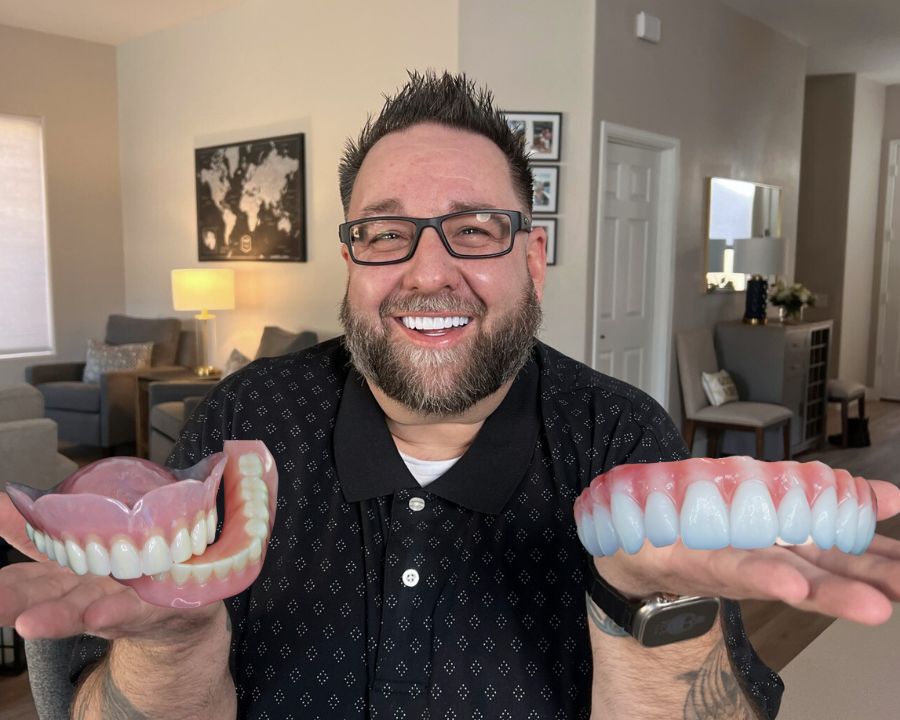
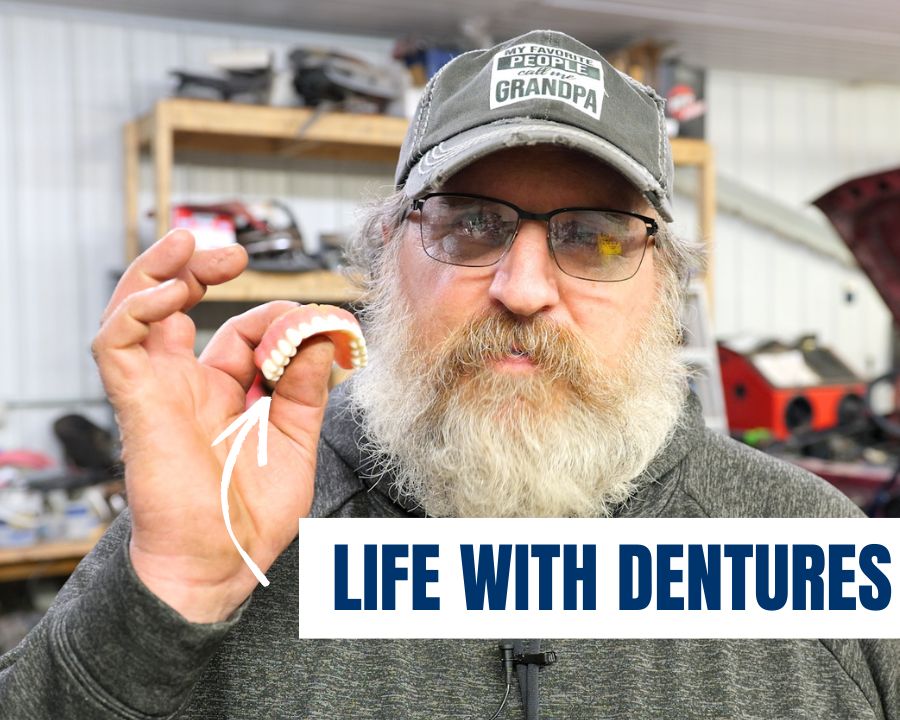

Fill Out The 60-Second Quiz Below


This guide is designed to walk you step by step through the dental implant process and each dental implant type with their associated costs.
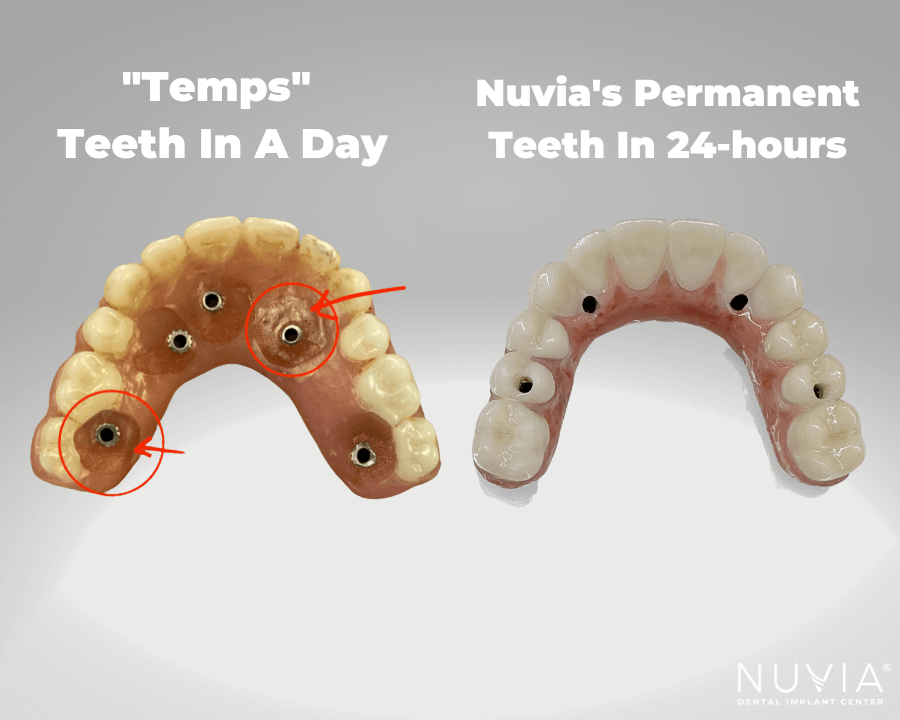
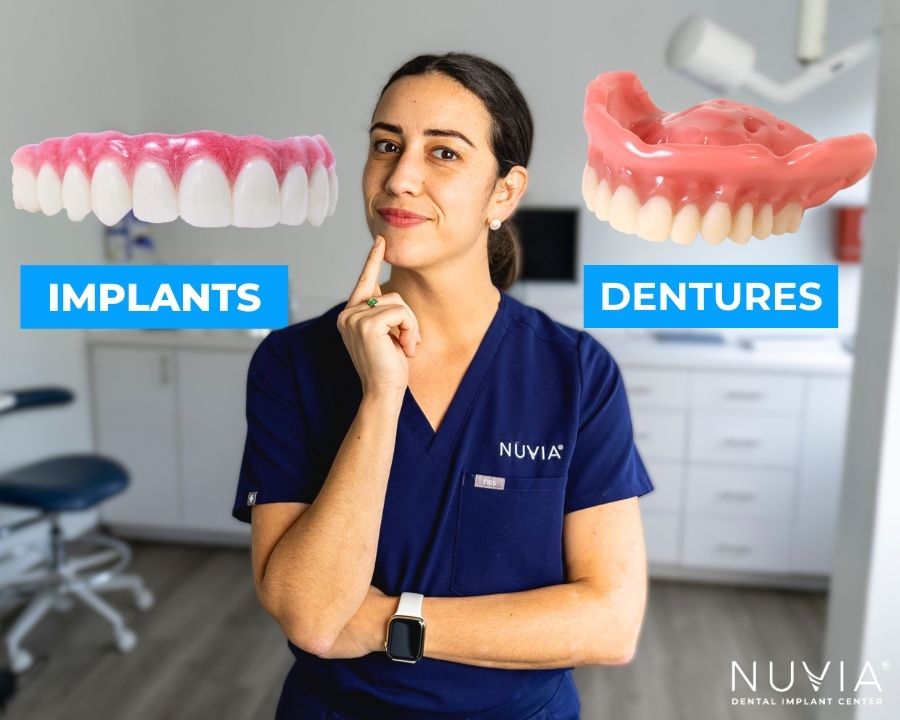
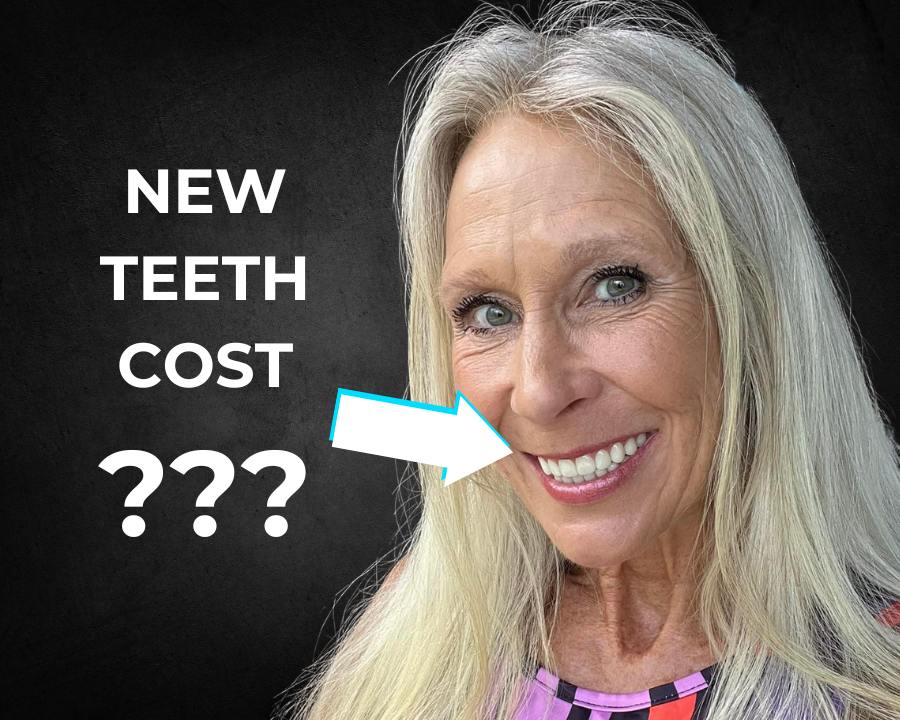
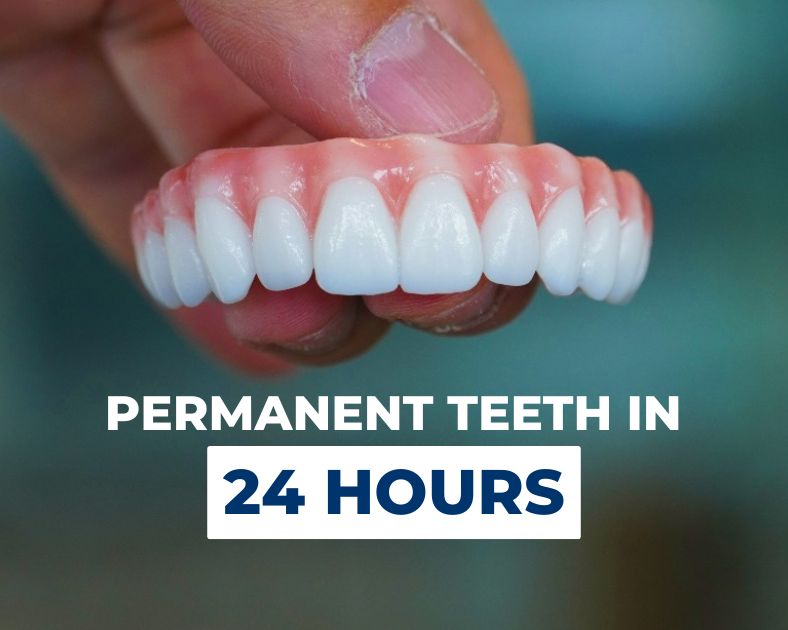
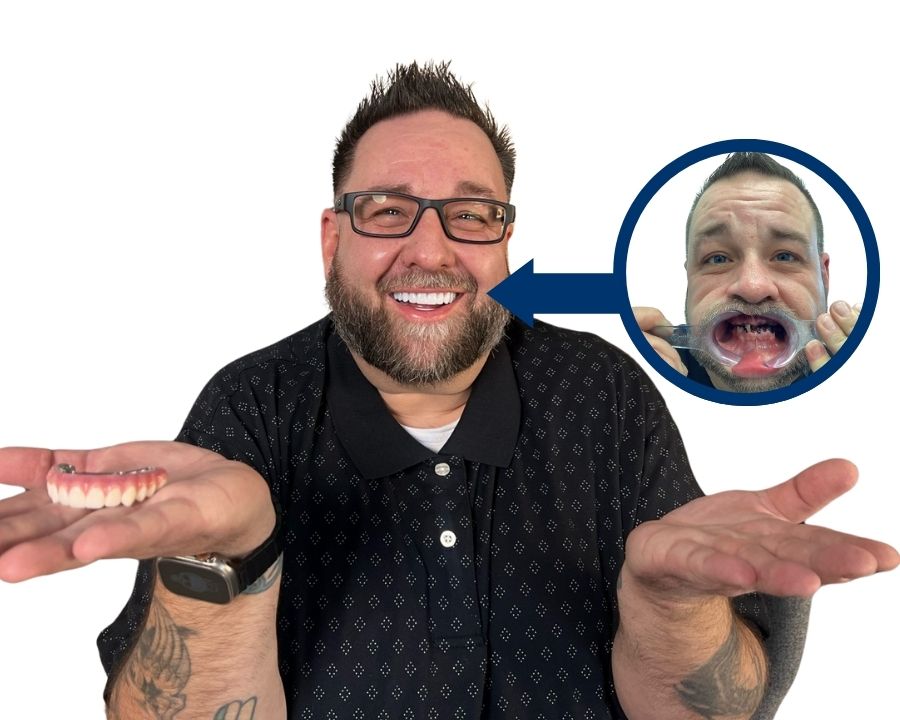
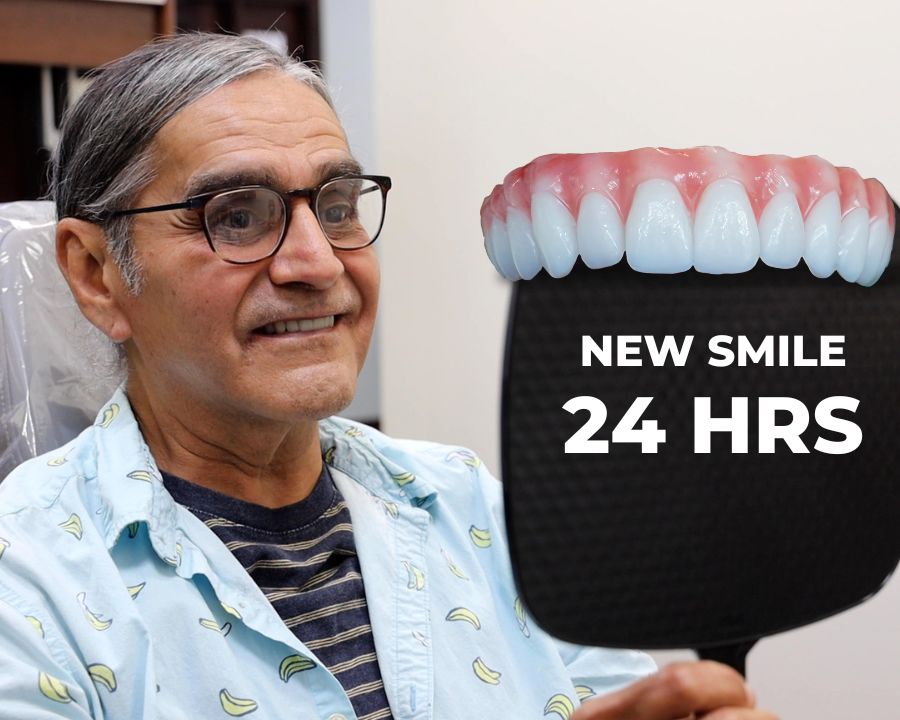
.jpg)