
As a restorative doctor, some version of "what are my options?" is one of the most common questions I hear. And the honest answer is: it depends. How many teeth are missing, what your bone looks like, your budget, and how permanent you want the solution — all of it matters.
Here's how I break it down, from the quick fix you can grab off Amazon to the permanent, life-changing solution I work with every day at Nuvia.
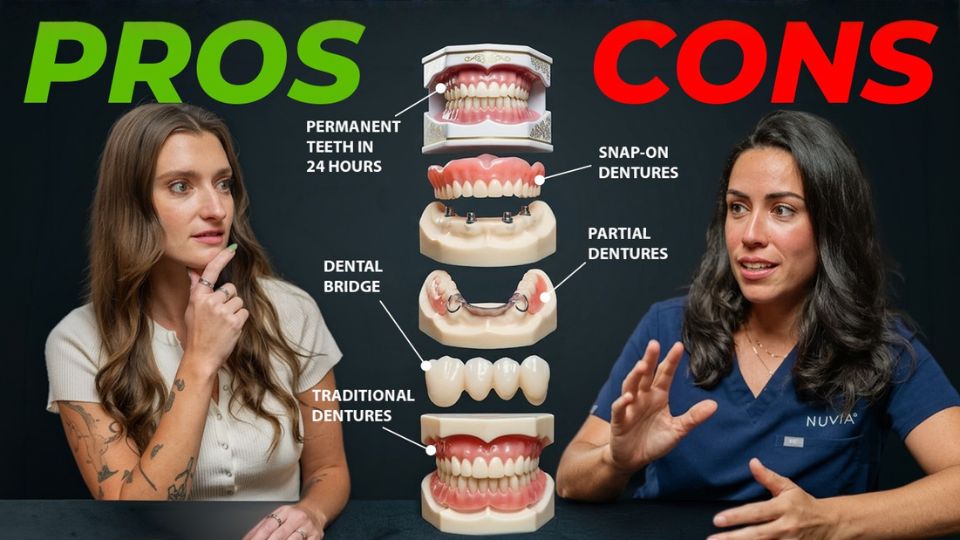
I'm talking with doctor Anoni, a restorative doctor, about every major tooth replacement option. So doctor Anoni, how are gonna break this down for us today? Alright. Well, we're gonna start off with single tooth replacement, and we are going to go all the way to full mouth tooth replacement covering both temporary options and ones that are more permanent. Okay. Sounds good. So what is up first? Okay. So up first is these temp tooth wax beads. Okay. Okay? So these work by melting them, basically, and then you mold them into a tooth. So let's say that you have a tooth knocked out or a crown completely broke off and you need a quick replacement because you cannot access your dentist. It happened on a Saturday afternoon and you are in the wedding party, my friend. If you need a very quick fake tooth, you melt these down, you mold it to the area, then you put that back in water, like cold water, so it'll set, and then you can kind of put it in and out. Certainly not something that you can eat or function with, but really good for if you're in a pinch. Okay. Okay? And what is the cost range for something like that? This, I mean, online you could probably find something like this for like ten dollars to twenty dollars something like that. Okay. Okay? So super temporary at home, no dental work needed. Gotcha. Then we're moving on to a more permanent tooth replacement. Okay? So this here is a dental bridge. Now, you'll notice you have a natural tooth, missing tooth, natural tooth. The thing about a bridge is it replaces, I don't wanna extract anything here, it replaces a missing tooth with what's called a pontic. So it looks like a real tooth but there's no root connection. Okay? Pros, this can be done within, let's say a two week turnaround period. You go into your dentist, they shave down the teeth next to the missing space, they take an impression, whether that's a digital or a physical impression, they send that to the lab, the lab will create a ceramic bridge, and then two weeks later, that gets cemented on. Like I mentioned, I think the biggest pro for a bridge is turnaround time. Another case where a bridge might be a really good option is if this missing tooth has been gone for a very long time and the bone has shrunk down to where it's not thick enough to hold a dental implant, this might be a good option, okay? Additionally, if the patient has received any kind of head and neck radiation or has been on a medication called a bisphosphonate, basically if they have osteoporosis and they're taking injectable bisphosphonates, that might predispose the bone to not heal well with an implant. Okay, so this option is great. So let's use a practical example here. The anchor teeth are like these land masses. Okay? They do have to be prepared or shaved down in order to hold the bridge. Good. That fake tooth in the middle is this bridge. Think about the stability required for this. So we wanna make sure that the span of the bridge is not significantly greater than what these land masses are able to hold. So a three unit bridge, meaning there's one fake tooth and two real teeth or two land masses, that typically can hold with good stability, especially if it's a back tooth, if you're chewing, you have these stable land masses. The longer this bridge gets without reinforcing, the more at risk the bridge becomes. So if you have just these two anchor teeth, but in between you have three pontics, let's say, and you are putting a lot of pressure on that as you're chewing, that bridge is not gonna hold well and is at a high risk of fracture. So if you're replacing a single tooth, this could make sense. If you're replacing many teeth and you're looking to do this bridge part with just pontics and no other stability, you may wanna evaluate other options. Okay. So let's get these guys out of here and talk about a different replacement for a single tooth. So this is a dental implant. A dental implant is typically titanium screws, some of them are ceramic nowadays, but that implant goes in to replace a tooth root Like that. Now we have individual crowns if you need crowns on the surrounding teeth. Right? You have individual crowns there and you have an individual crown on that implant. Advantage here is as opposed to a bridge, you can treat these like individual teeth. Right? So whereas with a bridge, you're cleaning around this guy and you really have to make sure you get under that. Waterpik is a great tool for that. Here, you can floss and treat this like a really unnatural tooth. Okay? The other advantage to getting an implant placed is with a bridge, if something were to happen to either of those anchor teeth, the whole bridge is compromised. You have to replace the whole thing. Let's say you end up needing a root canal on this tooth. You have to drill through the bridge to get there, and that can compromise the whole thing. Wow. Okay. With dental implants, you don't have to shave down these teeth if you don't need to. And if anything does happen to either of these teeth individually, the rest of the teeth are not affected, right? So you do have to be a candidate for dental implant. And if you don't have enough bone in that area, there's always grafting options, meaning the doctor can place bone there, allow that to heal, allow your body to create new bone, then place a dental implant. But I will say a single dental implant oftentimes, especially if it's in the back, will take more time before you can have this final restoration. Okay. Because you do want it to heal and integrate completely before you're putting pressure on that implant, because you don't want to interrupt the integration process. Okay. So that is a bridge versus an implant. Any questions there? What does the cost comparison look like? Great question. So with a bridge, you're looking at typically between, let's say, fifteen hundred minimum, typically for the individual crowns, maybe a thousand here, but that ranges. I mean, I know providers who will charge two thousand five hundred dollars per crown depending on the work that's needed to be done underneath those teeth. So we could be looking at anywhere between, let's say, four thousand to seven thousand dollars depending on the work that needs to be done underneath these teeth, okay? For a dental implant, you've got the implant itself, which is the blue part. You've got the connector, which goes into the dental implant and allows for the crown to be placed, so that part sticks up over the gum. And then you have the crown. Honestly, the price range is gonna be pretty similar. We're looking at like between four thousand five hundred to maybe six thousand five hundred, depending on where you are. Geographically, that can differ. I've certainly seen implants go for less, but it is important to note what kind of implant is being placed, right? So you do want to make sure that you're getting an implant from a reputable implant company, not some knock off that's not going to integrate well and might give you problems down the road. So that's something that it's important to ask your provider about and really educate yourself on. Okay. And when would you suggest somebody getting an implant over a bridge? So an implant, in my opinion, is a better long term solution. Okay. With a bridge, you are looking at replacing it every ten to fifteen years. You've really got to evaluate if these margins along the tooth, so this margin here can sometimes have an opening and you might get decay in this tooth. And so regular x rays are really important. So yeah, a bridge lifetime wise might end up being more than an implant because you may need to replace it, you may need to expand An implant, once the actual implant itself integrates into your bone, that should last a lifetime, right? If you are taking care of this well, meaning you're flossing, you're water picking, you're cleaning at home, there's no reason it shouldn't last you a lifetime. Okay. So I think longevity wise, the implant makes more sense. But again, not everyone is a candidate for an implant, so it is really patient specific. I mean, the goal here is to go over all these options, educate you guys out there as well as you, for anyone who does need a tooth replacement, And then once you're armed with all of this information, you can make the best choice for yourself on what is going to fit best for your lifestyle, for your budget, for your goals. Okay. To provide a good example of what kind of bone may make a patient a good candidate versus not a good candidate, let's use a real world example. So an implant is much like a screw, right? So we've got a dental implant right here. That screw underneath this is that connector and then the crown on top. When you are doing carpentry, you can have different kind of wood. Right? We wanna make sure that that screw, to give us the best stability, is going into nice solid wood as opposed to wood that's very porous or soft. You know, it's not to say that an implant won't stabilize over time if it goes into softer wood or softer bone, if you will. But that we might wanna allot a little bit more healing time. What happens during the healing period is that implant is inside of the bone. Under a microscope, that titanium is actually porous. Okay? So your body has bone breakdown cells and bone buildup cells. Immediately when an implant is placed about two weeks later, the bone breakdown cells are in much higher concentration because your body is remodeling the bone around that implant. Between weeks two to about six or eight, the implant is actually weaker than it was when it was first screwed in. Then the bone buildup cells start coming into higher concentration, meaning that cell by cell, your body's creating new bone that grows into that porous titanium and actually integrates with the implant. Okay? So, that is why allowing more time in particular if the bone is weaker can still give us a really successful long term implant solution. It's just really dependent upon that quality of the bone. We'll talk a little bit more about how this comes into play when we're talking about full mouth solutions, because sometimes individual implants can be what's called immediate load, where your provider might make a temporary crown for that implant if it has really good stability and there's strong bone. Typically, you do want to wait for that integration to happen because the strength offered by one implant is not always enough to withstand the really strong forces of chewing or biting. Okay. Okay? So what if somebody is missing more than one tooth? What would you, you know, say would work best for them? That's a great question. So as we talked about with individual implants, sometimes patients might be missing two or three teeth. You can do more than one individual implant to replace missing teeth. Okay. You can also incorporate implants into a bridge. Okay? Not with natural teeth. They have An implant has a different relationship with bone than a natural tooth. But you certainly can place an implant. If you're missing, let's say, a span of three teeth, you can have two implants here. Crown, crown, pontic. So it's still a bridge, but now it's held together by implants. Right? So that's another option if someone's missing, like, let's say three teeth in a row or something along those lines. Individual implants or implant bridges. Right? So let's move on to removable solutions for multiple missing teeth. Okay. This here is called a removable partial denture. This one is cast in metal. This is a good solution if somebody wants something removable that is going to be more of a long term solution for them because this is all cast in metal, so it's much less likely to break on you. This removable partial denture is more of a temporary solution because you can see it's not cast in any metal. It does have these little metal clasps to fit around the teeth, but it's it's certainly much more of a temporary solution. A removable partial denture of this kind of quality and material, this plastic acrylic with no metal casting, can run you maybe several hundred dollars, let's say, between five to eight hundred and fifty. Okay. Something that is cast in metal is going to be in the low thousands range. Right? So let's say between fifteen hundred to three thousand dollars. Okay. And what would be maybe some pros and cons for these partial dentures? Sure. A pro for a temporary partial denture like this is, let's say you do get that individual implant, and you need to wait several months until you have your crown. A removable partial can help you replace that missing tooth so you can function and aesthetically look right, right, like you're not missing a tooth, until you're able to get that crown. It's also oftentimes a more affordable option depending on how many teeth you're missing than getting some sort of restoration. Okay. Okay? And again, if your bone quality is not one where you can receive permanent restorations, if you have had radiation for cancer of the mouth, if you have had bisphosphonates IV. It's not always an automatic disqualifier because now there are things like hypobaric therapy and different things that we can do to help revitalize that bone. But something like this may be a better option for someone who just isn't a candidate for dental implants. And what are some things that people should consider maybe before going this direction? So putting a prosthetic, a removable prosthetic in your mouth can be uncomfortable. Right? Anytime you put something new in your mouth, it's going to take some getting used to. But the thing about a removable prosthetic is that oftentimes, it's not the most stable. So you might be chewing and having some rocking. That can cause some sores or, you know, difficulty actually processing the food. Additionally, this kind of material wears over time. The amount of patients that I've seen come in who have had a partial denture for a couple of years and have had it repaired and cracked and broken and, like, the teeth pretty much worn down to just these flat little surfaces. That's, I would say, most patients with a removable partial denture. In my opinion, the proper and best use for them is as a temporary solution until you're getting to a more permanent solution. Of course, sometimes the financials make more sense for a removable partial denture for patients than they do for, you know, something more permanent. Everyone's different. Everyone has a different situation, so this is a really it can be a really good solution for someone who's looking to replace teeth but not able to spend a little bit more on something that's more permanent. Okay. That makes sense. Yeah. Well, what if you're missing even more teeth and you're looking for something maybe quick? Okay. So let's say that you have, a bridge on your front teeth and that bridge snaps off. You can't go see your dentist for a couple of days for some reason. This instant smile is available on Amazon for like twenty dollars. It's a really good solution for short temporary fixes like that, but it is a one size fits all type deal, and so it certainly might not be for everyone. Right? We actually did a video on this where my assistant and I tried these on and did a full blown review. We can put the link in the description below if you wanna check that one out. It certainly has its use case, But on me, I dare say it was borderline comical because I I have a unique smile in that I show a lot of gum when I do smile. And so for people who have that hypermobile lip like me, even if you are missing a few teeth, it's something that you have to be very mindful of because when you smile, you show the transition between the, you know, the the fake gum and your actual gum. Alright. Cool. What would you categorize that as? Like a veneer? Like a This product is similar to these kind of like wax beads in that you're dipping it in hot water, you're molding it to your teeth, it's something removable. This is very much exclusively aesthetic. You cannot function with this. Speech is gonna be really difficult with this. But again, if everything fails on you on the front, in particular, because this doesn't go all the way to the back. If everything fails for you on the front and you need to, you know, have something when you're interacting with people, great little temporary fix. Okay. Well, what if somebody is looking for a full mouth restoration? Can you kinda walk us through what those options are? Totally. So in this same line where something that you can buy online and then mold at home, This is an easy denture. Okay? This is similar to the instant smile that we just talked about because you can buy this online, hot water, mold it to you. This online will run you between two to four hundred dollars. Wow. Okay? But again, pretty decent solution if you have a full denture and it happens to break on you and you need something quick. Now cons to this is it is kind of a one size fits all. They do have a male or a female option, but as far as the arch size goes and the palatal anatomy or like the roof of your mouth, there's not a lot of variety here. So again, in my opinion, pretty decent temporary fix. But if you want something that's really customized, that's gonna stay in your mouth and have really good long term suction and fit for your face, this might not be where you wanna put that couple hundred dollars. Okay. Okay? As I was discussing that palatal anatomy or the roof of your mouth, some patients have what's called a palatal torus, right? That's a bony protrusion on the roof of your mouth. Okay. I have one. If you feel with your tongue, you may or may not have one. I do. I do feel it. Okay. Cool. So this would be rough for you. A traditional denture can account for that because your dentist is gonna be taking an impression of your whole mouth and then customizing the denture itself to that. Right. This is a replacement for a full arch of missing teeth, and on the upper, it's held in typically by suction. Okay? A full denture can run you anywhere from eight hundred to three thousand per arch, depending on the kinds of materials that are used, the kinds of individual teeth that are placed, and on, you know, the city you live in. Okay? A big con to dentures is the lifespan of this kind of acrylic plastic material is oftentimes not great because through chewing, through normal function, you are going to have breakages, wear on the teeth, and the need for replacement over time. Additionally, this full palatal coverage can be really difficult to get used to. Speech, even the way that food is chewed and tastes is going to be different because part of that experience of tasting food is your tongue kind of mashing the food up against the roof of your mouth. You even have something called palatal rugae, which are these kind of folds of gingiva or gum tissue behind your front teeth. So again, if you feel with your tongue, you'll feel kind of like a rough patch behind your front teeth. Dentists don't account for that, and so again, chewing changes a lot when you have these. Last thing I'll say is when there are no teeth in bone, what we see is resorption. So what is resorption? Right when you have teeth taken out, you still have bone height. Right? As the years go by, if there are no teeth and no implants or structure holding that bone level, what you start to see is that bone decreasing in height and in thickness. Right? After several years of that scenario, what you start to see is severe atrophy. Right? So here, we see bone loss after several years with no teeth, no implants holding on to this bone. The way I like to measure this is by looking at what's called the mental foramen. This is where a nerve comes out and it's on both sides of your jaw. Okay? As this bone starts to atrophy, we can see that it's getting closer and closer to this. I've seen patients where the bone loss looks like this. Wow. I mean, everything's completely gone. We have barely, like, millimeters, that's half of a centimeter of bone height. Okay? And the biggest culprit of that is not only not having teeth or implants holding that height, dentures on top of the bone not having anything to hold the height, every time you're chewing, it's putting pressure on the bone and it's causing it to resorb more. So oftentimes we'll see patients, maybe they've had dentures for like twenty years, and we take an x-ray, and they have no bone left. I mean, at that point, it's kind of, it's a disability. Like, you really, dentures won't stay in because there's not enough bulk of bone, and also it's very difficult to place implants to replace those. Now, there's advanced techniques for implant placement, like placing, you know, let's say the upper arch has no bone left. You can place implants that anchor into the cheekbones. Those are called zygomatic implants, and they are longer. But they offer us different options in implant placement that can still give these patients who have been told like, hey, you don't have enough bone for implants, okay, but what about these advanced techniques? Zygomatic, transnasals, pterygoid implants. All of these sound like complicated words. They are complicated procedures, but if you find a surgeon who is well versed in this, who, you know, does these kind of complicated implants day in and day out, that's the only thing they do, you're gonna be in good shape. There is still hope even if you've been told that you don't have enough bone for implants. Okay. So speaking of implants, there is kind of a hybrid situation between a complete denture and something that's fixed across the full arch, like an all on four or all on six. Okay. This is the snap in denture. Okay? Patients will have implants placed into their bone, but remember that connector that I was talking about here? That connects the implant from below the bone to above the bone restoration? The attachments or abutments that they will have above the gum correspond with little housings inside of a full coverage denture. So those will actually just snap right in. Okay. So with snap on dentures, you are still looking at a full palatal coverage denture for the upper. For the lower, it is also going to have a denture look to it because you'll have what's called the flange or the part that goes over the gum tissue to provide more stability. These can run you anywhere between, let's say, eight thousand to fifteen thousand depending on your provider and the amount of implants that are used to hold things down. The most common setup that I'll see of these is a complete denture on the upper, and then, like, two to four implants on the lower that a denture can snap into. Because on the top, your palate or the roof of your mouth can provide some suction to provide stability and staying power to the denture. On the bottom, you have your tongue, your cheeks, your lips constantly moving, and there's nowhere for the denture itself to suction to. And so what patients oftentimes see with a lower denture is like, when they're speaking or when they're eating, it will pop out on them. An option, of course, is denture paste, but the amount that you have to use to keep those in is pretty aggressive. So yeah, this option is available. I don't have a good scenario for why a patient would go with a snap in denture if they are able to get four implants in, because that's typically the minimum that we need for something that's more fixed or screwed into the implants. But again, everyone chooses their own adventure, right? Sometimes a patient might say, no, I wanna be able to take these teeth out. I want to be able to clean them. I want to be able to, you know, get underneath them because I don't have the manual dexterity to take care of fixed restorations in my mouth, then maybe this is a great solution for you. And what are some things to maybe consider with this option? Like a denture, it's made of acrylic, okay? Similar to what you have on your nails, yes. And acrylic itself is prone to breakage, especially through repeated use and function. So what I'll often see with patients who have these kinds of restorations is maybe the implants look fine, maybe the denture has been repaired like three, four times, and they're frustrated and they want something that provides more stability. Additionally, since the support for this kind of restoration is not only these implants, but also the tissue, what you can see sometimes is wear on the bone and tissue. What I mean by that is you recall the bone that we were just looking at, and I showed that lower arch with like the very large dip. When patients have just two implants on the front, and then the whole rest of the denture is hanging off on the back, These housings are not completely rigid. They have some move to them, and so when the patient is chewing, the denture is bouncing up on the bone and the tissue, and over time it can really wear away that bone. So you will see that like serious dip behind that mental nerve, which makes the bone a lot weaker. You know, I've seen, I guess in my years of practice, patients who have maybe had a pathologic fracture of the lower jawbone in attempting to get, you know, different restorations with providers who maybe are not prepared for that thin level of bone, or, you know, who have to keep getting these snap ins replaced over time because the anatomy changes so much in the bone. So, yeah, I think it's important to consider what all the options are and what they are available to you because some providers might only offer this kind of prosthetic as opposed to a fixed because they might not be well versed in fixed prosthetics, and that might not be something that their practice offers. So, you know, you're going to offer what your practice has available to them. So if that is something that you are considering, make sure that you get a couple of different opinions from different dentists on what options are actually available to you and what's going to be the best for you in the long term. Because if you're already investing that much money in something like this, you wanna make sure that it's gonna last you. Absolutely. Well, let's talk about the fixed solutions then. What do we have going on over here? Okay. So when it comes to fixed solutions, we are looking at a couple of different options. One of the options that's not pictured here, but I do have an example of, is called three on six. So I'll walk you through kind of the levels of restorative options. Okay? So this is what I would call an f p, fixed partial, one. Okay? Three on six. So that means three bridges on six implants. Okay. Okay? This option only replaces white tooth structure, not gum. So case selection is super important. You need to have enough gum tissue and enough bone height to be able to mimic what natural tooth size is going to look like in your mouth. What do I mean by that? If your bone level is up here and you've had a lot of resorption over the years, these teeth are not gonna look like that. Yeah. They are going to look like horse teeth. Okay? And also, the timeline for a three on six is very different than from an all on four or all on six. Because if you have an experienced provider who actually wants to help make this look like a natural restoration, they're gonna take the time to shape the gum tissue. That means several rounds of temporaries that expand the gum tissue to house all of these pontics. Remember we talked about the pontics? To house all of these pontics and scallop around them in the way that normal normal gum tissue would. A pro is if this is done correctly, case selection, both the patient and the doctor are willing to put in the time to properly shape the gums and the bone is stable enough to hold this setup, it can look very natural. It does, however, pose an interesting situation when it comes to cleaning because you think about the gum tissue, let's say it's right around all of these. You need to clean around all of these individual anatomies. Right? So when you are flossing, you are going up and down over them and in between all of these implants in order to make sure that you're not accumulating any plaque or bacteria underneath there that can cause inflammation to the gums. Additionally, over time, your gums starts to pull back if it's not properly stimulated. So another thing that these patients may or may not notice, depending on the design of the actual teeth, is the black triangle. So when the gum pulls back and you have kind of a hole in between Right. You may or may not have seen that, like, with, you know, in in your own life or with someone in your life. So you'll be able to kinda see through, and then it'll stop looking natural in the long term. Okay? So case selection is super important for an f p one. An f p two, fixed partial two, is similar to an f p one, except that it also replaces some of the gum level. So let's say we've got our teeth here. An FP two is going to replace some of the gum level. Okay? The amount of implants in an FP two can vary dramatically. Like, you can have some of setup like this or you can have more of an all on x type setup. I don't know many people who would be a great candidate for this because when you smile, if you show any level of gum, your smile is going to show where that transition line is between the the fake gum and your natural gum. And so, I guess if you have a smile that's like this, you could consider something like that. But again, it can pose difficulty for cleaning because you're still dealing with a lot of anatomy there. Okay. Okay? An FP three, fixed partials three, is going to be something like an all on four or all on x restoration. Okay? So this here shows all on four. Meaning, all of the teeth are anchored to four implants in the bone. Okay? Sometimes you'll see all on six or all on five. It really depends on the patient's anatomy and bone structure. So if someone has a really large arch, you may see more implants placed there because the goal is from the front to the back, like the front most implants to the back most implants, you wanna have good spread. What that's going to offer is great stability when the patient is chewing. Great stability for the implants because implants are wonderful devices for withstanding vertical forces. But once you start applying shearing forces to them where they're having to put pressure against that, you know, bone that's been integrated into them, in the long term, they might fail. So, yeah, that's kind of a little bit of theory behind that. But again, one of the big advantages here is when you're looking at the surfaces that you're cleaning, we go we start with f p one, all of this anatomy. We get all the way to f p three. It's flat surfaces that you're cleaning in between the implants. So in my opinion, the hygiene is a lot easier to maintain. Okay. Okay. So in talking about FP threes, let's look at the different options that are available to us. So let's talk about this that you have here. This is a temporary full arch. Okay? So when you hear things like teeth in a day or same day teeth or, you know, full arch options like that, this is usually what they're referring to. So once the surgery occurs and the implants are placed into the bone, they will put cylinders onto those abutments, right? Abutments. Okay. And then they'll take a denture like this that has been hollowed out in the middle, and they will attach this set of teeth to that using flowable acrylic. Okay? So that's why you see these different colors here. Remember that spread I was talking to you about from front to back? This particular case is a tough one because this spread is not not ideal. But but yeah. So so a patient will be sent home with something like this. Pros, it's done the same day in the chair. Cons, This technique was created in the nineties and was revolutionary when it was. One of the big problems with this is this acrylic and all of these margins that are in between the new acrylic and the, you know, the acrylic that's native to the denture, they are bacteria traps, food traps. And so it becomes really difficult to keep this area clean. It absorbs and attracts bacteria and plaque into its pores. So even if you have the ability to brush it out of your mouth, it's still going to be a trap for for bacteria. Now the implant survival rate for a temporary solution like this is not bad. I mean, it's somewhere between ninety to ninety five percent. But things that can complicate it are the microflexure that exists in something that's acrylic. Like we talked about, over the healing period, implants are integrating with your body. That process is called osseointegration. It is a delicate process. Your body's creating this new bone cell by cell. If anything interrupts that process, implant won't integrate, it will fail. What I had seen personally in my practice prior to my Nubia days is these can fracture at a pretty high rate. I was repairing things often in order for the patient to be able to just get through the healing period. After they're done with the healing period and these temporaries, then we start taking impressions and doing a wax try in, and it's several visits for the patient, and several months, it can be anywhere between six to eight, ten months even, depending on the kind of procedure that needs to be done for the patient, until you get your final teeth. Okay. Okay? And in between, between this very old method and the, I would say, most cutting edge method, is it'll still be same day, but as soon as the surgery is done, the restorative doctor will come in, take a series of impressions. Sometimes that will involve attaching something similar to this to the implants and then breaking it off. That can have a pretty negative impact on the survivability of the implants because when the surgeon places the implants into the bone, he or she is gonna be measuring how stable those implants are via torque value. It's important that we measure the individual torques of all of the implants as well as the cumulative torque in the whole arch. Okay? There's a minimum threshold that we wanna hit that will give us the green light to, you know, actually load it or screw the teeth in without compromising or risking the implants in the long term. And so if you're putting something on there and ripping it off or you're, really manipulating them a lot, it can compromise their survivability for sure. But in that model that I'm talking about, they'll take those teeth and then mill something out of a similar material, a temporary material that's not reinforced with metal, And then they'll screw that in later in the day. It is same day teeth but still a temporary version because several months later you're coming in and starting that whole process of a new prosthetic. Okay? With any prosthetic in the mouth, there's always a risk of a change in speech, difficulty chewing or closing your mouth in the proper bite, or just it feeling weird. I like to compare any of these to an amputee getting prosthetic legs. Right? That patient is relearning how to walk, sit, stand. These patients with these oral prosthetics are relearning how to speak, chew, swallow. If you're doing that with a temporary set and then several months later, you're starting from scratch with the final set. Right? So it it is it's multiple steps until you get to the place where you're like, okay. I feel good about this. Right. Okay? Now at Nuvia, we do something a little bit different. We actually deliver the final permanent restoration twenty four hours later from the surgery date. Like the final set? The final set. The set that is intentioned to actually last you a lifetime. Okay? So these teeth are often made from zirconia or a ceramic that's harder than metal. There are certain circumstances where we'll use a different material called g cam. The beauty of having these two options as final restorations is it gives us flexibility on what's best for the patient. Right? So if we're doing a single arch, like, let's say just the upper teeth and not the lower teeth, and the patient has natural teeth on the bottom, GCAM is oftentimes a great fit because it's more similar to the hardness of natural teeth. So we like placing like on like so nothing is damaging each other. Right? When you're doing the full mouth, so, you know, upper arch over lower arch, or if you're doing a single arch and you have crowns or other ceramic work on the bottom, 24Z might be a great fit for you because it's not at risk of grinding away or deteriorating anything that is softer than it, okay? The way this works is a patient will come in for their evaluation. We, as restorative doctors, will take a ton of measurements, we'll take digital imagery. We combine all of that into the design process, and then the next visit is surgery day. The patient will come in, be put comfortably to sleep, and we will be taking our measurements after the surgery to fine tune our design that we already started. The lab works tirelessly overnight, and the next day, the patient has their final permanent restoration. What does this mean? You don't have to get used to multiple different sets Right. And retrain your mouth, your tongue, your lips to to something new over and over and over again. The tongue is a muscle. As with any muscle in the body, if you wanna train to do something new, it doesn't happen overnight. But having the ability to start from start from zero and get to the finish line in one go is really valuable to the patients. The other thing that is really of note in the ability to deliver the final teeth the next day is the strength offered here. In my experience, it's actually really helpful to the healing of the implants, right? So we talked about that osseointegration, right? We're already experts there. We're already experts there, right? Osseointegration. What happens is when there is microflexure or breakage of a temporary, the implants get impacted, of course. When you have this super resilient cross arch stability from the beginning, they're not getting forces applied to them that could be negative in the long term, right? So that leads to my next point here, which is our success rate in comparison to the national average. At Nuvia, our success rate is actually over ninety nine percent when it comes to implants. Wow. And I attribute that to this super rigid cross arch stability that's given from the beginning. So, you know, everyone has different options, but from my experience, you know, in having treated literally thousands of these, I've seen really great success with this kind of option for patients who are wanting to get dental implants and find a solution that is going to presumably last a lifetime. Can I actually test those out, see how strong they are? Oh, absolutely, my dear. You know, we've run over them with a literal car before. Oh my gosh. Yeah. That's actually crazy. Yeah. So how much would something like this cost in comparison to some other stuff we talked about? That's a great question. So once you start getting into this range, the cost varies dramatically. I've seen studies that have said that an average person is going to spend somewhere around ninety seven thousand dollars on their teeth in their lifetime. Wow. Whether you choose any of these options. Okay. Replacing these over and over again, you know, getting individual crowns, like patchwork all over your mouth, or getting full mouth of dental implants. The cost of Nubia's in particular is certainly well below the national average, which is great. But for more details on the actual pricing, Nubia's created a cost guide that actually breaks everything down and answers so many questions that we've heard over the years of this treatment, and that is available in a link in the description. So hopefully that's really helpful for you. Awesome. So what you're saying is you could either be replacing stuff over time, or you could go ahead and go with a permanent solution and then Correct. This is certainly much more of a one and done type scenario, and so, you know, I see this often. Patients come to me and I look at their x rays, and I'm like, man, you've been living at the dentist your whole life. They're tired of going back and forth. They want something that is going to last them, and that they know, you know, the investment I'm putting in here, I'm not gonna be continuing to take care of like one fee here, one fee here, a single crown here. That's what I'm doing for myself, for my health, for my longevity, and my my functionality. And so it is a really, really great option for people who are candidates. Awesome. And as I mentioned before, not everyone is a candidate for dental implants, but an easy way to kind of take one step and find out if you could be a candidate is to take our sixty second quiz. We can also link that in the description, so if you're interested in finding out more, definitely check that out.
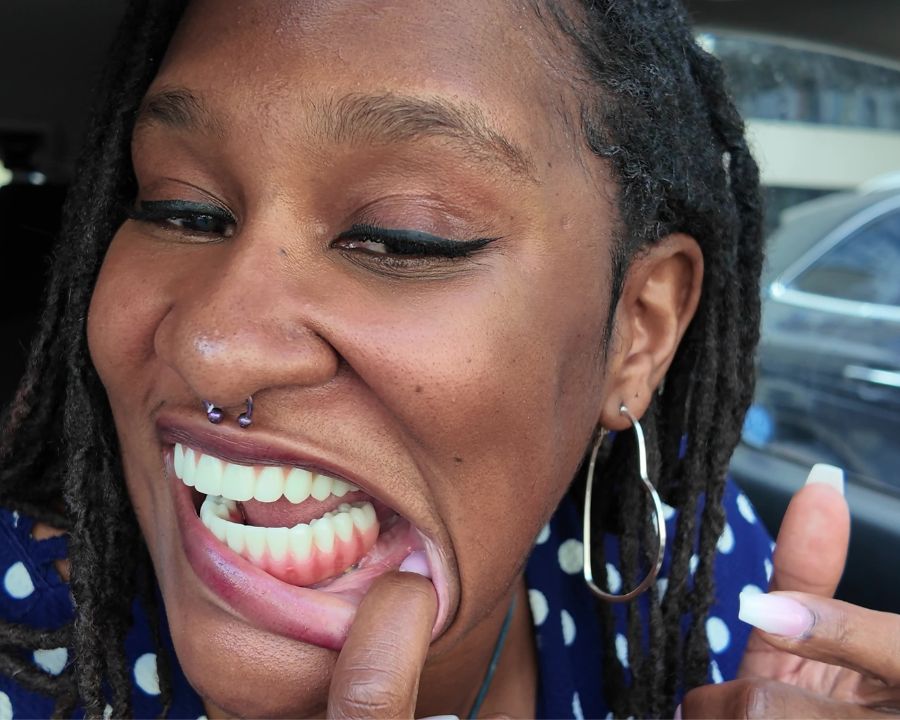
**Actual NUVIA patient(s) who may have been compensated for sharing their story. Not all those who come in for a consultation are eligible for this treatment. Results may vary in individual cases.
If You Need Something to Replace Missing Teeth Fast (Temporary Fixes)
These aren't dental solutions — they're bandaid fixes when something breaks on a Saturday and your dentist isn't open until Monday.
Wax beads (around $10–$20 online) let you mold a temporary tooth in a pinch. Products like Instant Smile serve a similar purpose for front teeth. Neither is something you can eat with, and neither is going to fool anyone up close. But if you're in a wedding party and a crown just fell off, they'll get you through the weekend.
Treat these as exactly what they are: a placeholder, not a plan.
Replacing a Single Tooth: Bridge vs. Implant
This is where most people with a single missing tooth are making a real decision.
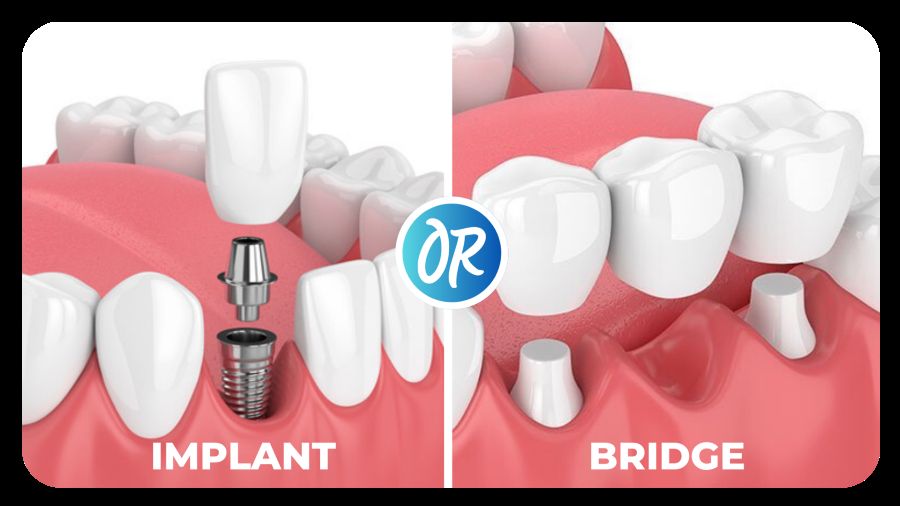
Dental bridge A bridge replaces a missing tooth by anchoring a false tooth (called a pontic) to the two teeth on either side. Those anchor teeth get shaved down to hold the bridge. Turnaround is typically about two weeks, and cost runs roughly $4,000–$7,000 depending on the work involved.
The tradeoff: you're permanently altering healthy neighboring teeth, and the bridge itself will likely need replacing every 10–15 years. It can also complicate things if one of those anchor teeth later needs a root canal — you have to drill through the bridge to get there.
Single dental implant An implant replaces the tooth root with a titanium post, then puts a crown on top. Cost is similar — roughly $4,500–$6,500 — but the neighboring teeth go untouched. If something happens to an adjacent tooth later, it's a separate problem.
Once an implant integrates into the bone, it should last a lifetime with proper care. In my opinion, if you're a candidate, the implant is the better long-term investment. The caveat is healing time — you need to let the implant integrate before loading it with a crown, which takes longer than a bridge.
Options for Missing Several Teeth
A few missing teeth all next to each other can be addressed with an implant-supported bridge — two implants anchoring a span of three teeth, for example. This avoids the weakness of a purely tooth-anchored bridge while still covering a gap efficiently.
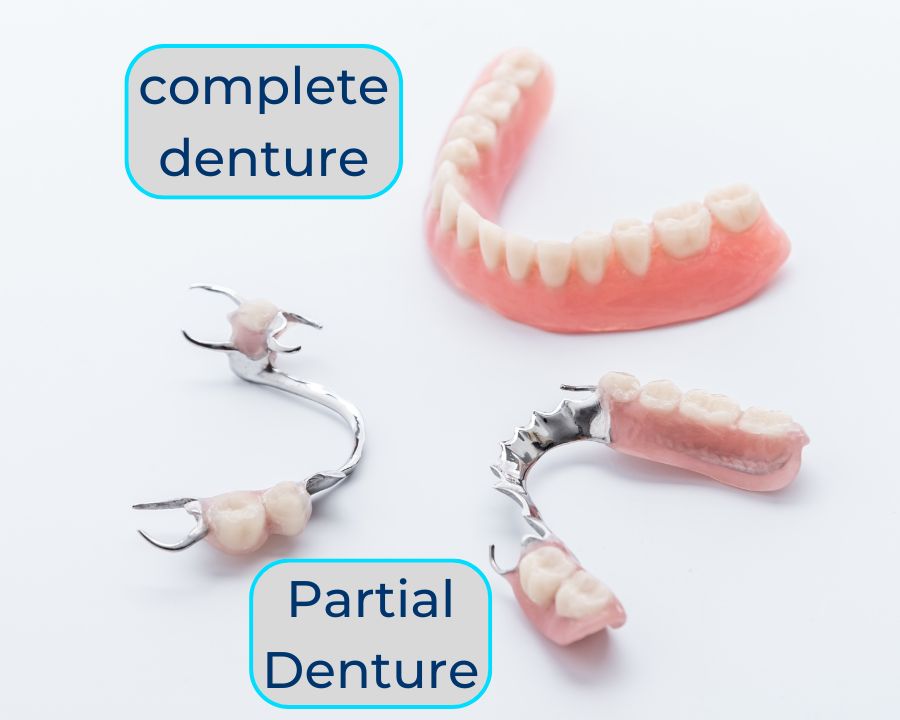
For patients who aren't implant candidates or want a more affordable option, a removable partial denture is a legitimate solution. The cast metal versions (roughly $1,500–$3,000) are more durable than the acrylic ones. In my opinion, these work best as a temporary measure while working toward something more permanent — acrylic wears, breaks, and isn't a great long-term answer.
Full Arch Options: What to Know
When most or all of the teeth in an arch are missing or failing, the options change entirely.
Traditional full dentures ($800–$3,000 per arch) are thought of as the most accessible option.
The problem is what happens underneath them over time. When there are no teeth — and no implants — holding bone structure in place, the jawbone resorbs.
I've seen patients after twenty years in dentures with almost no bone left. At that point, even keeping dentures in becomes difficult, and implant options become more complex. Dentures don't stop bone loss — they often speed it up.
Snap-in dentures ($8,000–$15,000) improve on traditional dentures by anchoring to implants. But they're still made of acrylic, which can break and wear down. And because the back of the denture rests on gum tissue rather than implants, it can bounce on the bone during chewing — contributing to the same bone loss problem normal dentures have over time.
Fixed full-arch dental implants — the All-on-4® method — are where I spend most of my time, and for good reason. Four to six implants support an entire permanent arch. Nothing is removable. Nothing is resting on tissue. The bone is supported, not being eroded.
What We Do at Nuvia — Replacing Missing Teeth Permanently
At Nuvia, we deliver the final permanent restoration 24 hours after surgery. Not a temporary like you’ll find almost everywhere else. The actual final set — made from zirconia, a ceramic that’s harder than metal.
This matters for more than just convenience. When a patient goes through weeks or months in a temporary acrylic set before getting their permanent teeth, they're retraining their mouth — tongue, lips, bite — multiple times. Starting with the permanent set means you go through that adjustment once, and you're done.
The other piece is stability. That rigid, cross-arch zirconia provides a level of structural support during healing that acrylic temporaries don't. In my experience, it genuinely improves healing. Our implant success rate at Nuvia is over 99% — compared to a national average of five to ten percent failure. I believe that stability is a significant part of why.
One more number worth knowing: studies suggest the average person spends around $97,000 on their teeth over a lifetime of patchwork repairs and replacements. A permanent full-arch solution isn't just about the smile — for a lot of patients, it's actually the smarter long-term financial decision.
.png)
Not sure which option is right for your situation? The 60-second quiz below is a quick way to find out whether you might be a candidate for permanent teeth in 24 hours.
Take the 60-second candidacy quiz →




.jpg)