
This website uses cookies to ensure the best experience on our website. We may share your information with our advertising and analytics partners as outlined in our Privacy Policy.
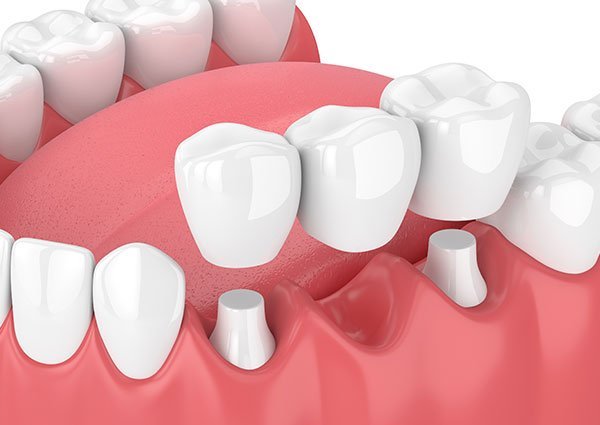
Crowns and bridges can work for a while—but when multiple teeth are involved, the cycle of repairs can start to feel endless. One crown fails, the tooth underneath weakens, a bridge needs replacement, and the work keeps building on teeth that may already be compromised. Full mouth dental implants replace failing teeth and failing dental work at the same time with a fixed, permanent solution designed to last.
These videos explore why some patients with multiple crowns, bridges, and repeated dental work decided to stop patching individual teeth and choose a more permanent solution.
Choosing how to replace missing teeth can be really overwhelming. So let's clearly break down the differences so you know what's best for you. Starting with option number one, dentures. Dentures are removable prosthetic teeth that are usually made from acrylic and sit right on top of the gums. On the upper denture, the appliance usually covers the entire roof of the mouth so it can create suction. What this means is that it's usually blocking the part of your mouth where taste comes from. On the lower denture, there's no suction at all. As it's resting on your lower gums, it's easy for the lower denture to slip and even fall out, which makes lower dentures the most difficult to stay stable. With traditional dentures, patients can only generate about ten to thirty percent of their biting force. What this means is that it can be extremely difficult to eat things like nuts, apples, and even a steak. The main advantage of dentures is that they're usually the most affordable upfront, and they don't require surgery. The trade off is stability, chewing power, and taste. Also, since there's no implants in the bone, there's nothing stimulating the bone. That means that bone loss can still occur. For some patients, especially when health or budget is the main concern, dentures can still be the right option. They're just rarely the best long term option. Option number two is a dental bridge. Bridges are typically used when someone is replacing one or a few missing teeth, not a full arch. The bridge is anchored to the natural teeth on either side of the missing space. Those teeth have to be trimmed down to support the bridge. Unlike a denture, a bridge is not coming out, and sometimes a bridge can look good. The limitation with bridges is that the missing space has no root or implant, And what this means is that the bone is not being stimulated. That means that bone loss can still occur. But with an implant, the bone is actually being stimulated. What this means is that bone loss is less likely to occur. And if one part of the bridge fails, the entire bridge needs to be replaced. So bridges can work in the right situation, but they're not designed to replace a full smile. Option number three is an implant retained denture, often called an overdenture. This looks very similar to a traditional denture, but now we've placed implants into the jawbone. With these dentures, they snap right onto these implants, which provide for a more stable design. With this option, most patients have about fifty to sixty five percent of their biting force, which is a big improvement from traditional dentures. Since there are implants in place, they can help slow down bone loss in the areas that they're placed. That being said, this is a removable prosthetic, so you have to take it out to clean it. Also, the snap in components tend to wear down over time, needing maintenance and sometimes even replacing. On the upper arch, they tend to still have phalanges and cover part of the upper palate depending on the design. These can be a good middle ground option for patients who want more stability and something that's still removable. If this video is helping you so far, drop a like and consider subscribing to the channel. It'll help a ton so that we can reach more people like you so they can make confident decisions about their dental health. Option number four is fixed dental implants, also known as All On four or All On X. A full bridge of teeth is securely attached to multiple implants that are placed in the jawbone. Since the bridge is attached to multiple implants, the forces are evenly spread across all the implants. However, this option is not removable by the patient. These teeth are designed to function just like natural teeth. Most patients can eat, speak, and smile confidently. These materials can vary from acrylic to ceramic to zirconia. These can affect durability and long term performance. Just as materials can vary for offices, so can timelines for treatment. It's very important to understand that at many offices, the teeth that you get on surgery day are just temporary teeth. It can sometimes take months and multiple appointments to get your final teeth. It's very important to ask what kind of teeth you're getting and when, because teeth in a day can mean very different things. At Nuvia, our approach is a little bit different. Our goal is to deliver permanent teeth just twenty four hours after implant surgery. These are not temporaries. These are your permanent teeth. After implants are placed, we digitally scan your mouth and we start making your smile. Our in house lab works tirelessly overnight to start milling your teeth. That means you don't have to wait months on end and have extra appointments to get your permanent and final smile. This option isn't always right for everyone, which is why proper evaluation is always the first step. So what does all this cost? The reality is it varies between each option. Some options are cheaper upfront, but they require more maintenance over time. Others are meant to be long term solutions. If you're looking into dental implants and want a clear understanding on how cost is decided, we've put together a free dental implant cost guide that breaks this down clearly, and you can download that using the link below this video. Choosing between dentures, bridges, and dental implants all comes down to a few factors. Your lifestyle, overall oral health, budget, and long term goals. There's no one size fits all solution. Just what's right for you. We strongly recommend stepping back and looking at how many teeth are actually missing and what you hope to achieve by getting new teeth. For example, replacing one or two missing teeth is a very different solution than replacing an entire arch. The solution that works well for a small gap may not give you the stability, comfort, or confidence you're looking for when missing multiple teeth. It's very important to ask yourself, what truly matters to you? Whether that's being able to eat certain foods again, speak clearly again, not have to worry about something moving in your mouth, or to have something that truly feels permanent to you. When those goals are clear, it becomes much easier to determine which option makes sense to you and which ones fall short over time. If you're curious whether permanent teeth in twenty four hours is an option for you, we've made it easy. You can take our quick eligibility quiz in the link in the description and continue learning at your own pace. Thanks for watching.
I'm talking with doctor Anoni, a restorative doctor, about every major tooth replacement option. So doctor Anoni, how are gonna break this down for us today? Alright. Well, we're gonna start off with single tooth replacement, and we are going to go all the way to full mouth tooth replacement covering both temporary options and ones that are more permanent. Okay. Sounds good. So what is up first? Okay. So up first is these temp tooth wax beads. Okay. Okay? So these work by melting them, basically, and then you mold them into a tooth. So let's say that you have a tooth knocked out or a crown completely broke off and you need a quick replacement because you cannot access your dentist. It happened on a Saturday afternoon and you are in the wedding party, my friend. If you need a very quick fake tooth, you melt these down, you mold it to the area, then you put that back in water, like cold water, so it'll set, and then you can kind of put it in and out. Certainly not something that you can eat or function with, but really good for if you're in a pinch. Okay. Okay? And what is the cost range for something like that? This, I mean, online you could probably find something like this for like ten dollars to twenty dollars something like that. Okay. Okay? So super temporary at home, no dental work needed. Gotcha. Then we're moving on to a more permanent tooth replacement. Okay? So this here is a dental bridge. Now, you'll notice you have a natural tooth, missing tooth, natural tooth. The thing about a bridge is it replaces, I don't wanna extract anything here, it replaces a missing tooth with what's called a pontic. So it looks like a real tooth but there's no root connection. Okay? Pros, this can be done within, let's say a two week turnaround period. You go into your dentist, they shave down the teeth next to the missing space, they take an impression, whether that's a digital or a physical impression, they send that to the lab, the lab will create a ceramic bridge, and then two weeks later, that gets cemented on. Like I mentioned, I think the biggest pro for a bridge is turnaround time. Another case where a bridge might be a really good option is if this missing tooth has been gone for a very long time and the bone has shrunk down to where it's not thick enough to hold a dental implant, this might be a good option, okay? Additionally, if the patient has received any kind of head and neck radiation or has been on a medication called a bisphosphonate, basically if they have osteoporosis and they're taking injectable bisphosphonates, that might predispose the bone to not heal well with an implant. Okay, so this option is great. So let's use a practical example here. The anchor teeth are like these land masses. Okay? They do have to be prepared or shaved down in order to hold the bridge. Good. That fake tooth in the middle is this bridge. Think about the stability required for this. So we wanna make sure that the span of the bridge is not significantly greater than what these land masses are able to hold. So a three unit bridge, meaning there's one fake tooth and two real teeth or two land masses, that typically can hold with good stability, especially if it's a back tooth, if you're chewing, you have these stable land masses. The longer this bridge gets without reinforcing, the more at risk the bridge becomes. So if you have just these two anchor teeth, but in between you have three pontics, let's say, and you are putting a lot of pressure on that as you're chewing, that bridge is not gonna hold well and is at a high risk of fracture. So if you're replacing a single tooth, this could make sense. If you're replacing many teeth and you're looking to do this bridge part with just pontics and no other stability, you may wanna evaluate other options. Okay. So let's get these guys out of here and talk about a different replacement for a single tooth. So this is a dental implant. A dental implant is typically titanium screws, some of them are ceramic nowadays, but that implant goes in to replace a tooth root Like that. Now we have individual crowns if you need crowns on the surrounding teeth. Right? You have individual crowns there and you have an individual crown on that implant. Advantage here is as opposed to a bridge, you can treat these like individual teeth. Right? So whereas with a bridge, you're cleaning around this guy and you really have to make sure you get under that. Waterpik is a great tool for that. Here, you can floss and treat this like a really unnatural tooth. Okay? The other advantage to getting an implant placed is with a bridge, if something were to happen to either of those anchor teeth, the whole bridge is compromised. You have to replace the whole thing. Let's say you end up needing a root canal on this tooth. You have to drill through the bridge to get there, and that can compromise the whole thing. Wow. Okay. With dental implants, you don't have to shave down these teeth if you don't need to. And if anything does happen to either of these teeth individually, the rest of the teeth are not affected, right? So you do have to be a candidate for dental implant. And if you don't have enough bone in that area, there's always grafting options, meaning the doctor can place bone there, allow that to heal, allow your body to create new bone, then place a dental implant. But I will say a single dental implant oftentimes, especially if it's in the back, will take more time before you can have this final restoration. Okay. Because you do want it to heal and integrate completely before you're putting pressure on that implant, because you don't want to interrupt the integration process. Okay. So that is a bridge versus an implant. Any questions there? What does the cost comparison look like? Great question. So with a bridge, you're looking at typically between, let's say, fifteen hundred minimum, typically for the individual crowns, maybe a thousand here, but that ranges. I mean, I know providers who will charge two thousand five hundred dollars per crown depending on the work that's needed to be done underneath those teeth. So we could be looking at anywhere between, let's say, four thousand to seven thousand dollars depending on the work that needs to be done underneath these teeth, okay? For a dental implant, you've got the implant itself, which is the blue part. You've got the connector, which goes into the dental implant and allows for the crown to be placed, so that part sticks up over the gum. And then you have the crown. Honestly, the price range is gonna be pretty similar. We're looking at like between four thousand five hundred to maybe six thousand five hundred, depending on where you are. Geographically, that can differ. I've certainly seen implants go for less, but it is important to note what kind of implant is being placed, right? So you do want to make sure that you're getting an implant from a reputable implant company, not some knock off that's not going to integrate well and might give you problems down the road. So that's something that it's important to ask your provider about and really educate yourself on. Okay. And when would you suggest somebody getting an implant over a bridge? So an implant, in my opinion, is a better long term solution. Okay. With a bridge, you are looking at replacing it every ten to fifteen years. You've really got to evaluate if these margins along the tooth, so this margin here can sometimes have an opening and you might get decay in this tooth. And so regular x rays are really important. So yeah, a bridge lifetime wise might end up being more than an implant because you may need to replace it, you may need to expand An implant, once the actual implant itself integrates into your bone, that should last a lifetime, right? If you are taking care of this well, meaning you're flossing, you're water picking, you're cleaning at home, there's no reason it shouldn't last you a lifetime. Okay. So I think longevity wise, the implant makes more sense. But again, not everyone is a candidate for an implant, so it is really patient specific. I mean, the goal here is to go over all these options, educate you guys out there as well as you, for anyone who does need a tooth replacement, And then once you're armed with all of this information, you can make the best choice for yourself on what is going to fit best for your lifestyle, for your budget, for your goals. Okay. To provide a good example of what kind of bone may make a patient a good candidate versus not a good candidate, let's use a real world example. So an implant is much like a screw, right? So we've got a dental implant right here. That screw underneath this is that connector and then the crown on top. When you are doing carpentry, you can have different kind of wood. Right? We wanna make sure that that screw, to give us the best stability, is going into nice solid wood as opposed to wood that's very porous or soft. You know, it's not to say that an implant won't stabilize over time if it goes into softer wood or softer bone, if you will. But that we might wanna allot a little bit more healing time. What happens during the healing period is that implant is inside of the bone. Under a microscope, that titanium is actually porous. Okay? So your body has bone breakdown cells and bone buildup cells. Immediately when an implant is placed about two weeks later, the bone breakdown cells are in much higher concentration because your body is remodeling the bone around that implant. Between weeks two to about six or eight, the implant is actually weaker than it was when it was first screwed in. Then the bone buildup cells start coming into higher concentration, meaning that cell by cell, your body's creating new bone that grows into that porous titanium and actually integrates with the implant. Okay? So, that is why allowing more time in particular if the bone is weaker can still give us a really successful long term implant solution. It's just really dependent upon that quality of the bone. We'll talk a little bit more about how this comes into play when we're talking about full mouth solutions, because sometimes individual implants can be what's called immediate load, where your provider might make a temporary crown for that implant if it has really good stability and there's strong bone. Typically, you do want to wait for that integration to happen because the strength offered by one implant is not always enough to withstand the really strong forces of chewing or biting. Okay. Okay? So what if somebody is missing more than one tooth? What would you, you know, say would work best for them? That's a great question. So as we talked about with individual implants, sometimes patients might be missing two or three teeth. You can do more than one individual implant to replace missing teeth. Okay. You can also incorporate implants into a bridge. Okay? Not with natural teeth. They have An implant has a different relationship with bone than a natural tooth. But you certainly can place an implant. If you're missing, let's say, a span of three teeth, you can have two implants here. Crown, crown, pontic. So it's still a bridge, but now it's held together by implants. Right? So that's another option if someone's missing, like, let's say three teeth in a row or something along those lines. Individual implants or implant bridges. Right? So let's move on to removable solutions for multiple missing teeth. Okay. This here is called a removable partial denture. This one is cast in metal. This is a good solution if somebody wants something removable that is going to be more of a long term solution for them because this is all cast in metal, so it's much less likely to break on you. This removable partial denture is more of a temporary solution because you can see it's not cast in any metal. It does have these little metal clasps to fit around the teeth, but it's it's certainly much more of a temporary solution. A removable partial denture of this kind of quality and material, this plastic acrylic with no metal casting, can run you maybe several hundred dollars, let's say, between five to eight hundred and fifty. Okay. Something that is cast in metal is going to be in the low thousands range. Right? So let's say between fifteen hundred to three thousand dollars. Okay. And what would be maybe some pros and cons for these partial dentures? Sure. A pro for a temporary partial denture like this is, let's say you do get that individual implant, and you need to wait several months until you have your crown. A removable partial can help you replace that missing tooth so you can function and aesthetically look right, right, like you're not missing a tooth, until you're able to get that crown. It's also oftentimes a more affordable option depending on how many teeth you're missing than getting some sort of restoration. Okay. Okay? And again, if your bone quality is not one where you can receive permanent restorations, if you have had radiation for cancer of the mouth, if you have had bisphosphonates IV. It's not always an automatic disqualifier because now there are things like hypobaric therapy and different things that we can do to help revitalize that bone. But something like this may be a better option for someone who just isn't a candidate for dental implants. And what are some things that people should consider maybe before going this direction? So putting a prosthetic, a removable prosthetic in your mouth can be uncomfortable. Right? Anytime you put something new in your mouth, it's going to take some getting used to. But the thing about a removable prosthetic is that oftentimes, it's not the most stable. So you might be chewing and having some rocking. That can cause some sores or, you know, difficulty actually processing the food. Additionally, this kind of material wears over time. The amount of patients that I've seen come in who have had a partial denture for a couple of years and have had it repaired and cracked and broken and, like, the teeth pretty much worn down to just these flat little surfaces. That's, I would say, most patients with a removable partial denture. In my opinion, the proper and best use for them is as a temporary solution until you're getting to a more permanent solution. Of course, sometimes the financials make more sense for a removable partial denture for patients than they do for, you know, something more permanent. Everyone's different. Everyone has a different situation, so this is a really it can be a really good solution for someone who's looking to replace teeth but not able to spend a little bit more on something that's more permanent. Okay. That makes sense. Yeah. Well, what if you're missing even more teeth and you're looking for something maybe quick? Okay. So let's say that you have, a bridge on your front teeth and that bridge snaps off. You can't go see your dentist for a couple of days for some reason. This instant smile is available on Amazon for like twenty dollars. It's a really good solution for short temporary fixes like that, but it is a one size fits all type deal, and so it certainly might not be for everyone. Right? We actually did a video on this where my assistant and I tried these on and did a full blown review. We can put the link in the description below if you wanna check that one out. It certainly has its use case, But on me, I dare say it was borderline comical because I I have a unique smile in that I show a lot of gum when I do smile. And so for people who have that hypermobile lip like me, even if you are missing a few teeth, it's something that you have to be very mindful of because when you smile, you show the transition between the, you know, the the fake gum and your actual gum. Alright. Cool. What would you categorize that as? Like a veneer? Like a This product is similar to these kind of like wax beads in that you're dipping it in hot water, you're molding it to your teeth, it's something removable. This is very much exclusively aesthetic. You cannot function with this. Speech is gonna be really difficult with this. But again, if everything fails on you on the front, in particular, because this doesn't go all the way to the back. If everything fails for you on the front and you need to, you know, have something when you're interacting with people, great little temporary fix. Okay. Well, what if somebody is looking for a full mouth restoration? Can you kinda walk us through what those options are? Totally. So in this same line where something that you can buy online and then mold at home, This is an easy denture. Okay? This is similar to the instant smile that we just talked about because you can buy this online, hot water, mold it to you. This online will run you between two to four hundred dollars. Wow. Okay? But again, pretty decent solution if you have a full denture and it happens to break on you and you need something quick. Now cons to this is it is kind of a one size fits all. They do have a male or a female option, but as far as the arch size goes and the palatal anatomy or like the roof of your mouth, there's not a lot of variety here. So again, in my opinion, pretty decent temporary fix. But if you want something that's really customized, that's gonna stay in your mouth and have really good long term suction and fit for your face, this might not be where you wanna put that couple hundred dollars. Okay. Okay? As I was discussing that palatal anatomy or the roof of your mouth, some patients have what's called a palatal torus, right? That's a bony protrusion on the roof of your mouth. Okay. I have one. If you feel with your tongue, you may or may not have one. I do. I do feel it. Okay. Cool. So this would be rough for you. A traditional denture can account for that because your dentist is gonna be taking an impression of your whole mouth and then customizing the denture itself to that. Right. This is a replacement for a full arch of missing teeth, and on the upper, it's held in typically by suction. Okay? A full denture can run you anywhere from eight hundred to three thousand per arch, depending on the kinds of materials that are used, the kinds of individual teeth that are placed, and on, you know, the city you live in. Okay? A big con to dentures is the lifespan of this kind of acrylic plastic material is oftentimes not great because through chewing, through normal function, you are going to have breakages, wear on the teeth, and the need for replacement over time. Additionally, this full palatal coverage can be really difficult to get used to. Speech, even the way that food is chewed and tastes is going to be different because part of that experience of tasting food is your tongue kind of mashing the food up against the roof of your mouth. You even have something called palatal rugae, which are these kind of folds of gingiva or gum tissue behind your front teeth. So again, if you feel with your tongue, you'll feel kind of like a rough patch behind your front teeth. Dentists don't account for that, and so again, chewing changes a lot when you have these. Last thing I'll say is when there are no teeth in bone, what we see is resorption. So what is resorption? Right when you have teeth taken out, you still have bone height. Right? As the years go by, if there are no teeth and no implants or structure holding that bone level, what you start to see is that bone decreasing in height and in thickness. Right? After several years of that scenario, what you start to see is severe atrophy. Right? So here, we see bone loss after several years with no teeth, no implants holding on to this bone. The way I like to measure this is by looking at what's called the mental foramen. This is where a nerve comes out and it's on both sides of your jaw. Okay? As this bone starts to atrophy, we can see that it's getting closer and closer to this. I've seen patients where the bone loss looks like this. Wow. I mean, everything's completely gone. We have barely, like, millimeters, that's half of a centimeter of bone height. Okay? And the biggest culprit of that is not only not having teeth or implants holding that height, dentures on top of the bone not having anything to hold the height, every time you're chewing, it's putting pressure on the bone and it's causing it to resorb more. So oftentimes we'll see patients, maybe they've had dentures for like twenty years, and we take an x-ray, and they have no bone left. I mean, at that point, it's kind of, it's a disability. Like, you really, dentures won't stay in because there's not enough bulk of bone, and also it's very difficult to place implants to replace those. Now, there's advanced techniques for implant placement, like placing, you know, let's say the upper arch has no bone left. You can place implants that anchor into the cheekbones. Those are called zygomatic implants, and they are longer. But they offer us different options in implant placement that can still give these patients who have been told like, hey, you don't have enough bone for implants, okay, but what about these advanced techniques? Zygomatic, transnasals, pterygoid implants. All of these sound like complicated words. They are complicated procedures, but if you find a surgeon who is well versed in this, who, you know, does these kind of complicated implants day in and day out, that's the only thing they do, you're gonna be in good shape. There is still hope even if you've been told that you don't have enough bone for implants. Okay. So speaking of implants, there is kind of a hybrid situation between a complete denture and something that's fixed across the full arch, like an all on four or all on six. Okay. This is the snap in denture. Okay? Patients will have implants placed into their bone, but remember that connector that I was talking about here? That connects the implant from below the bone to above the bone restoration? The attachments or abutments that they will have above the gum correspond with little housings inside of a full coverage denture. So those will actually just snap right in. Okay. So with snap on dentures, you are still looking at a full palatal coverage denture for the upper. For the lower, it is also going to have a denture look to it because you'll have what's called the flange or the part that goes over the gum tissue to provide more stability. These can run you anywhere between, let's say, eight thousand to fifteen thousand depending on your provider and the amount of implants that are used to hold things down. The most common setup that I'll see of these is a complete denture on the upper, and then, like, two to four implants on the lower that a denture can snap into. Because on the top, your palate or the roof of your mouth can provide some suction to provide stability and staying power to the denture. On the bottom, you have your tongue, your cheeks, your lips constantly moving, and there's nowhere for the denture itself to suction to. And so what patients oftentimes see with a lower denture is like, when they're speaking or when they're eating, it will pop out on them. An option, of course, is denture paste, but the amount that you have to use to keep those in is pretty aggressive. So yeah, this option is available. I don't have a good scenario for why a patient would go with a snap in denture if they are able to get four implants in, because that's typically the minimum that we need for something that's more fixed or screwed into the implants. But again, everyone chooses their own adventure, right? Sometimes a patient might say, no, I wanna be able to take these teeth out. I want to be able to clean them. I want to be able to, you know, get underneath them because I don't have the manual dexterity to take care of fixed restorations in my mouth, then maybe this is a great solution for you. And what are some things to maybe consider with this option? Like a denture, it's made of acrylic, okay? Similar to what you have on your nails, yes. And acrylic itself is prone to breakage, especially through repeated use and function. So what I'll often see with patients who have these kinds of restorations is maybe the implants look fine, maybe the denture has been repaired like three, four times, and they're frustrated and they want something that provides more stability. Additionally, since the support for this kind of restoration is not only these implants, but also the tissue, what you can see sometimes is wear on the bone and tissue. What I mean by that is you recall the bone that we were just looking at, and I showed that lower arch with like the very large dip. When patients have just two implants on the front, and then the whole rest of the denture is hanging off on the back, These housings are not completely rigid. They have some move to them, and so when the patient is chewing, the denture is bouncing up on the bone and the tissue, and over time it can really wear away that bone. So you will see that like serious dip behind that mental nerve, which makes the bone a lot weaker. You know, I've seen, I guess in my years of practice, patients who have maybe had a pathologic fracture of the lower jawbone in attempting to get, you know, different restorations with providers who maybe are not prepared for that thin level of bone, or, you know, who have to keep getting these snap ins replaced over time because the anatomy changes so much in the bone. So, yeah, I think it's important to consider what all the options are and what they are available to you because some providers might only offer this kind of prosthetic as opposed to a fixed because they might not be well versed in fixed prosthetics, and that might not be something that their practice offers. So, you know, you're going to offer what your practice has available to them. So if that is something that you are considering, make sure that you get a couple of different opinions from different dentists on what options are actually available to you and what's going to be the best for you in the long term. Because if you're already investing that much money in something like this, you wanna make sure that it's gonna last you. Absolutely. Well, let's talk about the fixed solutions then. What do we have going on over here? Okay. So when it comes to fixed solutions, we are looking at a couple of different options. One of the options that's not pictured here, but I do have an example of, is called three on six. So I'll walk you through kind of the levels of restorative options. Okay? So this is what I would call an f p, fixed partial, one. Okay? Three on six. So that means three bridges on six implants. Okay. Okay? This option only replaces white tooth structure, not gum. So case selection is super important. You need to have enough gum tissue and enough bone height to be able to mimic what natural tooth size is going to look like in your mouth. What do I mean by that? If your bone level is up here and you've had a lot of resorption over the years, these teeth are not gonna look like that. Yeah. They are going to look like horse teeth. Okay? And also, the timeline for a three on six is very different than from an all on four or all on six. Because if you have an experienced provider who actually wants to help make this look like a natural restoration, they're gonna take the time to shape the gum tissue. That means several rounds of temporaries that expand the gum tissue to house all of these pontics. Remember we talked about the pontics? To house all of these pontics and scallop around them in the way that normal normal gum tissue would. A pro is if this is done correctly, case selection, both the patient and the doctor are willing to put in the time to properly shape the gums and the bone is stable enough to hold this setup, it can look very natural. It does, however, pose an interesting situation when it comes to cleaning because you think about the gum tissue, let's say it's right around all of these. You need to clean around all of these individual anatomies. Right? So when you are flossing, you are going up and down over them and in between all of these implants in order to make sure that you're not accumulating any plaque or bacteria underneath there that can cause inflammation to the gums. Additionally, over time, your gums starts to pull back if it's not properly stimulated. So another thing that these patients may or may not notice, depending on the design of the actual teeth, is the black triangle. So when the gum pulls back and you have kind of a hole in between Right. You may or may not have seen that, like, with, you know, in in your own life or with someone in your life. So you'll be able to kinda see through, and then it'll stop looking natural in the long term. Okay? So case selection is super important for an f p one. An f p two, fixed partial two, is similar to an f p one, except that it also replaces some of the gum level. So let's say we've got our teeth here. An FP two is going to replace some of the gum level. Okay? The amount of implants in an FP two can vary dramatically. Like, you can have some of setup like this or you can have more of an all on x type setup. I don't know many people who would be a great candidate for this because when you smile, if you show any level of gum, your smile is going to show where that transition line is between the the fake gum and your natural gum. And so, I guess if you have a smile that's like this, you could consider something like that. But again, it can pose difficulty for cleaning because you're still dealing with a lot of anatomy there. Okay. Okay? An FP three, fixed partials three, is going to be something like an all on four or all on x restoration. Okay? So this here shows all on four. Meaning, all of the teeth are anchored to four implants in the bone. Okay? Sometimes you'll see all on six or all on five. It really depends on the patient's anatomy and bone structure. So if someone has a really large arch, you may see more implants placed there because the goal is from the front to the back, like the front most implants to the back most implants, you wanna have good spread. What that's going to offer is great stability when the patient is chewing. Great stability for the implants because implants are wonderful devices for withstanding vertical forces. But once you start applying shearing forces to them where they're having to put pressure against that, you know, bone that's been integrated into them, in the long term, they might fail. So, yeah, that's kind of a little bit of theory behind that. But again, one of the big advantages here is when you're looking at the surfaces that you're cleaning, we go we start with f p one, all of this anatomy. We get all the way to f p three. It's flat surfaces that you're cleaning in between the implants. So in my opinion, the hygiene is a lot easier to maintain. Okay. Okay. So in talking about FP threes, let's look at the different options that are available to us. So let's talk about this that you have here. This is a temporary full arch. Okay? So when you hear things like teeth in a day or same day teeth or, you know, full arch options like that, this is usually what they're referring to. So once the surgery occurs and the implants are placed into the bone, they will put cylinders onto those abutments, right? Abutments. Okay. And then they'll take a denture like this that has been hollowed out in the middle, and they will attach this set of teeth to that using flowable acrylic. Okay? So that's why you see these different colors here. Remember that spread I was talking to you about from front to back? This particular case is a tough one because this spread is not not ideal. But but yeah. So so a patient will be sent home with something like this. Pros, it's done the same day in the chair. Cons, This technique was created in the nineties and was revolutionary when it was. One of the big problems with this is this acrylic and all of these margins that are in between the new acrylic and the, you know, the acrylic that's native to the denture, they are bacteria traps, food traps. And so it becomes really difficult to keep this area clean. It absorbs and attracts bacteria and plaque into its pores. So even if you have the ability to brush it out of your mouth, it's still going to be a trap for for bacteria. Now the implant survival rate for a temporary solution like this is not bad. I mean, it's somewhere between ninety to ninety five percent. But things that can complicate it are the microflexure that exists in something that's acrylic. Like we talked about, over the healing period, implants are integrating with your body. That process is called osseointegration. It is a delicate process. Your body's creating this new bone cell by cell. If anything interrupts that process, implant won't integrate, it will fail. What I had seen personally in my practice prior to my Nubia days is these can fracture at a pretty high rate. I was repairing things often in order for the patient to be able to just get through the healing period. After they're done with the healing period and these temporaries, then we start taking impressions and doing a wax try in, and it's several visits for the patient, and several months, it can be anywhere between six to eight, ten months even, depending on the kind of procedure that needs to be done for the patient, until you get your final teeth. Okay. Okay? And in between, between this very old method and the, I would say, most cutting edge method, is it'll still be same day, but as soon as the surgery is done, the restorative doctor will come in, take a series of impressions. Sometimes that will involve attaching something similar to this to the implants and then breaking it off. That can have a pretty negative impact on the survivability of the implants because when the surgeon places the implants into the bone, he or she is gonna be measuring how stable those implants are via torque value. It's important that we measure the individual torques of all of the implants as well as the cumulative torque in the whole arch. Okay? There's a minimum threshold that we wanna hit that will give us the green light to, you know, actually load it or screw the teeth in without compromising or risking the implants in the long term. And so if you're putting something on there and ripping it off or you're, really manipulating them a lot, it can compromise their survivability for sure. But in that model that I'm talking about, they'll take those teeth and then mill something out of a similar material, a temporary material that's not reinforced with metal, And then they'll screw that in later in the day. It is same day teeth but still a temporary version because several months later you're coming in and starting that whole process of a new prosthetic. Okay? With any prosthetic in the mouth, there's always a risk of a change in speech, difficulty chewing or closing your mouth in the proper bite, or just it feeling weird. I like to compare any of these to an amputee getting prosthetic legs. Right? That patient is relearning how to walk, sit, stand. These patients with these oral prosthetics are relearning how to speak, chew, swallow. If you're doing that with a temporary set and then several months later, you're starting from scratch with the final set. Right? So it it is it's multiple steps until you get to the place where you're like, okay. I feel good about this. Right. Okay? Now at Nuvia, we do something a little bit different. We actually deliver the final permanent restoration twenty four hours later from the surgery date. Like the final set? The final set. The set that is intentioned to actually last you a lifetime. Okay? So these teeth are often made from zirconia or a ceramic that's harder than metal. There are certain circumstances where we'll use a different material called g cam. The beauty of having these two options as final restorations is it gives us flexibility on what's best for the patient. Right? So if we're doing a single arch, like, let's say just the upper teeth and not the lower teeth, and the patient has natural teeth on the bottom, GCAM is oftentimes a great fit because it's more similar to the hardness of natural teeth. So we like placing like on like so nothing is damaging each other. Right? When you're doing the full mouth, so, you know, upper arch over lower arch, or if you're doing a single arch and you have crowns or other ceramic work on the bottom, 24Z might be a great fit for you because it's not at risk of grinding away or deteriorating anything that is softer than it, okay? The way this works is a patient will come in for their evaluation. We, as restorative doctors, will take a ton of measurements, we'll take digital imagery. We combine all of that into the design process, and then the next visit is surgery day. The patient will come in, be put comfortably to sleep, and we will be taking our measurements after the surgery to fine tune our design that we already started. The lab works tirelessly overnight, and the next day, the patient has their final permanent restoration. What does this mean? You don't have to get used to multiple different sets Right. And retrain your mouth, your tongue, your lips to to something new over and over and over again. The tongue is a muscle. As with any muscle in the body, if you wanna train to do something new, it doesn't happen overnight. But having the ability to start from start from zero and get to the finish line in one go is really valuable to the patients. The other thing that is really of note in the ability to deliver the final teeth the next day is the strength offered here. In my experience, it's actually really helpful to the healing of the implants, right? So we talked about that osseointegration, right? We're already experts there. We're already experts there, right? Osseointegration. What happens is when there is microflexure or breakage of a temporary, the implants get impacted, of course. When you have this super resilient cross arch stability from the beginning, they're not getting forces applied to them that could be negative in the long term, right? So that leads to my next point here, which is our success rate in comparison to the national average. At Nuvia, our success rate is actually over ninety nine percent when it comes to implants. Wow. And I attribute that to this super rigid cross arch stability that's given from the beginning. So, you know, everyone has different options, but from my experience, you know, in having treated literally thousands of these, I've seen really great success with this kind of option for patients who are wanting to get dental implants and find a solution that is going to presumably last a lifetime. Can I actually test those out, see how strong they are? Oh, absolutely, my dear. You know, we've run over them with a literal car before. Oh my gosh. Yeah. That's actually crazy. Yeah. So how much would something like this cost in comparison to some other stuff we talked about? That's a great question. So once you start getting into this range, the cost varies dramatically. I've seen studies that have said that an average person is going to spend somewhere around ninety seven thousand dollars on their teeth in their lifetime. Wow. Whether you choose any of these options. Okay. Replacing these over and over again, you know, getting individual crowns, like patchwork all over your mouth, or getting full mouth of dental implants. The cost of Nubia's in particular is certainly well below the national average, which is great. But for more details on the actual pricing, Nubia's created a cost guide that actually breaks everything down and answers so many questions that we've heard over the years of this treatment, and that is available in a link in the description. So hopefully that's really helpful for you. Awesome. So what you're saying is you could either be replacing stuff over time, or you could go ahead and go with a permanent solution and then Correct. This is certainly much more of a one and done type scenario, and so, you know, I see this often. Patients come to me and I look at their x rays, and I'm like, man, you've been living at the dentist your whole life. They're tired of going back and forth. They want something that is going to last them, and that they know, you know, the investment I'm putting in here, I'm not gonna be continuing to take care of like one fee here, one fee here, a single crown here. That's what I'm doing for myself, for my health, for my longevity, and my my functionality. And so it is a really, really great option for people who are candidates. Awesome. And as I mentioned before, not everyone is a candidate for dental implants, but an easy way to kind of take one step and find out if you could be a candidate is to take our sixty second quiz. We can also link that in the description, so if you're interested in finding out more, definitely check that out.
See how patients replaced worn-down bridges, failing crowns, and damaged teeth with a full set of fixed teeth.
%20(1).jpg)
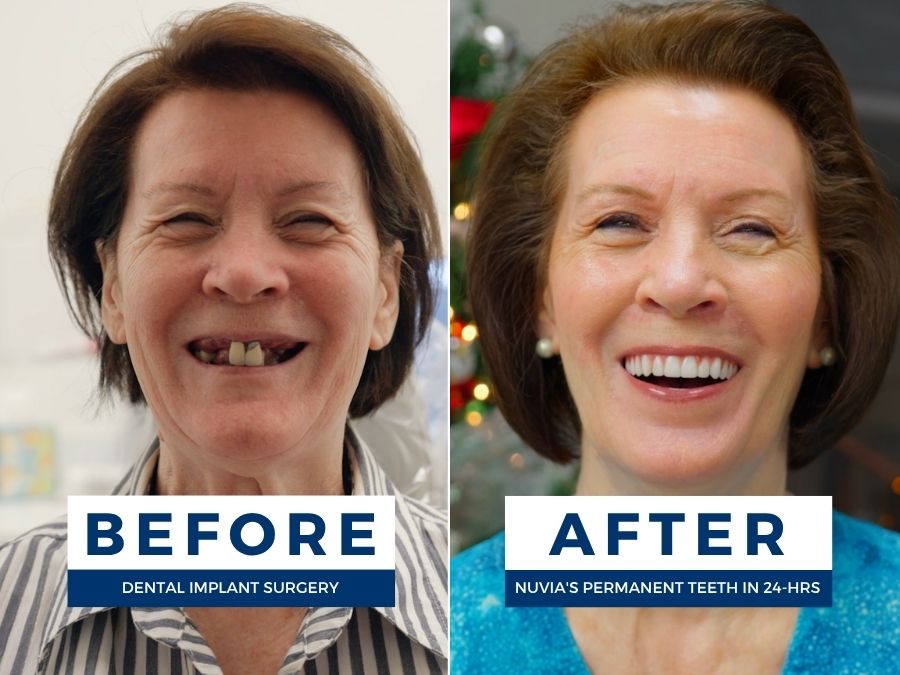
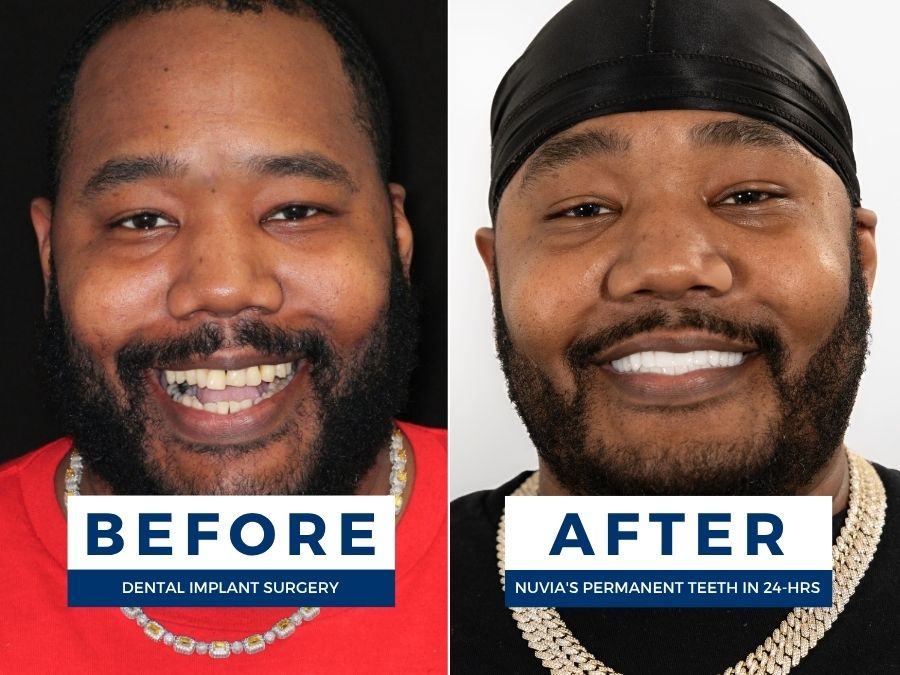
These conversations feature patients who spent years managing root canals, crowns, bridges, and failing teeth before deciding they wanted a more permanent solution.
You see a lot of people concerned that they might be too old, that it would be a waste of money, saying, I'm scared to death at my age to go through this, but I'm just saying I'm the biggest wimp I know. And here I am four and a half years later. You might have heard you're too old to get dental implants, that it's too risky at your age, recovery will be too difficult, or that you won't have long enough to enjoy the benefits anyway. But what if that's not true? I'm here with Duncan, who got dental implants later in life, to break down the three biggest fears people have about doing this at an older age. And you might be surprised what he discovered. All right, Duncan, let's get into it. The first big fear that people have about age and getting dental implants is this idea that once you hit a certain number, you might not even qualify to get it done. So let me first ask you, how old were you when you decided to do this? I was sixty eight years old. Did age ever come up? Did it affect whether you would be a candidate? Can you kinda walk me through that? It never came up. I I never imagined, I was gonna be too old for this. I think for a lot of us as we age, we put our focus and attention on our kids and grandkids, and we we pretty well dismiss any concerns medically about us because that's just our job as a parent and a grandparent. And so when all of a sudden something happens in in my case, in my life, I just dismiss it because I'm not worthy of that. And that's I think that's part of the human condition that I'll just I'll just give it to the kids and and be okay. And and I think that's a a sad commentary to have rolling around in your head. I think that's the way older folks mask their fear. Because if I can mask it with wanting to help others, then I don't feel so bad rather than coming out and saying, I'm scared to death at my age to go through this. And and so I think it's I think it's something we learn as we age, quite frankly. Age is not really a factor to becoming a candidate. You said they never brought it up at your appointment. That that wasn't a concern for them. So how did you find out if you did qualify? What what factors, like, were assessed for you? I sat down. The doctor looked at my teeth and my the scans they did on my mouth, and she just blurred out, you're good. Let's do it. And, again, I had twenty four teeth in my mouth at that time. They were just in terrible shape, and and her response was, frankly, immediate after she saw all the information she needed to make a decision. So you took some scans, which I'm assuming probably looking at your bone quality. And, did they also ask you questions maybe about your health and stuff? Yep. Asked me. And, and at the time, and I still am, I'm on blood thinners. And so she immediately said, you know, here's what we'll do with that, and and it was stopped the blood thinner two days before and started back the day after. And I trusted this doctor so much after just meeting her that if she just had done go stand in the corner on your head and we gotta look at something, I'd have done it. It just it just wasn't an issue, and I'm thankful that I had no fear in this. My fear was what the dentist said was a year and a half getting the same thing I had had for the last forty years. And I call that the Band Aid approach, and and Nuvia, far beyond any Band Aid approach, they do the full change. And what so what was Nuvia promising timeline wise in comparison to what this other dentist had told you? I was gonna have my teeth pulled, and in twenty four hours, I was gonna have full dental implants put in. Then I would come back in two weeks for an exam just to see if things were working correctly, and I would come back at four months to see that everything had come together the way it was supposed to. And and quite frankly, I had no idea what that was. I was trusting the doctor and the staff to know what that was, and that's exactly what happened. Wow. So at first, you were promised from another dentist a year and a half with the work. Nuvia, you were promised twenty four hours. And before we get into actually surgery and how it went, I do wanna ask you one more question, though, about kind of going into this process. I'm curious, since age wasn't a factor of you becoming a candidate, have you seen others your age or even older getting this done or that were getting it done, when you were getting it done? Oh, yeah. All you've got to do is go on the Smile Maker page and and look at folks, and they'll tell you. They'll have long standing conversations between us about how old were you, how old are you now, different things. And and you do. You see a lot of people concerned that they might be too old, that it would be a waste of money. And and my thought, I've been in better health the last four and a half years than I was the four and a half years prior to this. So in sixty three no. Excuse me. When I was sixty three, I ran three Tough Mudders, which is an endurance course and things, and and I just set my course to do that. So and I did it three times. So by sixty eight, I was no longer able to do that because I kept getting skin infections. And, and again, I had a stroke, but I didn't, I didn't connect any dots. So I went in five years from a very healthy older man to a guy needing help, I'd have never in a million years thought the help I needed was remove all my teeth and give me implants, and that would change my life medically and physically as it did. Wow. Yeah. So you were more so, like, kind of concerned of the opposite. Like, I probably should be getting something done or else I'm not gonna, you know, have this long rest of my life to live. Right. And and I never made the connection until I found out about Nuvia. I'm like a lot of us. I just did whatever the dentist said. Well, before we talk a little bit further about, you know, your experience with the Nuvia team, I do want to say for those watching and you're wondering, could I be a candidate for this? Do I qualify? The first step is by taking our sixty second quiz that you can find in the description below. It's a simple way to learn what could be possible for you. All right, Duncan. Let's move on to the next big fear that people do have at an older age, which is, can I really handle surgery or the pain? You know? So can you walk me through what that was actually like for you? Did you experience any pain during surgery? How did that go? Well, the great news is when I went in and they put the anesthesia in my arm, the CRNA said, now count backwards from ninety nine. Ninety nine was all I remembered saying out loud. I was out at ninety eight. And so I was completely out for and I have no idea how long, and I I didn't care. I was basically in deep sleep for the whole thing. I had absolutely no concept of what she did there. It just reinforced to me that I made the correct decision to go to Nuvia. With my history of root canals and things, every root canal I ever had was more painful than having twenty four teeth removed. And what I realize now is that's because Nubia chose, and their way of doing things is anesthesia, they put me completely under. Most of us, if we've had any dental work, know the sound in a dentist chair of the those kind of things. And not only does it hurt because they've already stuck your mouth a half dozen times with the needle, But then to hear that is just, in my case, excruciating compared to the difference how Nuvia handled this. Sure. I'll be on you. That's one of the smartest things I ever heard was, let's just put these folks out so that we don't elevate their fear and anxiety in mid process. Totally. I mean, I can imagine too, like like you, you have been going back and forth to the dentist for so many years that You know, going again you don't wanna be hearing any of that. You don't wanna be seeing any of that. So what I'm hearing is you were asleep. You were comfortably asleep. But what about when you woke up? How did you feel afterward? How did that part go? When I woke up, I didn't feel anything other than a little drowsy. I woke up, and they told me my wife was there to take me home. My wife drove us home. I don't remember her driving us home. I got out. I walked up into my front door. I remember that part. And then I don't remember anything. She had walked me upstairs, got me in bed, put ice packs on my face, and, I slept like a baby. And so it's like, again, I've had root canals where it was so painful that sleeping wasn't an option. In fact, went to one of my dentists I went to, they were cleaning my teeth and it was so painful. I finally said to the woman, you've got to stop. This hurts so bad. Just let me have a minute. She left the room, came back in with the dentist and said, okay, we'll give you a Valium so we can clean your teeth. And I looked to her and I said, you're gonna give me a Valium? Yeah, so we can finish cleaning your teeth. I said, lady, there's not a chance again that you're gonna give me a medication to clean my teeth. It isn't gonna happen. And so, again, the the difference in dentistry and Nuvia, in my opinion, was very much like that. Wow. That sounds like night and day. Oh. I mean, I can't even imagine that. Like, cleaning your teeth was super painful. Oh my goodness. And then versus going through and having twenty four teeth pulled and you're like, not a problem. Came back the next day, got my teeth. It's like and I had I'm I'm not a real curious person. If I believe in you, my curiosity doesn't have to continue to be examined. And so when I walked in the door that day to first meet the Nubia staff, I was already convinced I'd made a correct decision. And what I had was I had that validated step by step. And that's what I love about Nubia is, when you first walk in, they make you part of their family. And I didn't go in saying, listen, people. Here's how you've got to do blah blah blah. I just felt so welcomed and so at home. It took away any anxiety I could have had because these are folks I trusted. Wow. That goes a long long way, I'm sure, throughout every part of the process as well. So when you did go back in the next day, though, were you like, to get your your teeth Were you in were you uncomfortable then at all, or did was that part painful for you? No. No. They just put me in a chair and said, alright. Put you know, lean you back a little bit. Wasn't painful. Wasn't anything. And I did feel pressure, and what I realized was that was hooking my implants, my teeth, to the implants they'd already put in my mouth. And I thought, wow, these are so tight. That's so cool. Because the little bit that I thought was no one has tight dentures. Dentures are never tight even when you glue them, you know, in your mouth, those kind of things. And I was just stunned at how tight these felt. It wasn't painful in the least. It was just my acknowledgment. And, again, I'm real thankful that I didn't have a lot of fear going into it because so many folks we see on the Smile Maker page share their anxiety and their fear, and so often that's based on their dental history, just like me. Most folks my age and older, we've learned enough, and I tell people, I'm a cynic at heart. And so if it sounds too good to be true, I'll just wait for the brick to hit me and acknowledge I was right. And here I am four and a half years later, not being hit by a brick. Best decision I ever made, dentally. So so that's what I know all of us go through, especially those of us elderly. We go through that issue, and, I I would just love to give everybody a big hug and say, you got this. Not a problem. Absolutely. So going through, you know, the surgery, the next day you got your new teeth. Now there's kind of this recovery stage. Did you ever feel at any point, like, during this whole process, like, oh, I don't think I can handle this or or this is too much? Like, how was it physically for you? I was I feel blessed. I didn't have pain at all. I had some discomfort, as I mentioned. My my new teeth were very tight, and and what I realized is that's the way they're supposed to be. And so, I think a lot of us who are fearful, that becomes our our basis for how we're going to process through things. Now again, I can't promise anybody, because I'm no doctor, that they're not going to have some pain. We all address that differently. I'm just saying, I'm the biggest wimp I know, and and I I didn't feel it. And so if you feel some concern, what I know about Nubia is you call your Nubia staff, and you say, here's what's going on. Can you explain this to me? And and they will do that. A lot of pain is right up here in my head, and I know it's that way for folks. And, again, especially as we get older, because we have a lifetime of knowing what happens and how it feels when you go to a dentist. Right. So you're saying, you know, even at your age that you were you didn't it wasn't this big deal. You kind of let the team take care of it. You got through it. It's not that big of a deal. Is that basically what you're saying? Yeah. Again, that was my approach. What I would love to do after being around Nuvia for this long is so many people, my opinion, create anxiety and havoc for what they're about to step into. And and again, I think that's the human condition. If you've had a lot of bad teeth and bad teeth experiences, you know how that's gonna feel. And that takes over any notion of trust, and and and that's a challenge. And I think Nubia is great facing that challenge. Well, I know one of the other reasons that you chose Nubia was because you would be getting your permanent teeth in twenty four hours the very next day. And you said that did happen. But I am curious, you know, why was that quick turnaround such a big deal to you? You know? I know time is precious, especially as we get older. So can you kind of talk about why? Oh, sure. Because I just come from a new dentist who said after she examined my teeth, that it was gonna take a year and a half, multi visits, multi dental work to get my teeth better. And at least at that point, I knew my teeth were terrible and having them all removed at one time was gonna be more a blessing than a curse. She had her way of doing things, and and I don't I don't dislike that person for saying that. It's that's the mentality that I realized happens in the dental world. We'll be glad to take care of everything you've got, and it's going to take so long. Oh, by the way, we had to get to pay more because we had more issues come up than we knew at first. And so here I am four and a half years ago in twenty four hours, I don't have any teeth problems anymore. And if I had gone with the dentist who I believe was sincere and doing what she thought was correct, I wouldn't have even started my stuff with her probably at that point. Wow. Wow. Well, four years later, like you said, I wanna touch on another concern that we do get from people is if I'm getting to this age, you know, seventies, eighties, it might not even be worth it. Will I even be able to enjoy the benefits long enough or that cost won't really pay off? So, again, four years, what would you say to that? I would say unless you're more of somebody than you really are, meaning God, that you know our future. I had no clue. Now one day I'm gonna die, and I don't fear that. It's just gonna happen as we get older. When we start using that as our buffer for making decisions, I think that's tragic because in the last four and a half years, I have not had one ounce of the same problems I was having before. Everything about my health has changed. And the only way I know that is I walked through this with Nuvia, and the infections that were, in my body almost continually don't exist anymore because they were in my teeth. And I think that's a difficult thing to really comprehend. And, again, I'm just talking as me being my old man. The older I get, the less I care to believe somebody who's trying to do something for me. That's just part of aging. And and that's why when I see that those are people I just wanna go give a big hug to and say, walk this journey. It's well worth it. Absolutely. Well, since you did get your teeth twenty four hours after surgery, when did you start noticing maybe the differences in your quality of life that you that you're mentioning? What happened for me was, my focus was I had these new teeth. Now I had a mouthful of teeth. They were just broken and crooked, and my teeth were gray, dark gray from some type of periodontal disease, I think I've been told. All of a sudden, I look in the mirror and I've got these beautiful white teeth, and I'm thinking I had gotten to the point where I seldom brushed my teeth. Well, my first day in front of a mirror with these, I put toothpaste on my toothbrush, look in the mirror. I'm just stunned at how great these teeth look. Now this mug I've had forever, so I wasn't impressed about that. But it was these teeth were gorgeous. And so I'm brushing my teeth and looking at them, and and I'm finding inside what I think is joy. And it and it was something I I hadn't felt for decades around my smile or my teeth. And so I took three days off from work and I was a therapist at the time, so talking was important to me. I spent my twelve hour shift talking to people. Other than a little bit of a lisp, I didn't have any issues. It it my my brain took care of the new teeth without me having to focus on that. And and it took me, I think, a couple of weeks for all that to happen. One thing I noticed with my new teeth was, because they came together, and I'm going to make a sound here, I love that sound four and a half years later. If I would have tried to do that with my old teeth, I would have risked cracking them because they were so brittle. And so every now and then, I'll just sit around doing nothing and oh, how cool. And so it just brings back that flood of joy. And and I'm thinking, how cool is that? So so those are things that that I look at, and I just hope for people my age and older, as well as the younger folks, that you can just walk through this with what I call courage. And and I didn't swell up bad, and and I had no bruising at all. And so if you have bruising, if you have swelling initially, I tell people those are badges of courage and honor to walk through that because they go away, and what you've got is a beautiful set of teeth. And so it's just a matter of, I call them mind games, you know, that we play with ourself. When I was in my twenties, thirties, forties, I'd go out and do something and hurt myself and wouldn't think twice about it because that's just what you do. At my age, I can't imagine very many instances where I would say, well, I'm just gonna go out and do a, knowing I'm gonna be in significant pain from doing it. I'm not doing that. I don't run marathons anymore. I don't climb and jump out of trees. I had enough sense, though, to trust Nuvia with what they said, and if it was ten times more painful, I'd do it again tomorrow, because that pain absolutely goes away. Again, you're stuck with a beautiful set of teeth. Not not a bad option. Wow. I love the way you put that, Duncan. And it sounds like too, like a lot of these benefits you notice after the fact, some of them are like little things, you know, like little things I didn't even think about. You're you're enjoying brushing your teeth. Like, who would have thought you'd be enjoying something so small as that? But I think these little things, like you said, bring so much joy that they are big things. Right? And that's kind of what it sounds like. And I know earlier you mentioned your health previous to getting this done. You know, you're kind of having some issues going on. Can you kind of talk about maybe some changes you've seen in vat after the fact as well? Sure. Sure. As I said, some of the things I was struggling with was when my because my teeth were just really constantly infected, that infection was traveling to different parts of my body. And on three different occasions, I I was my skin was breaking out so badly that I went to the emergency room because it didn't make sense. That was the infections that were just catching on to parts of my body. And again, at the time, we didn't understand that connection at all, and I don't know specifically. But when I have my primary care doctor tell me that's something a lot of people are experiencing these days, again, I'm just a blessed man and thankful because if I hadn't been moving toward getting these, I would have spent more time having the same kinds of infections. And, and so I'm I'm real thankful that Nubia showed up, or that I showed up to Nubia, actually. Yeah. Yeah. So four years later, you haven't experienced any of what you had? None. None. Wow. Wow. Wow. Wow. And every time I look in a mirror, again, the mug is what it is. I've been this way for a long time. But when my mouth opens, it just brings joy to me. I'm thinking how weird a transaction that is. And so if you're one of those folks that has had your teeth removed or broken or whatever the case may be, they're just so bad that you don't open your mouth and show show it for anybody. I'm telling you what a gift this is. So it's easy to talk ourselves out of it for numerous reasons as I've already mentioned. The reality is my life is so much better now than it was before. And if I hadn't taken this the steps toward Nuvia, that wouldn't be my my situation. So I'm more than thankful. I am so, so glad you took those steps, Duncan, and you're here today. Four years later, sounds like it was worth it to you. A hundred percent. I am curious if people are, you know, wondering what is the first step I take or how much does something like this cost, Where should they look to, you know, find more information about that? There's a cost guide right down here that you can get, and Nubia sends that to you and explains the process financially. And and I'm telling you from my end, it was worth every penny, and I do it twice. I had no idea what my costs were gonna be with the dentist that told me a year and a half. I just know that it wouldn't have stopped in a year and a half. It would have continued. And so I look at this and think, you know, what what a fortunate decision that was. And and I'd I'd give every penny again if need be. Amazing. Well, Duncan, thank you so much for joining me today and sharing your story. You've shown that age doesn't have to hold you back and that you're never too late to look into your options. So thank you. Thank you again. Oh, you're more than welcome. And I sure hope if you're watching this, you'll take that step forward because it's worth it. Absolutely. Well, for those watching, until next time. Keep smiling.
There are a lot of dental implant places as we know. Why NUVIA? I was very skeptical walking in that NUVIA office and to know that I could walk in on a Monday, then walk out on Tuesday with a brand new set of permanent teeth. That was a game changer for me. My, dentist would have to prescribe me Valium just to walk through the doors. The people in Nuvia took all that fear away from me. There's so many parts of me that were affected by not having teeth that are so much better now. It's just completely different. But before we get started, I do wanna kind of try out a little experiment, do a little poll. So raise your hand if you've ever been insecure about something, no matter big or small. Think of something specific too. Keep your hand up. Keep your hand up. Now, keep your hand raised if that insecurity has ever held you back from doing something you wanted to do. Alright. Now, keep your hand raised if you would willingly come on stage right now and talk about that insecurity in front of all of us. Alright. That's what I thought. Well that's why this panel is super important today because these incredible people, our new VA patients came on stage and they're willing to open up about something that used to be their biggest insecurity which was their smile. And though their lives are a lot different now, they are coming on stage to basically relive their past. So give them a huge round of applause for being open and vulnerable with us today. It takes a lot of courage to go into that first appointment to get started. So, after talking with all of you guys on the podcast, I kind of learned that there is a deeper reason why a lot of you guys decided to came in and a specific moment sometimes that happens for, you know, reach your breaking point. So I kinda want each of you guys to answer the question of, what was your deeper why for going in and getting something like dental implants done? And Ricky, I wanna start with you because you've opened up before about, you were at a banquet, and you couldn't chew the food. You you couldn't chew the steak there. So can you kind of tell us that story and and share us that deeper why? So I was, at the head table at a banquet, and just like this, everybody was staring at you, which, is not a great feeling. And, of course, the banquet food was, less than desirable. And, I was cutting the steak and I realized, I couldn't chew it anymore. That's how bad I had neglected it, because I kept kicking the can down the road. And I had the I you know, everybody's looking at you, so it's not like you can just, like, spit it out on your plate, or you're gonna be the guy that everybody's over there, kicking while you're on the ground, you know, choking and stuff. So, I decided I needed to do something and I was sick all the time and I went to, somebody told me they said, hey, you ever thought it could be your teeth? And, so I ended up, going to many places and I ended up at NUVIA. So Awesome. Thank you, Ricky. So many things actually crossed my mind with this question because there's many that did it. But what started was I was putting band aids, constant band aids on my teeth, trying to fix them and nothing was sticking. I bit into a hamburger and a crown that I had, not even a year ago, broke off into my hand and I felt lost and devastated and hopeless. Completely hopeless. I needed a solution. And I didn't know implants were an option until I found NUVIA. And so, just being broken over and over again was the final straw for me. Well, like Ricky, I was unable to chew. I had missing teeth on one side at the bottom and missing teeth on the other side at the top. So I was unable to chew food like I wanted to, like I was supposed to. My oral health was deteriorating. And, I just got fed up. I just got tired. I knew something needed to be done. I wanted to take better charge of my health and, I found Nubia. That's it. My situation actually started when I had children. I had three children back to back, and it caused calcium deficiency. But the dental providers kept doing work on weak teeth, so eventually they kept falling out. But what led me to Nuvia was actually seeing my family enjoy Popeye's. Y'all love Popeye's. And I wanted to take part in it. My husband's like, you sure? And I said, yeah, I'm I'm gonna eat it. But as soon as I bit that delicious chicken, I broke a tooth. And I started to cry. And I said, Jesus, you need to fix it. I need you to fix it right now. Fix it. And in the middle of my tears, I opened Facebook, and there was a Nubia app. And I took that as a sign, and here I am. For me, my why really was the fact that I had so much that I wanted to share with people in the workspace, and I lost all confidence in doing that because I was ashamed of the way that my mouth looked. But what took it was the fact that I was on my way to go on a work trip, and the week before, my front tooth fell out. And I didn't know how I was gonna proceed. My husband knew how much that affected me and he found NUVIA. Showed me ads and also I started going through all the testimonial videos and I was hooked. I thought I finally found a place that could potentially help me. So that was my why behind finding Nuvia, and the rest is history. I had severe trauma at seventeen. I, lost most of my upper teeth. And so I had a flipper. I wore a flipper since I was seventeen years old. And so as the years went on, teeth would fail. The anchor points would fail and my flipper would get wider and wider and wider until, what, three years three and a half years ago or so now. But it got to the point where a tooth my one of my major anchors was failing, and it was it was time. I couldn't really go much wider with my flipper anymore because it was too brittle. So, yeah, I like she said, we got online and started researching it and twenty four hour teeth came up, and that's when I made that decision. I had dental in or I had dental situations since the age of five. I would lose teeth. I would brush my teeth. My parents are like, how do you have these cavities? I'm a seventies child. Nothing really worked back then. I was called a jigsaw puzzle. I spent two years researching before I even found Nubia. And here I am, three years later. So for me, I came from a different spot in my journey. I had never had, dental issues. I am a disabled army veteran. I had never had a cavity in my entire life and one day I had no teeth. And for ten years I dealt with dentures and I basically stopped living. And my why, and I'm not even being dramatic about it, my why literally was I was at a low that I had never that I had never felt. I hadn't left my house in a few years. I was the class clown. And call it divine intervention, call it the universe, whatever, but it was a Facebook ad that got me. And I was scheduled for, full, snap ons through the VA that were free and I was so dreading it had been scheduled for years. And I woke up that day and made my appointment and less than a month later, I already had my two week appointment behind me because Michelle got me in right away and stayed stayed until I got through all of every step of it in finance. Everyone's gone. Myself, Michelle, and my smile consultant are there and it's eight PM at night because she knew that I needed this. And I'm two and a half years later and I am happier and healthier than I've been in a very long time. So, thank you, Anupia. Thank you guys all seriously again for being so open and vulnerable with this. I know it's not easy. The next question I wanna ask is, there are a lot of dental implant places as we know. Why NUVEA, right? And so, I wanna ask Ricky and Bishop this one specifically, but how did you end up trusting Nubia? How did you know it was the right place to go? So, Bishop, I wanna ask you first, you called yourself mister skeptical when you first walked into your Nubia office, but somehow that changed. So, can you kinda talk about how that happened? It's true. I was very skeptical. I I I saw the Nubia ad, I took the sixty second quiz, I set up my consultation, and I just knew that they wanted my money, you know. And, as soon as I got in the office, took those first steps, someone called me by my name and then I heard that chime go off to realize that my money had been refunded. Unheard of, okay, alright. So, you know, then I think I was offered a cookie or something and I had jokes immediately walking through the door, but it they they literally they treated me like family. And I got to know everyone in that office, you know. I was completely fed up with my situation and wasn't sure what I was gonna do, wasn't didn't know what to expect. But walking in that NUVIA office and to know that I could walk in on a Monday with with failing teeth and poor oral health and walk out on Tuesday with a brand new set of permanent teeth, that was a game changer for me. So, that's that's what what led my decision. Ricky, I wanna ask you, you have told us a story where you've been to seven different places. So, why Nuvia? How did you end up trusting that they were the right place to go? So, I'd been to all these places and, of course, you know, anxiety and fear and doubt and you're just like, oh my gosh, let me get to eighty and nobody's gonna care what my teeth looks like. That's your your brain is doing all kinds of stuff to make excuses. And, finally, whenever I decided, I go to this place and I don't know if NUVIA had geofencing on me or what, but I'm waiting in their room with people with a lot different, like grayer hair than me. And I, kept seeing these ads on your phone because everybody's got their phone in their hand and it was Nuvia ads and I was like, wow, this is pretty slick. So whenever I went back, they were telling me they were going to have one person do everything. And I was like, you gotta have more than two hands because somebody's gotta hold my hand if I'm gonna be awake for this. And so my biggest question was, what am I gonna leave here with? She opens the drawer, she pulls out a denture, and she cuts the pink part out with an X acto knife, and she says, we're gonna put this in your mouth for ten months. Wasn't measured for my face or anything. And I said, you know what? Let me take this home and I'll think about it. And I walked out the parking lot and I called Nuvia and Keller, and it was pouring down rain, and I got in my truck, and they said, can you be here by noon? I said, I'll be there in twenty minutes. So, I drove over there, I walked in, and they already knew who I was, which was crazy. That's really I thought they were geofencing But it made a big difference because I grew up watching Cheers. So, I go in and I meet all these great people and they do all this cool stuff and they tell me, it's not going to be one person. I'm actually going to have a hand holder and everything. And I said, well, I can't beat this. So, I'm in a room with this fine looking gentleman over here, Richard, and, he said, you know what? This is whenever I knew that the culture at this company that obviously it starts at the top and works its way down through everybody in this company. Because Richard said, you have other options. You still have some decent teeth in your mouth. You could go do this. And I'd already checked on that and the return on investment was not good. So I told him, I said that's just not an option. And right then and there when I knew he didn't want the money, he was more interested in me as a person. It was that was a game changer for me. And I couldn't help but say, okay, this is the place I'm supposed to be. So Thank you, Ricky. Like Randy said, I think all of you guys are here for a specific reason. So, thank you for sharing that. The next question I wanna ask is specifically for you, Dennis. Even after saying yes to NUVIA, there are a lot of fears and a lot of doubts that patients will either hear from the family, their friends, even themselves. What kind of fears were going on through your mind? You did mention you had a lot of past Trump dental trauma. So, what fears were you having and how did you overcome those fears? Who helped you overcome those fears? Yeah. I mean, I had over a hundred surgeries on my face, and dental work. So it was I have a lot of PTSD. My, dentist would have to prescribe me Valium just to walk through the doors. So fear was very big on my on me and and to go through to sit in a dental chair took a lot. But the compassion that Nubia gave me, was the game changer. I mean, it took the fear away. Landon over here was the first person that actually wanted to hear my story. And, I had a lot of trauma. So for somebody to sit there and engage with my story, that was the first time in my life. And this is thirty plus years of living with this trauma. And that's what got over my fear was the people in Nubia that took all that fear away from me. And it's hard to explain just walking through those doors and meeting these people. They're they're just family. And to get over that fear by compassion, that's that's what it was. It was all of you people just treating me with respect for the first time in my life. It was it was pretty amazing. And And I think the coolest thing about your story, Dennis, is that you didn't go in only once. You actually went in twice. So can you talk briefly on that as well? Yeah. I went in twice. I hadn't I was trying to just I don't know. I don't do things for myself. And so I went in for the top arch only because that's where I was missing most of my teeth. So the what I went through, healing and and the surgery and meeting all these people, and it was it was so incredible that six months later, I was back in the chair getting the bottoms done. Like I said, I can't emphasize enough the compassion. That was my biggest thing. And just to feel comfortable in a dental chair, for me, was huge. So to go back six months later and do that whole thing over again, it was unheard of. I would have never thought I would be doing that, but now, I mean, I can't even look back. It's it's truly amazing. Now, I wanna get to you, Sharala. You also went in twice. So, another unique perspective here. And since you had your second procedure more recently, I wanna ask you, did you notice any improvements from the first time you went in to the second time you went in? How is it how is it different? What was most surprising was that there was really some things that were the same, which shows the consistency of the process throughout the the years. And so that really surprised not necessarily surprised me, but it really gave me a sense of confidence in Nuvia and what Nuvia does. And, also, whenever we have the opportunity to share with others, whether they go to the San Antonio clinic or they go to the Keller clinic or they go to Tampa clinic, we know that their processes are going to be consistent. So that was one thing that was very good. I thought it was a positive from my top arch and my bottom arch. But the things that I found a little bit different, I went in with a different perspective the second time. I had a little bit more insight. I had been around the company for three years. I'd had multiple conversations with many people. And so I I kinda knew, what I was listening out for. But I think because I went with intention, I did see that the information that is provided to the patient was a lot more clear. There was a lot of clarity with things. There were maybe some questions that we had before that maybe wasn't explained as much in the, three years ago, that now there's a little bit more emphasis upon. And so I definitely saw that, just clarity in the instructions. And then the last thing was the technology. I saw an upgrade of technology from three years ago. That also gave me a sense of confidence in the process too. So, those were the differences that I saw between the top and bottoms. I know another question on a lot of people's mind is, you know, what happens if something goes wrong? And Ricky, something after surgery kind of came up with you, and so I wanna I want you to talk about what kind of happened and how it was handled. You have a two week appointment as y'all know. And before the two week appointment, I just kept just had something going on inside my mouth. I didn't know what it was. I was like, oh my gosh. So I called and I said, hey. I know I got a two week appointment in a couple of days. It's like day eight. Can I go ahead and come in? And my doctor said, yes. Come on in. So I get in there and, they look in my mouth. I'm pretty used to that now. So, she said, oh, this is what we have, and she explained it to me, and I may use the wrong terminology, maybe like a bone spur or something. She said, this is when I knew, like it was amazing. She said, Ricky, I'm your doctor. You're my responsibility. I'm going to fix it for you today. She gave me a little anesthetic, she fixed it right there. That's customer service. That's caring about the person that just walked in. People in today, they look for so many reasons to skirt responsibility and stuff. And, these guys might not agree, but, I'll tell y'all. I have the best set of teeth that Nuvia has ever done. So I don't know about that. It's just amazing. Awesome. Now, I wanna bring it over to Angel. We saw you come across our social media. You decided to post a video just on your own social media, on your own volition about your Nuvia experience and it was very detailed, it was very in-depth. And I kind of wanna ask you, you know, what made you inclined to go and post that on your own? You know, why What about your experience stood out to you for you to go and do that? Well, first my followers have been on this journey with me for my health for quite a long time. And so this was part of that healing journey. But the reason I wanted to mostly tell them about NUVIA is because NUVIA is not just a dental office. When I walked into NUVIA, even before then, when I got my phone call from Priscilla, and then I walked in and met Gretchen, and I had my consult with Nikki, And I talked to Janae. And I had Justin and Bella and Tyesha, all three Baileys, doctor Kakar, Maddox and Jaeger. The fact that I know their names is important to me. I was a person. I wasn't just a patient. I wasn't a number. Nikki cried with me when I was trying to figure out if I could even afford it. She said, we're gonna make this work. And she sat there with me and she cried with me. My husband's just like, okay, but it's y'all just cry. But NUVIA is special. You all are special. You are changing lives whether you realize it or not. And I just wanted people to know if they were in a situation like I was, take that chance. Get off the fence. Give it a try because you changed my life from the moment you called me to right now. And I thank y'all for that. I I just wanna piggyback off of something that Angel said and I would love to see you guys give yourself a round of applause for being the Dental Implant Restoration Company of the Year, for two years consecutive. For the last question, I want to talk about the unexpected. You all came in. You shared your why at the beginning of this. You shared the reason why you came in. But there are a lot of things that came from your experience more than you ever imagined, right? So, I wanna talk about that. Michelle, I wanna start with you. I've talked with you on the podcast about your career now. You're in school. You're wanting to be a counsellor. And you said that was something that you never thought you could do before this. So I would love if you could kinda share more about that and kind of what direction you're heading. In December, it'll be five years since I had my surgery. And had I thought about the five year plan when I got my surgery, it is so much better than how I could have expected it. Like, sitting even up on the stage in front of you guys and not feeling insecure. I mean, that's it's huge. But I am in school. I went back to I I actually decided to go back to college and pursue my counseling degree. I'm gonna go back and get my master's in therapy. I've always been a heart centered person. I've always had that drive to go out and help people. I want to help them and and help them heal and find their passion and go after it. And I have such I've had I remember feeling this when I was a little girl. I've always had it. But since I was sixteen, seventeen years old, my teeth started failing and I couldn't I couldn't show up. I couldn't talk to people. I hid. I I hid myself and I couldn't do it. And up until I found NUVIA, which was still the one of the single greatest blessings of my life, I was able to say, oh my gosh, I'm confident. I can talk to people now. And I did it. I went back to school. I went back to school and not only am I in school, but I'm killing it. I'm like, like, so good at school because I'm going after something that I'm so passionate about. And I am gonna go out there and I'm gonna change as much as I can as a person, one person at a time. Sharing smiles is a universal language that we can all understand. And a compassionate smile and making eye contact with somebody is, it makes such a huge impact on people. We just don't realize it. And to be able to show up and smile and talk, just talk to people, it it's it's life changing. You put it in God's hands and enjoy the ride because this is so much better than I ever dreamed. Thank you, Michelle. Trish, I wanna bring it to you. You've also shared with me that you're no longer embarrassed and you're even sharing your story on social media, everywhere, and that's something that you wouldn't have done before. So, can you kind of talk about that transformation and how that was kind of you know, more unexpected than you thought? I was excited for COVID. I was hiding behind a mask because I was embarrassed. I love going out. I love travelling. I wanted to let everybody know that Nubia saved my life. Many of you guys know, many of you guys don't know. The Phoenix team love you guys to death. The doctors love you guys. I went in. I was told I was a candidate, guys. Ten minutes later, walk, walk, walk, you're not a candidate. What did I say to you guys? Did I say something wrong? I'm sorry, your BMI is too high. You need to lose fifty pounds. I have a lot of medical issues. I can drink water. I can gain weight. I can eat candy. I can gain weight. So I'm like, how in the world am I going to lose these fifty pounds? My doctor says, okay, we have to do your every quarterly blood test. Okay, no big deal. I've got Hashimoto's, PCOS, thyroid, you name it, I've got it. I was a medical nightmare when they had to clear me. I'll tell you that. But anyway, my doctor called me. She goes, I need to see you immediately. Can you get here by seven? That scared me. I go in, You have cancer. One week later, I'm on the operating table. One week later, we didn't get it. You have tumors. You have ten percent chance of living. So there, I was like, I'm never going to smile again. I'll never smile again with my family. But I went back for surgery two and three in September. I had lost forty pounds because I changed how I was eating for the cancer. I needed to survive for my family. I called the Phoenix office about two weeks after I got my notification I was in remission. And here I am. I called him. I got into the office. Doctor Slobin comes in. I think you have to tell me something, Tricia. Why didn't she tell me you had cancer? How do I bring this up to you guys? But if you guys would not have told me no, would I be here sitting with you guys here today? Probably not. So thank you guys for telling me no. Trish, you are incredible. Thank you so much for sharing that with us. And I do wanna ask you one more question. How have you seen your confidence change after you've got this done? What is life like now? Really wanting me to answer this in two point two seconds? The people that I've met, these hooligans that I get to spend time with, being in pictures, I am travelling like crazy. I went on an Alaskan cruise to celebrate my fiftieth birthday and my one year in remission. I took over twelve hundred pictures. I didn't take pictures. If you look at my wedding picture twenty five years ago, I was not smiling. From that far ago, I didn't smile. Like my mom said, I had issues since the age of five. The confidence is there. These guys call me Ms. Shenanigans because I always find something for us to get in trouble with, have fun with. But what it is, is that I'm smiling. I'm out there. If you have a bump in the road, don't stop. Push through that bump. Because at the other end, you're much happier. And Trish, you've shown that time and time again. So that is incredible. Randy, I wanna bring it over to you. I You've told me that your health has actually improved after getting dental implants. And I've actually heard that from a few of you guys here. So let's have Randy talk about it first and then you guys can chime in, but can you kind of talk about maybe what you saw change? So when I went into this journey, as I was saying earlier, you know, I went in for all of the reasons of, you know, I just I had to figure out how to live again. Because I was going through some health issues as well. You know, you can only live so many years of swallowing macaroni and cheese whole. You can only, you know, survive on so many things, and that was part of it. So I had gained weight that I had never gained. I started having stomach issues. My doctors were saying, you know, you're you're not chewing your food, you're swallowing it whole, it's not good. You know, all of these things just continued going. So I knew I needed to do this and all of these reasons, but what I didn't truly realize was that not only was I going to going to be able to be healthier by just eating, you know, normal, and it was like, wait a minute, I've gone all these years, I can now eat raw vegetables. I can now eat salads, all the things that I actually loved and were gone. So I just started eating those things, and I started dropping weight and dropping weight and dropping weight. And I just like probably most of us in this room, I have a gym membership. I had not used it. Every Monday, I say I'm going to, but I started this journey. I had never weighed I'm a short guy, so I had never weighed over two hundred pounds in my life. I started this journey at two thirty eight, and I'm down two more since we talked. I am now one forty six. And that almost every bit of that comes from the fact that I can just eat healthy again. And I get to, you know, be part of things. And that what does that translate? It translated translates into, you know, the happiness, you know. Again, going back to the military. I I suffer from severe PTSD. This was the worst thing that could have happened to me as a human being, and I don't know how there were times I don't know how I was gonna get out of it, but again, I do know how. And that's because I'm sitting right here right now, and this process and everything that we did, that, you know, that went on and has changed my life. And it's just it's mind boggling because I'm happier, I'm healthier, I'm even taking less medications on the PTSD. And that's because of you all. Yeah, you are. Well, thank you. Thank you, Randy. Ricky, I wanna come to you. You mentioned earlier that you felt sick all the time. You didn't know if it was because of your teeth. So whenever your teeth were pulled out on surgery day, when did you start to feel maybe differently? So for years, like, since two thousand eighteen, I was sick all the time. And I had had cancer and they cut it out and then, they thought I had stomach cancer or something because they couldn't figure out why. I'd go to the bathroom at, like, one, two, three o'clock in the morning just sick as a dog. And, like, every night, which probably had a big big, deal on my teeth not being so good also. So whenever, I was trying to figure out what was wrong with me, besides the obvious, The the one of the doctors said, you ever thought it could be your teeth? Honestly, this is this is here. You know, I mean, it's something you don't really think about. You know, millions of people don't think about that. And, so whenever I went to Nuvia and they took them out, and, I went home and slept really well. And whenever I got up the next day to get my implant my teeth put in, in twenty four hours, by the way, just throwing that out there. And, the, I could already feel my body healing. It was the craziest thing. And here we are three plus years and I haven't been sick one single day since. So I wanna touch on this as well because before I went in to get my surgery, I was getting two or three really severe sinus infections a year. They were gonna do a balloon sinusoplasty. I was getting this weird stuff in my ears. And after they had done my surgery, I haven't had a sinus infection since I got my teeth done at all, so I didn't have to go get that other surgery. And then my the whooshing in my ears my ears have gone away. And the dentist at Nubia said I had so much impacted infection in up around my body. I mean, that's scary because you you don't realize that it's like, everything is connected. But it it really physically changed how I felt as well, for sure. Which makes you a lot more pleasant to be around. With three minutes left until the Q and A, Angela, I wanna bring it to you because I know you have mentioned as well that your health has changed after the fact. So do you wanna touch on that? So, yeah. I actually was not able to really chew my food, obviously. So I was either taking big chunks, choking on chunks, or just trying to make it through. And then when I had a colonoscopy endoscopy, they found I had a hiatal hernia because I was struggling. I had an umbilical hernia because I'm bulging. I'm trying to force food. All of those things were happening to me. Last year, I actually lost over seventy pounds without trying because I was that sick. They thought I had cancer. I'm still going through those tests, but because I did not have teeth, I was putting my body through things that it did not need to go through and I didn't realize it. It was it was the most scary thing I've ever experienced in my life. But since I have my teeth, my BMI is better, my heart is better because I have POTS Syndrome, My mental health is better. There's so many parts of me that were affected by not having teeth that are so much better now. My life is a completely different it's it's just completely different. So thank y'all. We've obviously learned it's way more than just the smile. Alright. So now we're gonna bring it to you guys. If you guys wanna ask raise your hand and then go go ahead and ask your question. Now that obviously all of you guys have gone through this incredible process and have incredible smiles, what would you say to somebody, like, who is in the beginning stages and, like, do you did you regret anything? No. No regrets. No. What I the biggest thing I say is I literally am just like, just trust the process and put your faith in, you know, the the folks that who have studied this and and and this is what their job is. And then other than that, you just follow the orders and trust the process. Way more simple than it is when we were walking into that door that day. Trust me. And I always tell I say this to, potential patients on the Smile page is that so many people are scared to walk through that door. I have dental PST, and when I walk through that door, it's family. They're still my family. I take them surprises every couple of months. Because if they were not there, I probably would not have done this because you are so scared of the unknown, or being told no, or being told that this is the only thing you can do, but it's going to take you three to five years. So once somebody can walk through that door and realize that they are not a number, that you are there to do what's best for them as a patient, that's what really matters. I was on the fence. Like I said, Nikki cried with me. What changed it for me was she said, you deserve this. You deserve this. You've been through enough. Do this for you. That changed me. I always try to tell people, you know, it's really hard. Like she said, you don't invest in yourself. But this process isn't investing in yourself. It's investing in everyone around you because you are happy. So everyone around you, your family, your grandkids, kids, cousins, mothers, fathers, everybody around you is happy. So it's not just an investment in yourself. You're investing in your whole life. I I also wanna touch on what Dennis said because not just women, but humans in general, we tend to always wanna take care of everybody else. It's take care of this person, take care of that person. When we put ourselves on the back burner, they need to know it's okay to put themselves first. My question for you guys is, and we all know the answer to this, but for someone who just stumbled upon this video on YouTube and is interested in what you're saying, how long after your surgery did you actually get your permanent teeth? Twenty four hours. Alright. What? To learn more about the cost of Nubia's permanent teeth in twenty four hours, download the cost guide in the description below.
Hi. My name is Jeanie, and I've had these implants for a little bit over a year. And I'd like to tell you three good things and three bad things about the implants. The first bad thing is the swelling. And if you get black and blue, which I did, I was very black and blue, but it was brief, brief, very brief. But I had no pain. I suffered years with toothache pain. So this was a blessing. It's still a bad thing, but it really wasn't that bad. Now let's get to the three good things. Number one is I have more confidence knowing that when I smile, you can't see any teeth missing. It's heaven. The second bad thing is the Waterpik. You have to use it often just to help get some of the food particles out of your mouth, but it's no big deal. You get used to it. The second thing is the teeth in your mouth, the ones you're looking at now, stay there. You don't have to take them in and out every night and soak them. It's heaven. The third bad thing is cost. And I had spent so much money on dental appointments. Let's do this, and now let's do this. So I had just finished with braces on my top and lower. And when I went back to the dentist to see how things were, he said I needed another bridge, another implant. I just went crazy. So I probably spent a hundred thousand dollars through the years, and then I came here. I should have came years ago. I'm also saving money on denture cream to hold in my partials, upper, lower denture cream, then you soak them all night. I can't imagine how much money I spent through the years just with that. That's excluding all the implants and everything else I had. But if you want to get your own idea of how much it'll cost you, there's a cost guide for you to look at, and it'll give you a general idea of the cost. Look in the description below. It's listed. The third and final good thing is I got my teeth in twenty four hours. Imagine that. Not all these dental implant companies do that. The staff here at Nuvia was amazing. They cared about me. The doctors call you at home to go over your history. It was really thorough, and they were good to me. And I'll think of that always because I needed it at that time. So if you're sitting on the fence wondering, Should I get the implant? Can I afford it? Can you afford not to get them? Because every time you go to the dentist, more money, more money. I know I spent one hundred thousand dollars on the teeth I used to have. It was so worth it to me. I'm so happy with them.
Hi. I'm doctor Park. Hello. I'm doctor Giggu. And today, we're gonna go over tooth replacements from a single tooth all the way so multiple teeth to all teeth. So it depends. Every patient's a little bit different. So we're gonna go through these options for you. Okay? Alright. So first, we're gonna talk about when you're missing a single tooth and you're looking for some kind of temporary solution. This product is called Temp Tooth, and what you do is you you warm it up and you're able to kinda mold it with your fingers and make some kind of temporary tooth in the meantime. And so let's say you have this temporary solution in your mouth, and now you're making your way into the dental office. What are some options? What is your first thing that you're thinking for a single tooth? Sure. So if you lose a single tooth, basically you have three options. One is to do nothing. If you do nothing, what's going to happen over time is the adjacent teeth to this space, they're going to shift towards each other because teeth they like to touch each other. And also the opposing teeth from the opposing arch going to drift downwards. Obviously this is not an ideal situation and what's going to happen over time is you're going to lose the bone in this area as well. The other classic option is to have a dental bridge. So dental bridge is basically you are shaving down the adjacent teeth and then you connect them with a fake tooth, also called the pontic in between. As you can see in order to achieve that, you have to shave down the teeth in these areas. Sometimes those teeth, they are healthy teeth and obviously that's not an ideal situation. So docs apart from your experience, what are some pros and cons to the having the bridge? Okay. So in terms of having a bridge, let's get into kind of the cons immediately. You kind of touched on it already. If you do have two healthy teeth here, and you're trying to replace a single tooth, unfortunately, you're going to have to trim these teeth. So these are gonna be called your abutment teeth, and then it's gonna replace a single tooth here, which is called your pontic, and you'll have it there. Okay? Another con is because you don't have a tooth there, over time, as you had mentioned, the bone and the soft tissue in this area will kind of start to resorb and the gap, you'll develop a gap underneath this pontic, and so that becomes a problem in itself because now you have a food trap that can possibly cause some decay or some periodontal issues with these abutment teeth here. So over time it's very difficult to maintain the hygiene for these and these pontic teeth become very vulnerable to hygiene issues and decay and perio and stuff like that. And obviously the pro is you know you're getting that fixed, you're getting that area corrected with you know the pontic and you're maintaining the spacing and your occlusion and the aesthetics of it. Okay. So the other option is dental implant. Here you can see a dental implant. Basically a dental implant is a screw made out of titanium that we place inside the jawbone with certain width and certain length. So here is the actual size of a dental implant, and here is a model that we can use so you can see that you place this dental implant inside that jawbone. So the benefit of that is you treat this space as a single tooth and then when you have the crown on top of the implant you can floss between the teeth and do the hygiene of every single tooth independently. In order to be able to place the dental implant, need to have solid bone. And sometimes if you don't do it immediately after you lose the tooth, you may lose the bone stock necessary for placement of a dental implant. In that case, you have to go to your surgeon and they may do some additional steps, such as bone grafting, in order to prepare that area so you can have the dental implant in that space. And just to add to that, when you're looking at two options, you're looking at the bridge option versus the single implant, the single implant is considered more conservative treatment because these two teeth are not being trimmed and you can maintain the spaces between the teeth, so you're gonna be treating these as individual teeth, brushing, flossing, and being able to maintain all three sites. That's right. So let's talk about the cost for these treatments. Let's start with single tooth implant. Yeah, for a single tooth implant, considering the implant placement and restoration, depending on different parts of the country it can range between four to six thousand dollars. Yep. Alright and then if we look at a three unit bridge, because each individual site is considered a crown, this itself would also be considered approximately four to six thousand dollars, which is kind of surprising. Obviously, you're not going through any surgery, but as discussed, you are including the adjacent teeth part of your treatment, and that's what causes the material cost to go up. Let's say you're missing more than one tooth. So we've got these little bad boys. This one comes with multiple names. This is a partial denture. It could be called the transitional. It could be called the flipper. The reason why it's called that is because there is only acrylic and then there's some little metal clasps here. So this is a really temporary solution before you move on to something like this. This is a cast metal partial. So these are considered more of a final restoration versus something like this where this is more of a temporary solution. I would say this, in terms of cost, will run you a couple hundred dollars because like I said, this should only be worn maybe six months, hopefully less until you can get into something more permanent. If you want something removable, this is more permanent. This would cost maybe around two thousand dollars but again, it is removable, it's not the prettiest, and you know, then we can talk about more fixed solutions for multiple. Absolutely. So as Doctor. Park mentioned, these are somewhat less ideal options when you're missing multiple teeth. One of the options that you have for some fixed prosthesis is that let's say you're missing three different teeth that are next to each other, you can, if you have enough stock of bone, can place separate implants in these areas and then cover them with separate crowns. The other option would be to have a bridge supported by dental implants. Meaning that you place an implant in this location and in this location and you connect them with a bridge. Similar to the bridge that is supported by a natural tooth, but in this case the bridge is supported by dental implants. And the cost for this option depends on the location that you are in the country and also the number of implants placed and the number of teeth that are restored by those implants. All right, so we've just discussed missing multiple teeth with partials, some fixed options. And we've got this as that, doctor Parr? As seen on TV, instant smile comfort fit flex. So in my professional opinion, obviously this is not a great solution. It's not a permanent solution, but if you're in a tight bind, obviously everybody's dental needs are different and if you're in a tight bind and you need something just to get by, you know, you can get, you can use this product. It's kind of where you put in hot water and you stick it on the front so it's kind of like a removable veneer. And if this option is something that you may need to consider in the temporary, we do have Doctor. Anodi with Nuvia. They actually tried to do this product to see how it turned out so check out that video if you want. But like again, like I said, this is very temporary, you can use it just before you can get to the dental office but So doctor Park, what happens when you lose all of your teeth? Yeah. In that case we can start with this product. This product is, you can buy online, it's called Easy Denture. It's very similar to a couple of products we talked about today where you put in hot water, and obviously the patient has no teeth, they put in hot water, they put it in their mouth, it forms to their ridge, and you have a temporary solution replacing all of your teeth. I see. So initially when I first saw this product it looked it's good border molding, so it's nice and molded here, but it's hard because this is it seems like it's a one size fits all solution, so this may not work for you. It's gonna be very difficult to kind of go online, purchase something like this, and have it actually fit correctly. And so that's why we kind of move towards going to the dental office, and we have a complete denture here made by a dental office. Custom made? Custom made so you can see there's a lot more anatomy of this patient's roof of the mouth, nice borders, and then obviously the teeth are custom length to make sure everything looks great. So what are some downsides of having custom made dentures? Yeah, I mean, there's so many I can go through, but the biggest one that I hear when working at Nuvia is, hey, I moved to a denture and now I'm not tasting my food as That's right. Because, you know, yeah, ninety percent of your taste buds are on your tongue, but you're missing the roof of your mouth and you're still being able to taste through the roof of the mouth. It's very difficult when this full palate is there. This is there because you need that suction. Otherwise, this thing flops around. Helps with the stability of the denture. Yeah. But as you get older, unfortunately, things shrink. Your bone shrinks, your soft tissue shrinks. Over time, a denture definitely needs to be replaced every, I would say every two to five years. Every patient's a little different, but these things, these are approximately two thousand dollars to five thousand dollars for a single denture. A big downside for dentures is bone loss. That's true. If you want to go into a little more detail on Yeah, sure. Let me show you a quick diagram here. Think about this as your lower jaw and think about it, that's like a half of your lower jaw, think about the denture sits over this area. So what happens because there is no tooth in that area, what happens is over time you start losing bone. So your bone level from this level comes down to this level. Also there is a nerve that runs under your jaw that gives sensation to your lower lip and your lower jaw and it comes down from a hole inside your jawbone. So what happens over time you start losing bone more and more And what's going to happen is the denture is going to start rubbing against this nerve and that can cause also pain and some discomfort and as you lose the bone, the amount of bone gives stability to that denture. So with less amount of bone, the denture over time is going to become less stable. If you're wearing a denture and you wait a long period of time, as you can see you're going to lose significant amount of bone and that's going to limit the possibility of placement of dental implants inside your jaw bone. So if you have problems with your dentures, when your dentures are not stable enough and they are rocking, so one of the options is to place some dental implants inside your jawbone, that way the denture is more stable. So that's going to segue to the next option that we can talk about is the prosthesis that are supported by dental implants and they are removable. So the idea in this scenario would be that you place two to four, sometimes more implants inside the jawbone, and the denture going to snap in into those areas. As you can see in our models, this is a top jaw. Four implants are placed inside the jawbone, and they have these parts, male and female, that the denture snaps into place in those areas. So that gives stability of the denture and then also it limits the bone loss associated with loss of teeth in those areas. Alright. So kind of doing a summary over the implant overdenture. It's removable. It's technically a little bit more cleansable because you could take it out at night. You should be taking it out at night, keeping it clean. Yep. The abutments here, this one, this model doesn't show it, you have little nylon buttons that are there that help clip the prosthetic into place. Those do have to be replaced. Wear and tear. Yeah, wear and tear which is normal because you're taking them on and off, on and off and so those buttons wear out. Typically with those cases you're replacing it every six to twelve months depending on wear and tear. And this is still kind of the full palate. This option has the full palate. It still has the full extensions that go into like the the vestibule, so it's still pretty bulky. The cost, if you're wondering about cost for this, this could be around ten to fifteen thousand per arch. And so that's the removable option, implant removable, and now we're going to get into the the fixed And at any time during this video you have questions about the costs for any of these options, go down to the description below and you'll see the cost guide. So if patients are asking about some of the fixed options, meaning that they're not happy with the fact that in this case the denture, it is supported by implants, but it can be removed. And to be honest, there are some benefits in this scenario for some patients. For example, if the patient does not have the best dexterity, that can be a very good option because the fixed option needs a lot of cleaning and hygiene, and this option is much easier. Or for some other medical conditions, there are some very good indications to use this option. But if the patient is more interested in a fixed option and everything else is okay from the dexterity point of view, is we can place certain number of implants in jaw, top jaw or lower jaw, and attach the fixed prosthesis to those implants. So the historical name for this procedure is called Allon X, meaning that all the teeth are supported by X number of implants. And that X can be between four to six or more. So historically, the idea would be that you place four implants. Let's say this is your top jaw, these are your maxillary sinus, that they are big holes inside your face, and you place four implants in this fashion and the prosthesis will be attached to those four implants. Obviously this is going to be your nose, this is going to be your maxillary sinus, and the prosthesis is going to get attached to this area. So this, as you can see, is going to be a fixed option, meaning that the prosthesis, we're going to talk about it, is going to get attached to this area And the cleaning parts will be on top of it and also on the bottom of it. Okay? Doctor Park, could you please elaborate a little bit about the prosthesis part of the implant supported fixed prosthesis. I know. It's a mouthful. Mouthful. I know. So here we have the traditional Alon X prosthetic as I was kind of trained on. Done multiple prosthetics like this. I'm sure you've done it Yeah, I actually start off with this. In surgery, after you've placed those four implants, you put the denture in the patient's mouth. Right after surgery, you drill out these holes in the denture and attach these metal cylinders to the implants. Then it's a lot of lab work. You go on the back, you're trimming the extensions, the palette off, and polishing it up, trying to make it look pretty obviously. Not the prettiest prosthetic you've seen, but this is what is called teeth in a day and this is a technique that was developed in the late nineties. Yep. So over twenty years, even today still some practices are probably doing it this way. But, you know, we can go into the pros and cons of these, but we can also we'll go into talking about the Nuvia Way. Yes. As you can see, this is the Nuvia Way and you can compare it to the traditional way. So the first thing that comes to mind is the quality of the material. The reason is this material is basically plastic. It's liquid and powder that have been mixed together and with that material there is some flexibility in that prosthesis. Meaning that when you attach it to the denture as the patient starts chewing and function, there is some flexure in that material. And the problem is that flexing will get translated to the implants. And the worst thing for implant healing and stability, especially in that four to six month critical healing time, is if this implant starts moving, there is a chance that that implant is going to fail. Whereas in this scenario, the Nuvia way, the material is way, way more robust, it's zirconia based and there is way less flexure associated with this material compared to that material. So the important point about this in both cases you're going to end up with a final material that is similar to this. In the traditional way, you're to be in the temporary material for four to six months before you get it to the final material. In the way that Nuvia does it, the final material is delivered to you immediately in twenty four hours and that separates the two different systems. Let's say our moms come in and want to get this treatment You need something as strong and rigid and so obviously we would go with the stronger material. You know, we are respecting the healing process. That's why we're trying to push, you know, these stronger permanent materials twenty four hours after surgery. So I think we just covered everything on the table here. We did. Not bad? Very good. If you have more questions, financial questions about the cost of any of these products or any additional dental treatments Nuvia does have a cost guide. We'll have it available in the description below.

After taking the 60-second quiz, you'll have a consultation. Your consultation begins with a full evaluation of your crowns, bridges, remaining teeth, and bone structure. Many patients already know their dental work is failing or becoming harder to maintain. This step helps determine whether continuing to repair those teeth makes sense—or whether replacing them with a permanent solution may be the better long-term option.

During your consultation, you’ll receive a clear breakdown of the total cost of treatment and what’s included. You’ll also review financing options and monthly payment plans so you understand exactly what your path forward could look like before making any decisions.

Your procedure is completed by an experienced oral surgeon alongside a dedicated CRNA who manages your anesthesia and comfort throughout the surgery. Any failing teeth are removed, implants are placed, and your treatment is designed to replace the failing foundation—not continue building on top of it.

24 hours after your procedure, you’ll return to receive your custom set of permanent teeth. Traditional restorative work like root canals, bridges, and crowns can stretch across years of appointments and repeat procedures. One dental implant patient, Duncan, said his local dentist estimated it would take 18 months to repair his teeth using those methods before he ultimately chose full mouth dental implants instead and had his smile restored in 24 hours.

For many patients, the biggest change is no longer organizing their life around dental problems. Instead of wondering which crown may fail next or whether another major procedure is around the corner, they finally have a stable, fixed solution designed to restore how they eat, speak, and live day to day.
Learn more about replacing failing crowns and bridges, treatment timelines, costs, and when full mouth dental implants may make more sense than continued restorative work.
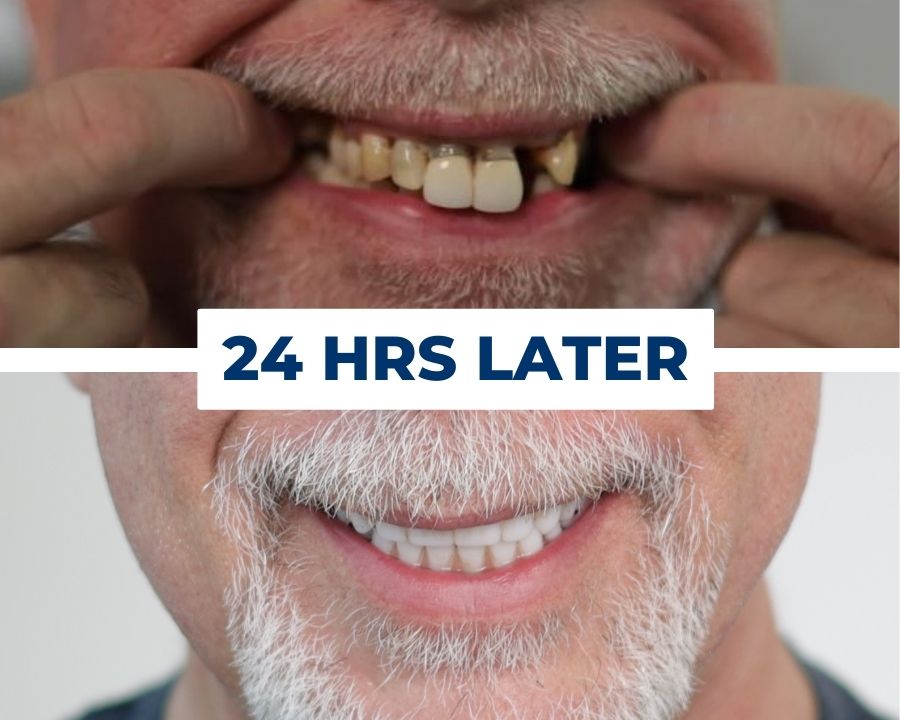
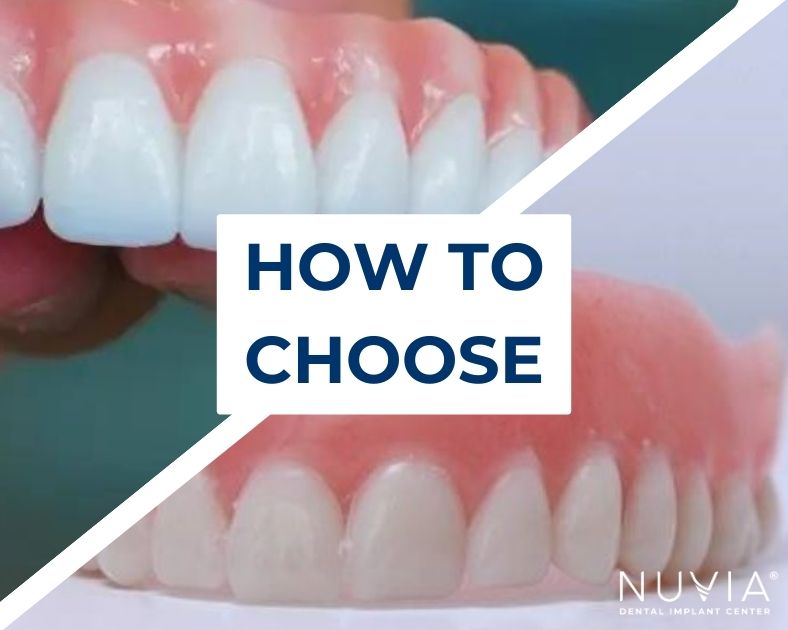
.jpg)
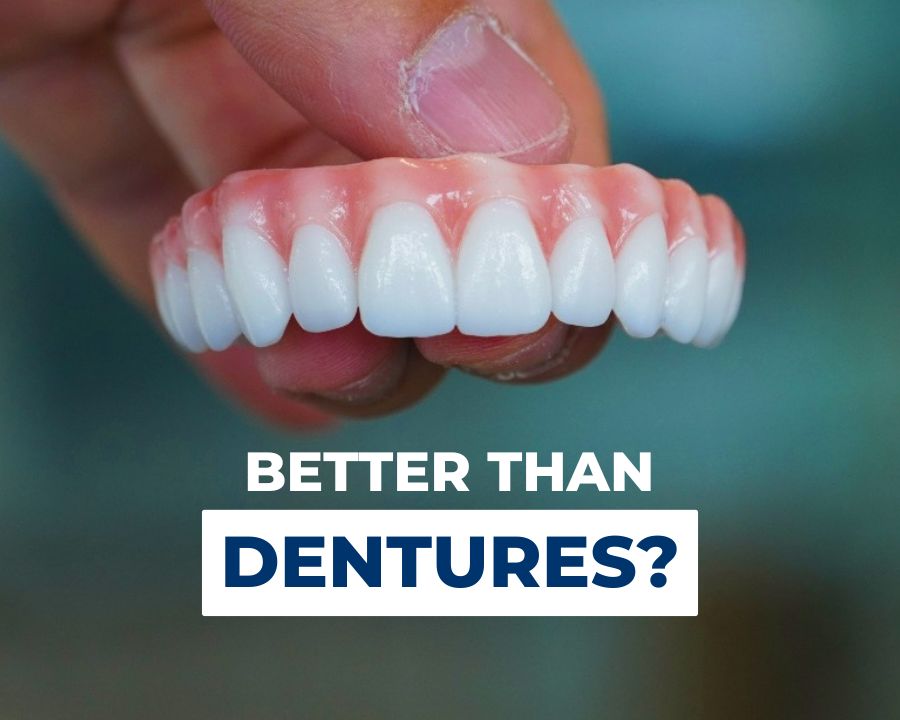
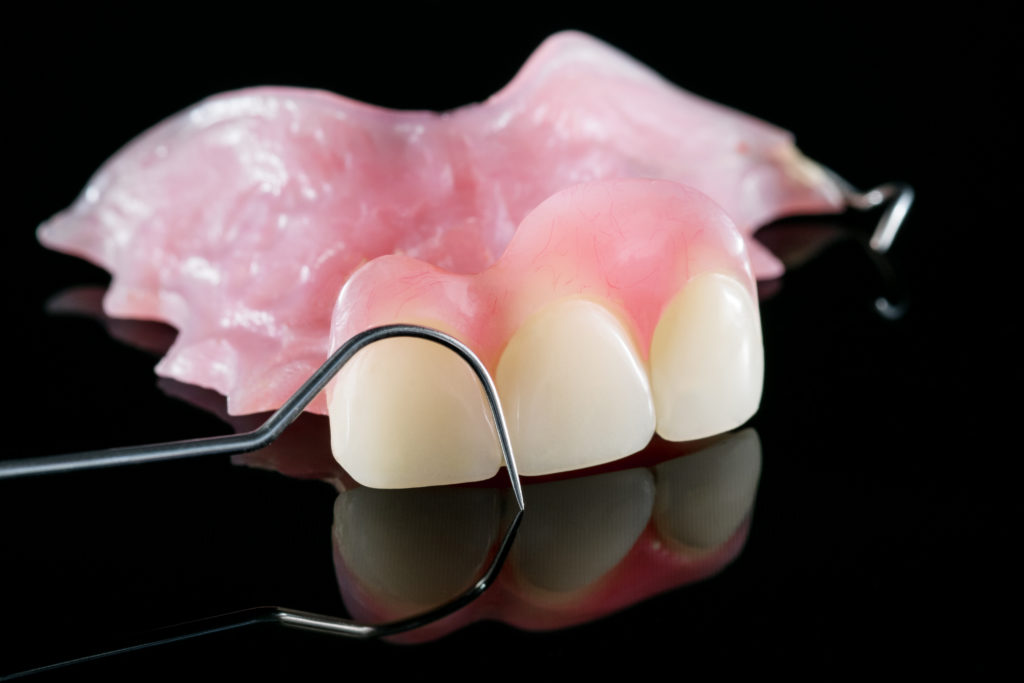

Fill Out The 60-Second Quiz Below


This guide is designed to walk you step by step through the dental implant process and each dental implant type with their associated costs.
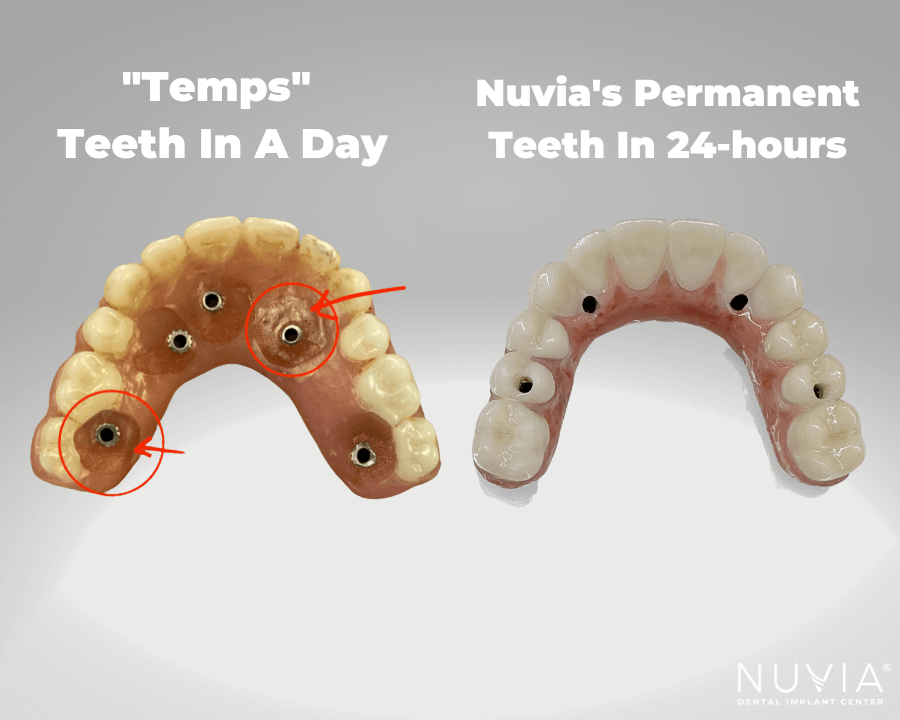
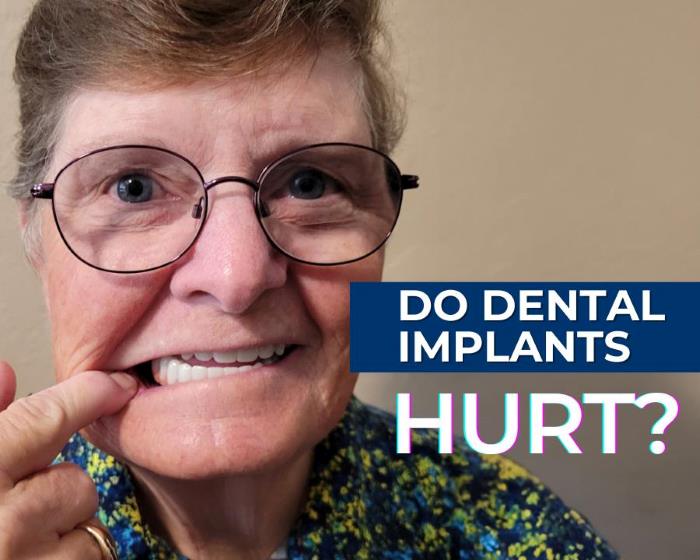
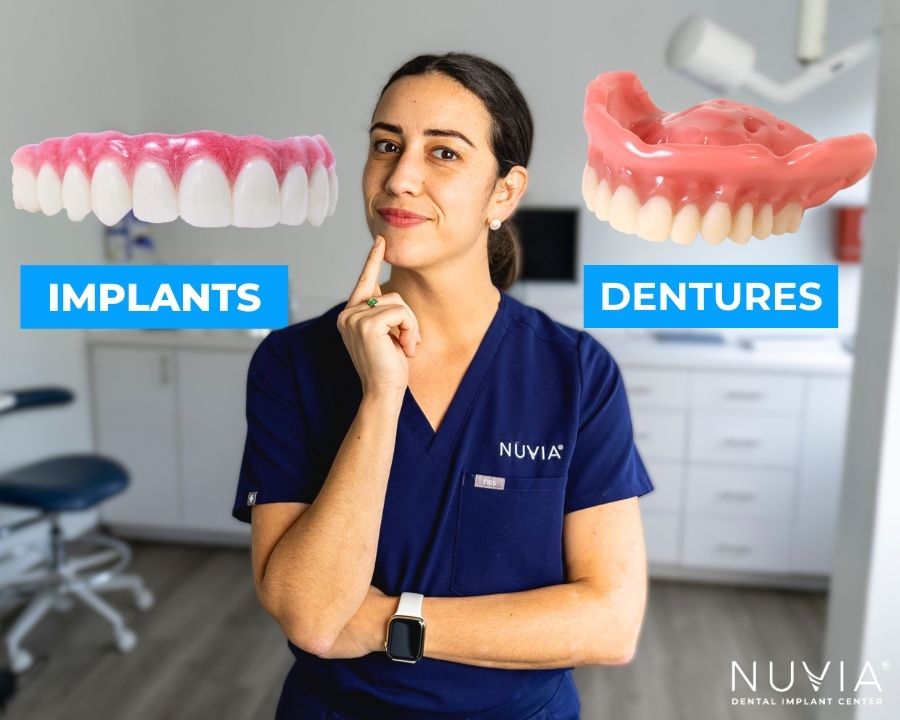
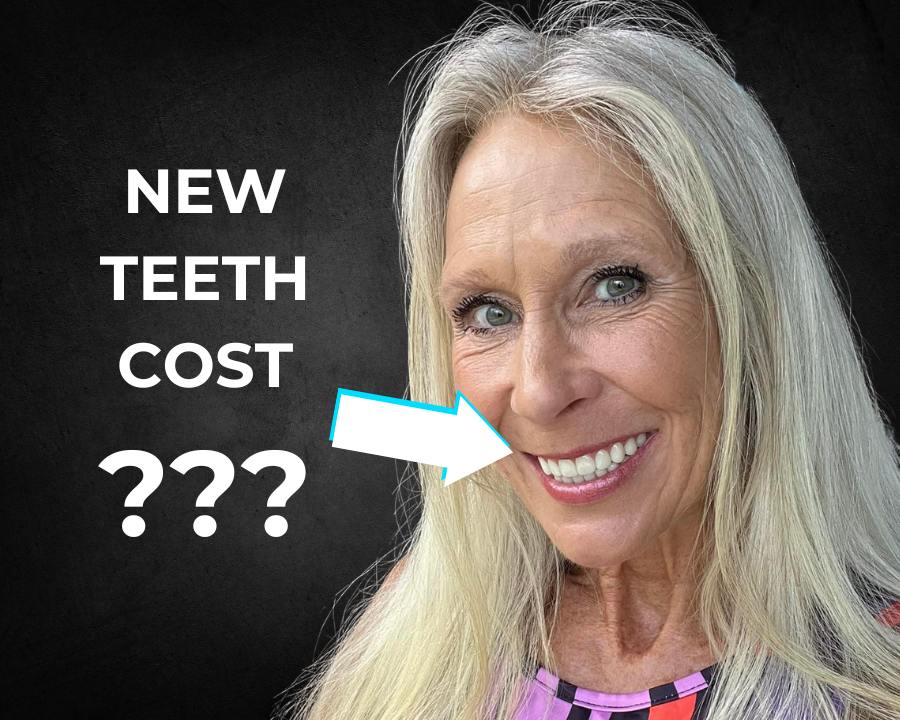
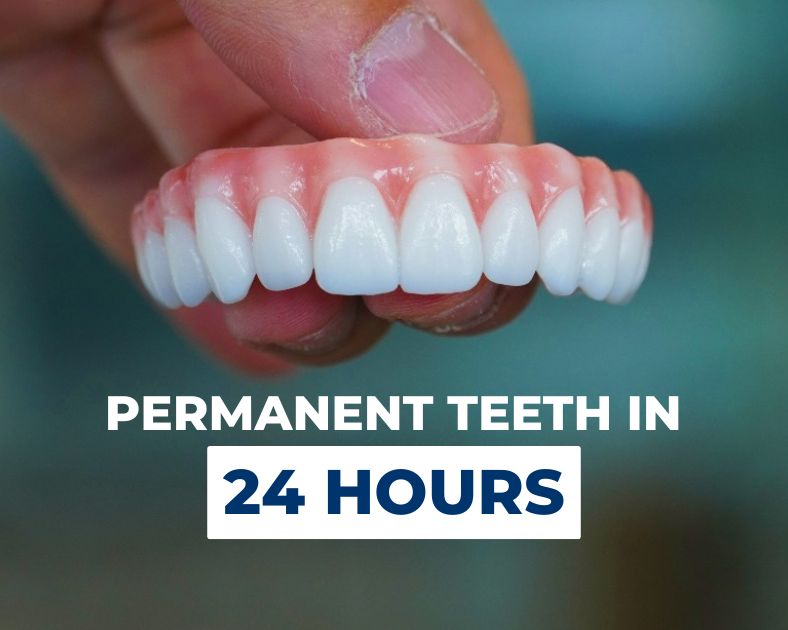
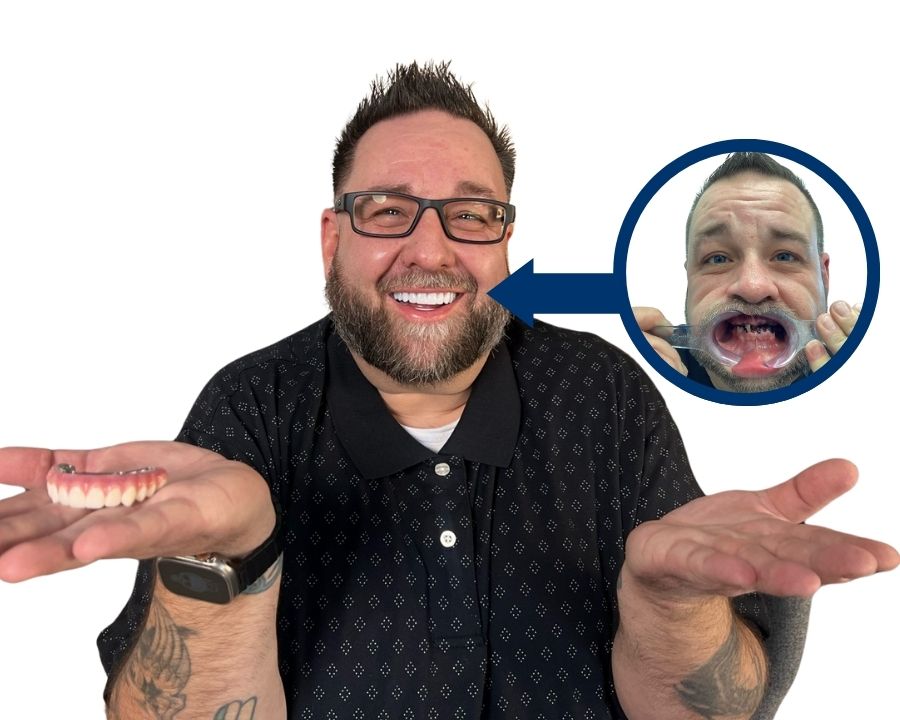
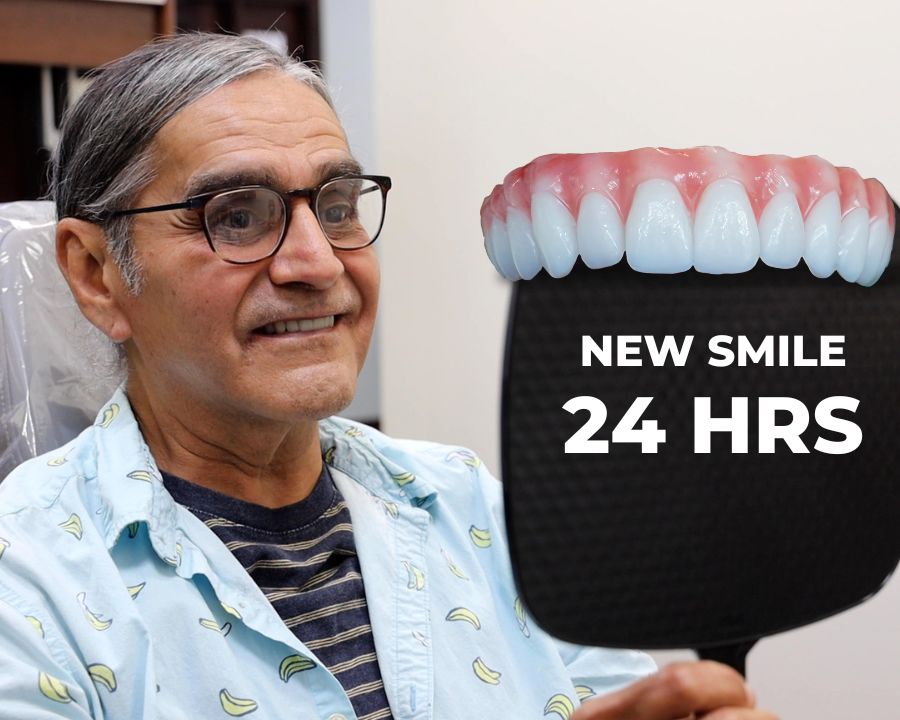
.jpg)