

.jpg)
The most common assumption people make before calling Nuvia is that full-mouth dental implants cost somewhere around $100,000. Some people do the math themselves: a single implant runs $4,500 to $5,000, there are 28 teeth in a full mouth, so the number must be somewhere between $126,000 and $140,000.
That math makes sense. It's also completely wrong — and it's the reason a lot of people never make the call.
Why the single-implant calculation doesn't apply
Full-arch restoration doesn't replace each tooth with its own implant. Instead, four to six implants are placed strategically in the jawbone to support an entire arch. That's the whole arch — every tooth, top or bottom — supported by a fraction of the posts you'd need if you were replacing teeth one at a time.
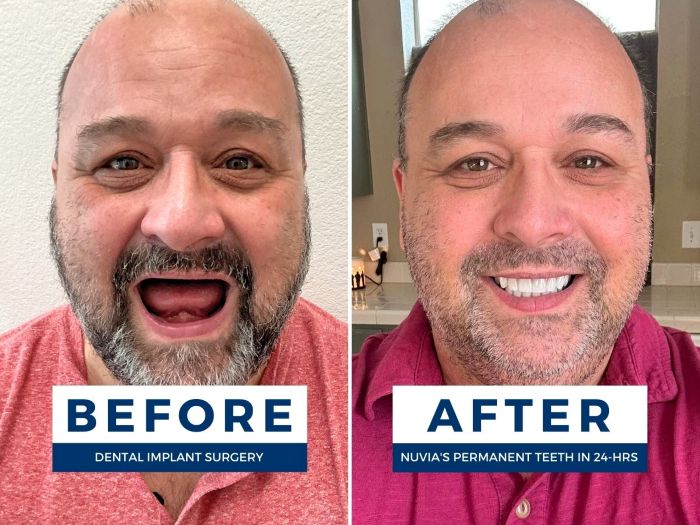
The result is a complete, permanent set of zirconia teeth that don't come out. One surgery, permanent teeth within 24 hours.
Because the architecture is different, the pricing is different. Most Nuvia patients pay between $250 and $900 per month, depending on whether they're restoring one arch or both. That's the number to anchor on — not a lump sum that was calculated using the wrong model entirely.
Read Here for more on Dental Implant Financing
The comparison most people haven't made
Before V got her implants, she asked her dentist to give her a rough estimate of what it would cost to fix everything in her mouth through conventional dentistry — every tooth, every treatment, projected over a lifetime.
Then she compared that number to the cost of full-arch restoration at Nuvia and found that a full mouth restoration would be cheaper. She also commented that there would be no guarantees if she just had a dentist fix everything, one tooth and procedure at a time.
"Even if I paid that total cost on the dentist bill over time, which would be nickel and diming and hidden cost, there would be no guarantee. So even though they did all this work and even though I paid all this money, there's no guarantee that what they did would actually work to save my mouth and my teeth.”
That’s why she ultimately went with the more affordable and permanent option and got her new smile at Nuvia. She wanted a smile she could trust.
Michelle ran the same numbers, except she had years of bills to work from. She read them out loud during her interview:
- Root canal: $600–$1,100 per tooth (premolars run $700–$1,300; molars $1,000–$1,800)
- Crowns: $800–$1,500, or up to $2,500 for all-porcelain
- Bridge work, bone grafts, follow-up visits: not included in those figures
She'd spent $4,500 at a time on single fixes she thought were permanent. Crowns that broke within a year. Root canals on the same tooth more than once. A bridge that was held in with Fixodent because the bone loss had made it too unstable to stay on its own.
When she sat down with her fiancé and mapped out every tooth in her mouth — what it would cost to fix each one through conventional dentistry — the number came out to more than what a new smile with full mouth dental implants would cost.
"I could have easily paid for my implants in one year… I signed up the next day."
This isn't a rare situation. Oftentimes, people just never think to do the math because they're comparing the lump-sum cost of implants to the per-visit cost of a single root canal. The full picture looks different.
Why People Disqualify Themselves Before Even Finding Out If They’re a Candidate (Don’t Make the Same Mistake)
"I thought only the wealthy could truly afford the perfect Hollywood smile."
That's how V put it. Sharala described it differently: "It's always this concern of like, is it going to work out for me? It worked out for others, but is it going to work out for me?"
The belief that dental implants are a luxury for a different income bracket is the single biggest cost myth in this space. It shapes how people search, how they talk themselves out of calling, and how long they wait before finding out what the actual numbers look like.
What many people discover when they get to a consultation is that the monthly payment — spread across a financing plan — lands in a range they can work with. The upfront lump sum felt impossible. The monthly number is a different conversation.
Ninety-two percent of Nuvia patients use financing. The monthly payment is the real number. The lump sum is not what most people should look at.
How Real Patients Actually Made Dental Implants Affordable
Sharala had serious doubts going into her consultation. Once she spoke with a Smile Consultant and learned about the financing options available to her, the math started shifting.
"I don't necessarily have to have this full cost upfront — it is something that I could put into payment plans."
She and her husband sat down and looked at where their money was actually going. Date nights alone were eating more of the budget than they'd realized. They didn't eliminate date nights. They made them less formal. Half of what they'd been spending on one category covered the monthly payment.
“These teeth did enhance our love because that was like an investment in something different, right? Because now I feel like I can do things better and I can be a better wife and show up better as a person, you know, for my husband just because now the confidence that has increased by getting them."
Three years later, she describes getting her dental implants as the best investment she's ever made.

Sharanna was the only one working in her household at the time. She looked at her spending the same way Sharala did — haircuts she could do herself, nails she could skip, fast food in the morning before work that added up faster than she'd thought.
"I knew I was going to make a way so I can make those monthly payments."

V works in healthcare, talks for a living, and couldn't afford a long recovery window. She needed the process to be fast and the cost to be predictable. The 24-hour timeline mattered, but so did knowing the price she was quoted was the price she'd pay.
Two years out, she's been promoted. Her boss noticed the difference in how she showed up in front of people. She credits her smile.
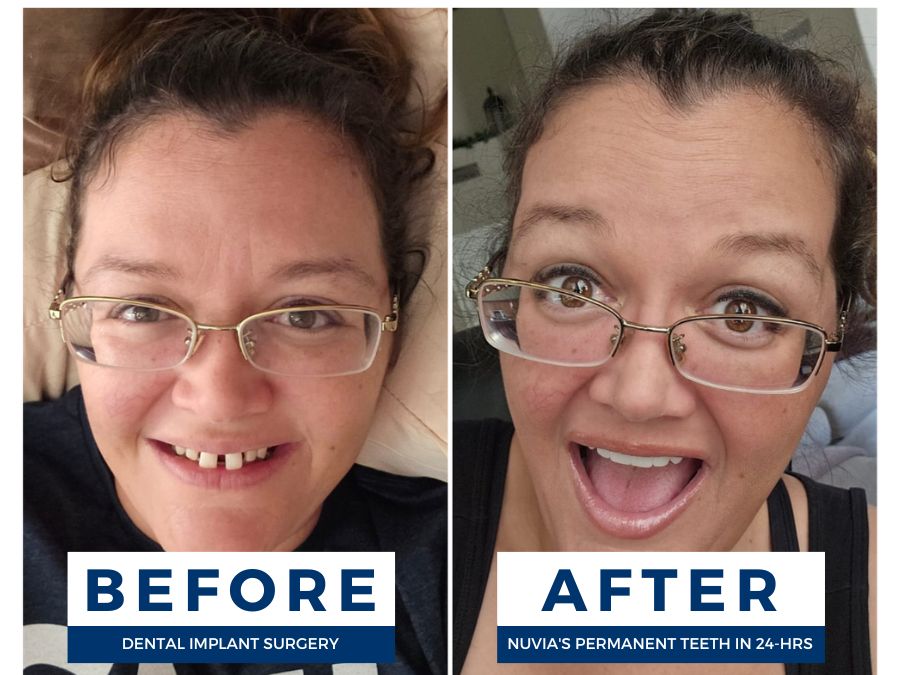
Randy is a medically retired, disabled veteran on a fixed monthly income. He'd spent close to a decade in VA-provided dentures that never worked properly. When he found out that financing was available — including options he hadn't been told about, like having a family member take out the loan while he made the payments — he moved forward.
"I just adjusted my budget," he said. "It's no different than paying my utility bill."
He's lost 90 pounds since getting his implants — not from dieting, but because he can finally chew.
What the price actually includes
One fear patients carry into the process is that the quoted price won't be the real price. Every dentist appointment has ever come with a surprise. Why would this be different?
V expected to be nickel and dimed. She wasn't.
"The quote that I received at my consultation — to the penny — was the amount that I paid out once we were done. There was no extra hidden anything. It was 100% transparent."
That included anesthesia. That included the CT scan, the treatment planning, the surgery, the smile design, the permanent zirconia restoration placed within 24 hours, and the follow-up care. Nothing was an additional cost or a hidden fee.
Michelle, five years out, says the same thing: "What I saw is what I got. Clearly printed out on paper, broken down into Michelle language. It was honest. It was right."
The all-inclusive structure matters specifically because of the history most of these patients had with dentistry before Nuvia. Root canals quoted at one price. Crowns that failed. No warranty. Bills that kept coming. The contrast between that experience and a single, transparent number is part of why patients move forward with confidence rather than hesitation.
The cost of waiting
There's one more number that doesn't appear on any dental bill: the cost of bone loss.
When teeth are lost or extracted, the bone that supported them begins to resorb — shrinking and losing density over time. This process doesn't stop on its own, and it doesn't announce itself. It just makes future treatment more complex, more expensive, and in some cases, eventually impossible.
Every year of patchwork repair on failing teeth is another year of bone loss could be risking the option for permanent restoration. Patients who move forward sooner tend to have more straightforward surgical situations. Patients who wait — because they assume they can't afford it, because they're trying to save up an unrealistic lump sum — sometimes arrive at a point where more complex bone preparation is required.
The cost of waiting isn't always visible on the front end. It often shows up later.
Finding out what it actually costs for you
Cost varies based on whether you're restoring one arch or both, your specific anatomy, and other clinical factors. The best way to get a real number — not a range, not an estimate — is a consultation with a Smile Consultant who can walk through your specific case and the financing options available to you.
The 60-second quiz below is a starting point. It looks at basic candidacy, takes less than a minute, and tells you whether a conversation with Nuvia makes sense before you pick up the phone.
Take the 60-second quiz to see if you may be a candidate →




.jpg)

.jpg)