
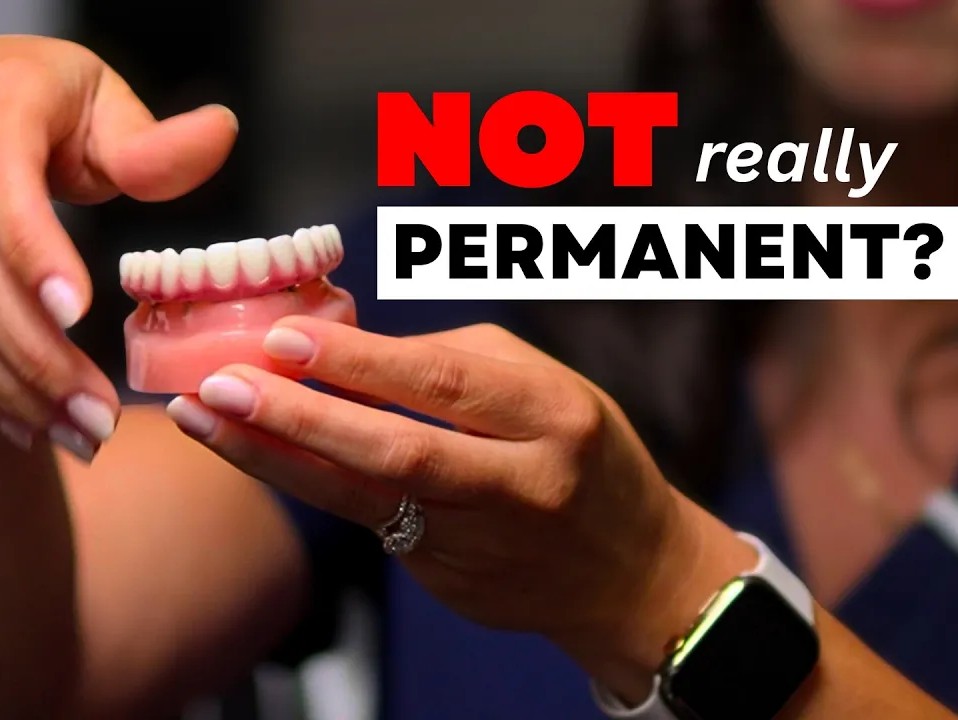
I hear some version of the same thing almost every week: "Is this actually real? How can you have permanent teeth in 24 hours? That sounds impossible."
I get it, I really do. When you've spent years in a cycle of dental work that doesn't hold — root canals, crowns, extractions, and even dentures – the idea of a permanent solution available the day after surgery could sound like something you'd see in an infomercial.
So let me walk you through it the same way I walk every patient through it when they sit down with me for a consultation. Here is what this process actually is, how it works, and what you should genuinely expect.
First, What "Permanent Teeth in 24 Hours" Actually Means
You may have heard the phrase "teeth in a day"® before. I want to address that directly because it's not the same thing as permanent teeth in 24 hours.
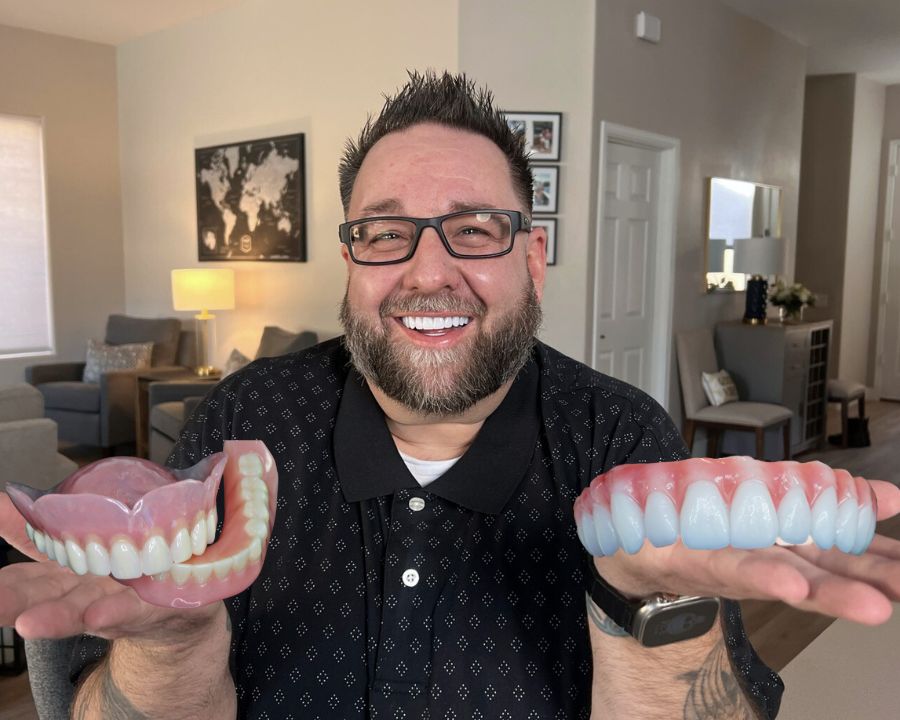
The traditional "teeth in a day"® process uses an acrylic arch. When I say acrylic, I mean the same material used in acrylic nails. It's a plastic that has what's called microflexure, meaning it flexes, or can move, slightly under pressure.
That flex (or movement) can be a serious problem during healing. When a healing implant experiences any movement at all, it can interfere with osseointegration (when your bone fuses to the dental implants). Movement is one of the ways implants fail.
Before I joined Nuvia, I practiced the traditional approach of temporary teeth, or “teeth in a day”® for years. I watched those acrylic arches fracture from time to time and I saw breakage during the healing period. I saw what that did to patients who had already been through so much to get to that point.
At Nuvia, your permanent set of teeth is created the night you have your implants placed and 24 hours later, are put in your mouth. And, they’re made from zirconia, which is virtually indestructible.
I’ve never heard of microflexure happening with a set of Nuvia teeth. For patients who follow aftercare instructions, their implants don’t move during healing. The rigidity of the material is actually what allows the implants to heal the way they should.
When I switched to this process, I saw the difference right away. Lower failure rates, less breakage, better outcomes. I was a convert from day one.
"But How Do You Know the Implants Are Actually Working If You Put the Teeth on Right Away?"
This is a really good question.
What's happening underneath your new teeth during the months after surgery is osseointegration — your bone is growing around and fusing to each implant. The teeth sit on top of that process; it doesn't interrupt it, because of how rigid the material is.
At the four-month mark, we bring you back in and remove the teeth entirely. Then we individually test each implant to confirm it has integrated successfully. Our success rate at that point is {{success_rate}}.
In the rare cases where an implant hasn't integrated the way we want, we catch it early enough to do something about it at no additional cost. Patients have follow up visits to check on things, and can always call into the office and come in if something doesn’t feel right. We want this to work long-term, and we stand behind it.
I always warn patients beforehand that when we take the teeth out at that four-month appointment, they're going to feel strange. And every single time, that's exactly what happens. They look at me and say, "Where are my teeth? I need them back. They feel like me now."
"What If I End Up With a Lisp?"
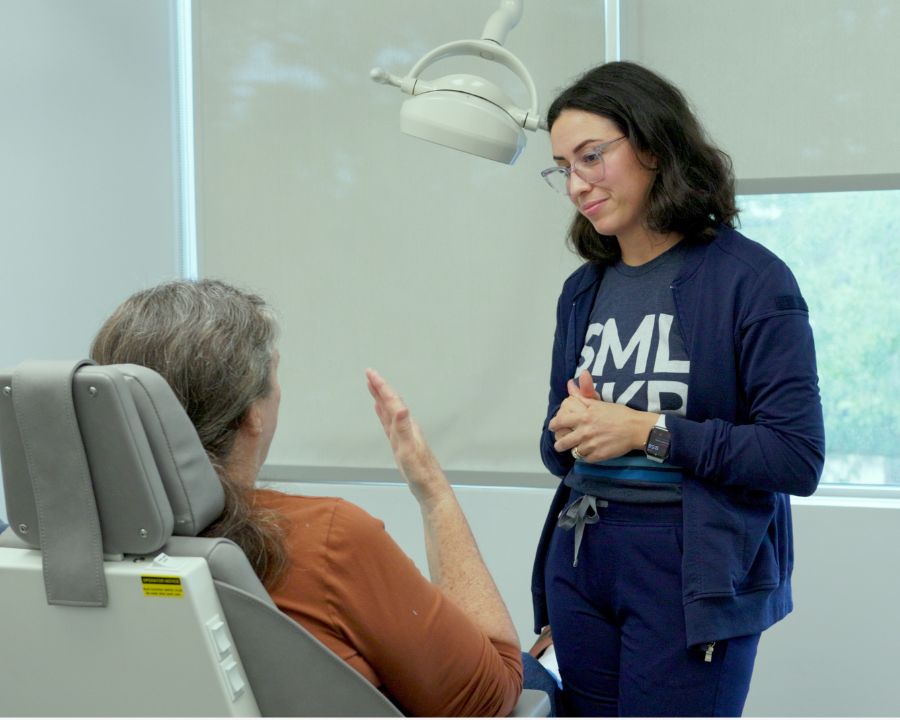
I want to be honest with you: your speech may feel different for a while after getting your new teeth. Here's the analogy I use.
Think about someone who has a leg amputated and receives a prosthetic. They have to relearn how to walk, stand, and sit — movements they've done their entire life — because the physical environment has changed. Their muscles need time to adapt to the new reality.
Your mouth works the same way. Your tongue, lips, and cheeks are all muscle. When you introduce something new into that environment — even a retainer or Invisalign — those muscles go through an adjustment period. With practice and repetition, speech returns to normal. For some patients, especially those who had significant tooth loss or jagged teeth before, speech actually improves from where it was.
If you do notice a difference in how you sound, remember, it’s not permanent, and it's something we can work through with you.
More on what to expect during the healing process here.
What About TMJ or Jaw Pain?
For the overwhelming majority of patients, TMJ or prolonged jaw pain isn't a problem. When your new set of teeth is properly designed, everything functions the way it should.
That said, any time the proportions or orientation of the jaw shift, there can be an adjustment period. If you experience jaw discomfort, the most common fix is a simple bite adjustment we make in the office. If you grind or clench at night and aren't wearing a night guard, that can also play a role.
Almost every time jaw discomfort comes up, we can identify the cause and address it directly.
Are the Teeth Made Specifically for My Mouth?
Nuvia teeth certainly aren’t one size fits all. Each set of teeth is designed specific to each patient.
We take digital scans, and a full series of measurements specific to you. The design process starts that day.
By the time you come in for surgery, we're roughly 80% of the way through the design. That's a big part of what makes the 24-hour timeline work — the preparation and customization happen before surgery.
Then, once the surgery is completed and we take some additional measurements, Nuvia’s in-house lab gets started. This way, when you wake up the next morning, your smile has already been created specific to your anatomy, and your bite.
.jpg)
How Long Has Nuvia Actually Been Doing Permanent Teeth in 24 Hours?
When patients ask how they can trust a process that sounds new, my answer is this: it isn't new.
Nuvia has been developing and refining this process for over ten years, with significant investment in research and development to improve every part of it — from materials to technique. I've been with Nuvia since 2023, and I'm still seeing updates and improvements regularly. We're never done refining.
Not to mention, Nuvia holds an A+ rating with the Better Business Bureau and has been named Dental Implant Restorations Company of the Year by Healthcare Business Review three years in a row.
.jpg)
Are You a Candidate For This?
Not everyone is — and I want to be straightforward about that. Candidacy depends on bone density, overall health, and other factors that need to be evaluated individually.
The best starting point is to take the 60-second quiz. It's quick, it's free, and it gives you a real sense of whether permanent teeth in 24 hours could be an option for you before you commit to anything. If you've been living with failing teeth or a smile you've been hiding, you deserve to know whether there's a permanent answer.
That's what the quiz is for.




.jpg)

.jpg)