This website uses cookies to ensure the best experience on our website.
We may share your information with our advertising and analytics partners as outlined in our
Privacy Policy.
If you've been researching full-mouth dental implants, you may have come across the term "3 on 6." It's an approach that's been gaining attention — partly because it's marketed as a more natural-looking alternative to the well-known All-on-4® method, and partly because it's been backed by providers offering it as a branded treatment.
This article explains exactly what 3 on 6 is, where it came from, and why most experienced providers — including Nuvia — offer All-on-4/All-on-X® as the preferred solution for patients needing a complete set of permanent teeth.
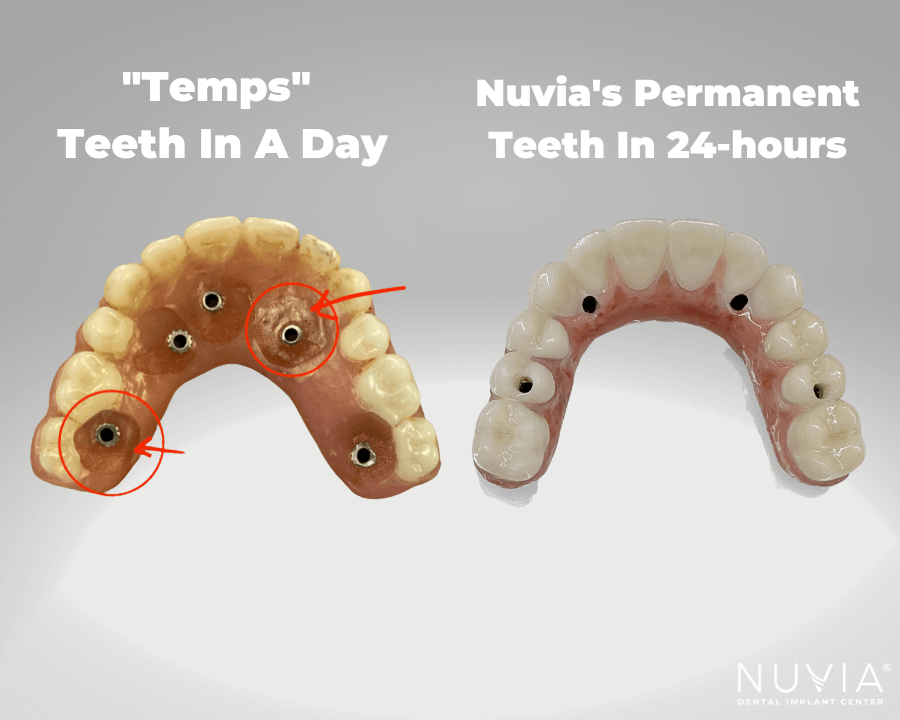
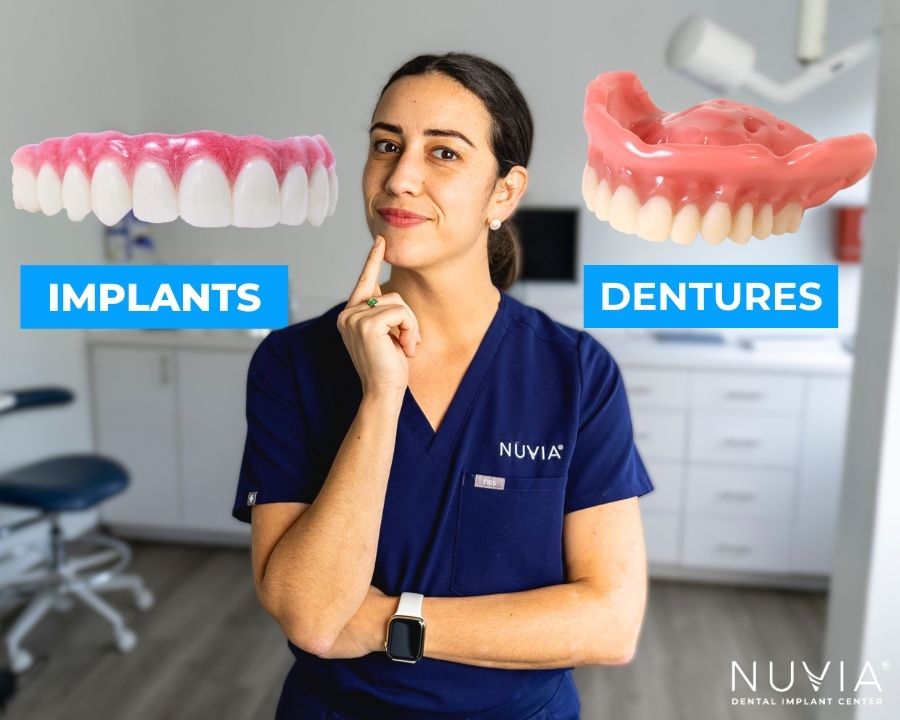
So when it comes to fixed solutions, we are looking at a couple of different options. One of the options that's not pictured here, but I do have an example of, is called three on six. So I'll walk you through kind of the levels of restorative options. Okay? So this is what I would call an f p, fixed partial, one. Okay? Three on six. So that means three bridges on six implants. Okay. Okay? This option only replaces white tooth structure, not gum. So case selection is super important. You need to have enough gum tissue and enough bone height to be able to mimic what natural tooth size is going to look like in your mouth. What do I mean by that? If your bone level is up here and you've had a lot of resorption over the years, these teeth are not gonna look like that. Yeah. They are going to look like horse teeth. Okay? And also, the timeline for a three on six is very different than from an all on four or all on six. Because if you have an experienced provider who actually wants to help make this look like a natural restoration, they're gonna take the time to shape the gum tissue. That means several rounds of temporaries that expand the gum tissue to house all of these pontics. Remember we talked about the pontics? To house all of these pontics and scallop around them in the way that normal normal gum tissue would. A pro is if this is done correctly, case selection, both the patient and the doctor are willing to put in the time to properly shape the gums and the bone is stable enough to hold this setup, it can look very natural. It does, however, pose an interesting situation when it comes to cleaning because you think about the gum tissue, let's say it's right around all of these. You need to clean around all of these individual anatomies. Right? So when you are flossing, you are going up and down over them and in between all of these implants in order to make sure that you're not accumulating any plaque or bacteria underneath there that can cause inflammation to the gums. Additionally, over time, your gums starts to pull back if it's not properly stimulated. So another thing that these patients may or may not notice, depending on the design of the actual teeth, is the black triangle. So when the gum pulls back and you have kind of a hole in between Right. You may or may not have seen that, like, with, you know, in in your own life or with someone in your life. So you'll be able to kinda see through, and then it'll stop looking natural in the long term. Okay? So case selection is super important for an f p one. An f p two, fixed partial two, is similar to an f p one, except that it also replaces some of the gum level. So let's say we've got our teeth here. An FP two is going to replace some of the gum level. Okay? The amount of implants in an FP two can vary dramatically. Like, you can have some of setup like this or you can have more of an all on x type setup. I don't know many people who would be a great candidate for this because when you smile, if you show any level of gum, your smile is going to show where that transition line is between the the fake gum and your natural gum. And so, I guess if you have a smile that's like this, you could consider something like that. But again, it can pose difficulty for cleaning because you're still dealing with a lot of anatomy there. Okay. Okay? An FP three, fixed partials three, is going to be something like an all on four or all on x restoration. Okay? So this here shows all on four. Meaning, all of the teeth are anchored to four implants in the bone. Okay? Sometimes you'll see all on six or all on five. It really depends on the patient's anatomy and bone structure. So if someone has a really large arch, you may see more implants placed there because the goal is from the front to the back, like the front most implants to the back most implants, you wanna have good spread. What that's going to offer is great stability when the patient is chewing. Great stability for the implants because implants are wonderful devices for withstanding vertical forces. But once you start applying shearing forces to them where they're having to put pressure against that, you know, bone that's been integrated into them, in the long term, they might fail. So, yeah, that's kind of a little bit of theory behind that. But again, one of the big advantages here is when you're looking at the surfaces that you're cleaning, we go we start with f p one, all of this anatomy. We get all the way to f p three. It's flat surfaces that you're cleaning in between the implants. So in my opinion, the hygiene is a lot easier to maintain. Okay. Okay. So in talking about FP threes, let's look at the different options that are available to us. So let's talk about this that you have here. This is a temporary full arch. Okay? So when you hear things like teeth in a day or same day teeth or, you know, full arch options like that, this is usually what they're referring to. So once the surgery occurs and the implants are placed into the bone, they will put cylinders onto those abutments, right? Abutments. Okay. And then they'll take a denture like this that has been hollowed out in the middle, and they will attach this set of teeth to that using flowable acrylic. Okay? So that's why you see these different colors here. Remember that spread I was talking to you about from front to back? This particular case is a tough one because this spread is not not ideal. But but yeah. So so a patient will be sent home with something like this. Pros, it's done the same day in the chair. Cons, This technique was created in the nineties and was revolutionary when it was. One of the big problems with this is this acrylic and all of these margins that are in between the new acrylic and the, you know, the acrylic that's native to the denture, they are bacteria traps, food traps. And so it becomes really difficult to keep this area clean. It absorbs and attracts bacteria and plaque into its pores. So even if you have the ability to brush it out of your mouth, it's still going to be a trap for for bacteria. Now the implant survival rate for a temporary solution like this is not bad. I mean, it's somewhere between ninety to ninety five percent. But things that can complicate it are the microflexure that exists in something that's acrylic. Like we talked about, over the healing period, implants are integrating with your body. That process is called osseointegration. It is a delicate process. Your body's creating this new bone cell by cell. If anything interrupts that process, implant won't integrate, it will fail. What I had seen personally in my practice prior to my Nubia days is these can fracture at a pretty high rate. I was repairing things often in order for the patient to be able to just get through the healing period. After they're done with the healing period and these temporaries, then we start taking impressions and doing a wax try in, and it's several visits for the patient, and several months, it can be anywhere between six to eight, ten months even, depending on the kind of procedure that needs to be done for the patient, until you get your final teeth. Okay. Okay? And in between, between this very old method and the, I would say, most cutting edge method, is it'll still be same day, but as soon as the surgery is done, the restorative doctor will come in, take a series of impressions. Sometimes that will involve attaching something similar to this to the implants and then breaking it off. That can have a pretty negative impact on the survivability of the implants because when the surgeon places the implants into the bone, he or she is gonna be measuring how stable those implants are via torque value. It's important that we measure the individual torques of all of the implants as well as the cumulative torque in the whole arch. Okay? There's a minimum threshold that we wanna hit that will give us the green light to, you know, actually load it or screw the teeth in without compromising or risking the implants in the long term. And so if you're putting something on there and ripping it off or you're, really manipulating them a lot, it can compromise their survivability for sure. But in that model that I'm talking about, they'll take those teeth and then mill something out of a similar material, a temporary material that's not reinforced with metal, And then they'll screw that in later in the day. It is same day teeth but still a temporary version because several months later you're coming in and starting that whole process of a new prosthetic. Okay? With any prosthetic in the mouth, there's always a risk of a change in speech, difficulty chewing or closing your mouth in the proper bite, or just it feeling weird. I like to compare any of these to an amputee getting prosthetic legs. Right? That patient is relearning how to walk, sit, stand. These patients with these oral prosthetics are relearning how to speak, chew, swallow. If you're doing that with a temporary set and then several months later, you're starting from scratch with the final set. Right? So it it is it's multiple steps until you get to the place where you're like, okay. I feel good about this. Right. Okay? Now at Nuvia, we do something a little bit different. We actually deliver the final permanent restoration twenty four hours later from the surgery date. Like the final set? The final set. The set that is intentioned to actually last you a lifetime. Okay? So these teeth are often made from zirconia or a ceramic that's harder than metal. There are certain circumstances where we'll use a different material called g cam. The beauty of having these two options as final restorations is it gives us flexibility on what's best for the patient. Right? So if we're doing a single arch, like, let's say just the upper teeth and not the lower teeth, and the patient has natural teeth on the bottom, GCAM is oftentimes a great fit because it's more similar to the hardness of natural teeth. So we like placing like on like so nothing is damaging each other. Right? When you're doing the full mouth, so, you know, upper arch over lower arch, or if you're doing a single arch and you have crowns or other ceramic work on the bottom, 24Z might be a great fit for you because it's not at risk of grinding away or deteriorating anything that is softer than it, okay? The way this works is a patient will come in for their evaluation. We, as restorative doctors, will take a ton of measurements, we'll take digital imagery. We combine all of that into the design process, and then the next visit is surgery day. The patient will come in, be put comfortably to sleep, and we will be taking our measurements after the surgery to fine tune our design that we already started. The lab works tirelessly overnight, and the next day, the patient has their final permanent restoration. What does this mean? You don't have to get used to multiple different sets Right. And retrain your mouth, your tongue, your lips to to something new over and over and over again. The tongue is a muscle. As with any muscle in the body, if you wanna train to do something new, it doesn't happen overnight. But having the ability to start from start from zero and get to the finish line in one go is really valuable to the patients. The other thing that is really of note in the ability to deliver the final teeth the next day is the strength offered here. In my experience, it's actually really helpful to the healing of the implants, right? So we talked about that osseointegration, right? We're already experts there. We're already experts there, right? Osseointegration. What happens is when there is microflexure or breakage of a temporary, the implants get impacted, of course. When you have this super resilient cross arch stability from the beginning, they're not getting forces applied to them that could be negative in the long term, right? So that leads to my next point here, which is our success rate in comparison to the national average. At Nuvia, our success rate is actually over ninety nine percent when it comes to implants. Wow. And I attribute that to this super rigid cross arch stability that's given from the beginning. So, you know, everyone has different options, but from my experience, you know, in having treated literally thousands of these, I've seen really great success with this kind of option for patients who are wanting to get dental implants and find a solution that is going to presumably last a lifetime. Can I actually test those out, see how strong they are? Oh, absolutely, my dear. You know, we've run over them with a literal car before. Oh my gosh. Yeah. That's actually crazy. Yeah. So how much would something like this cost in comparison to some other stuff we talked about? That's a great question. So once you start getting into this range, the cost varies dramatically. I've seen studies that have said that an average person is going to spend somewhere around ninety seven thousand dollars on their teeth in their lifetime. Wow. Whether you choose any of these options. Okay. Replacing these over and over again, you know, getting individual crowns, like patchwork all over your mouth, or getting full mouth of dental implants. The cost of Nubia's in particular is certainly well below the national average, which is great. But for more details on the actual pricing, Nubia's created a cost guide that actually breaks everything down and answers so many questions that we've heard over the years of this treatment, and that is available in a link in the description. So hopefully that's really helpful for you. Awesome. So what you're saying is you could either be replacing stuff over time, or you could go ahead and go with a permanent solution and then Correct. This is certainly much more of a one and done type scenario, and so, you know, I see this often. Patients come to me and I look at their x rays, and I'm like, man, you've been living at the dentist your whole life. They're tired of going back and forth. They want something that is going to last them, and that they know, you know, the investment I'm putting in here, I'm not gonna be continuing to take care of like one fee here, one fee here, a single crown here. That's what I'm doing for myself, for my health, for my longevity, and my my functionality. And so it is a really, really great option for people who are candidates. Awesome. And as I mentioned before, not everyone is a candidate for dental implants, but an easy way to kind of take one step and find out if you could be a candidate is to take our sixty second quiz. We can also link that in the description, so if you're interested in finding out more, definitely check that out.
What are 3 on 6 dental implants?
The name tells you the structure: three dental bridges supported by six implants. Each arch — upper or lower — is divided into three separate sections, and each section has its own bridge anchored by two implants.
The result is a full set of fixed, non-removable teeth. Unlike traditional dentures, there's no adhesive or suction involved. Unlike snap-on dentures, you can't take them out. The bridges are screwed into the implants and stay in place.
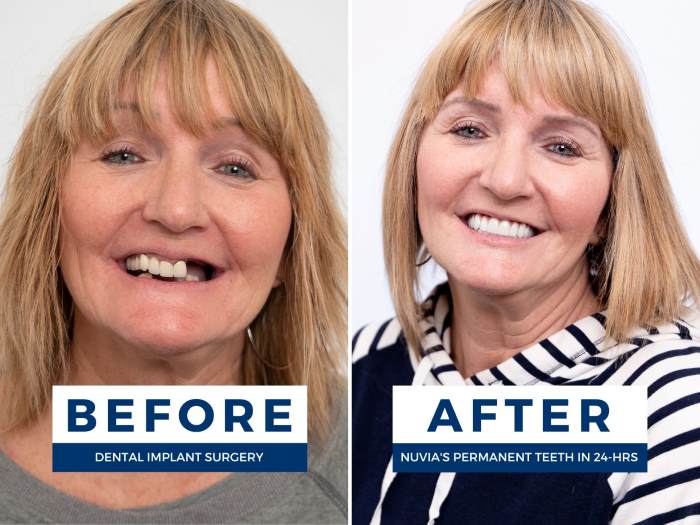
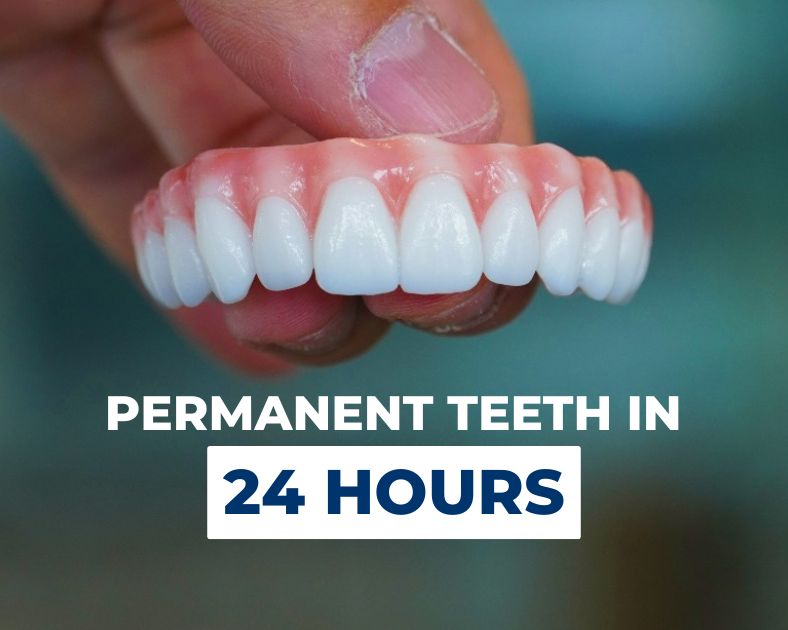
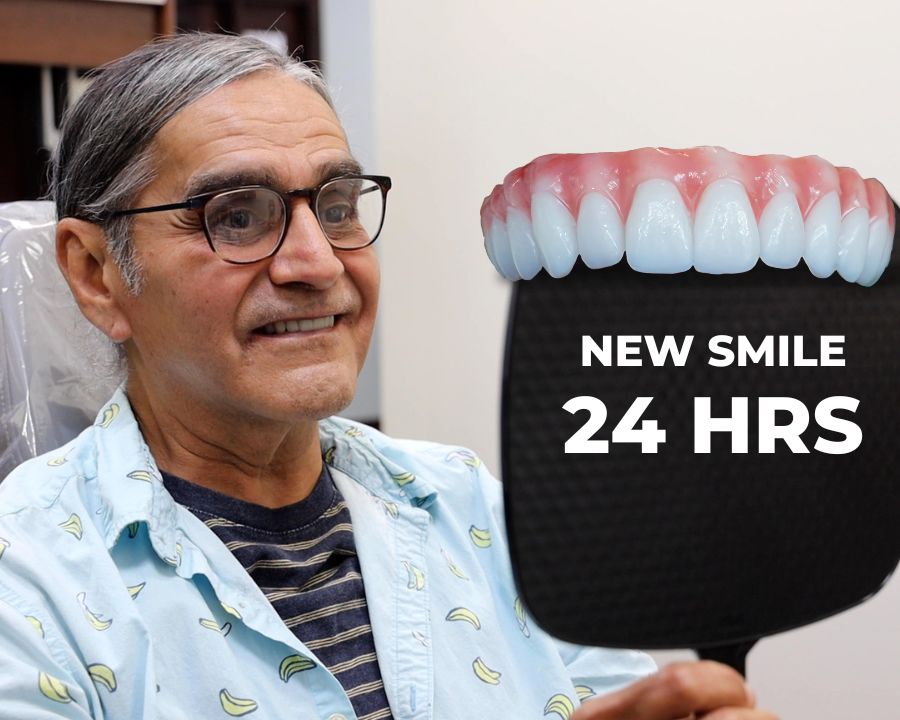
One feature that 3 on 6 advocates highlight is aesthetics: because the three bridges sit directly against the patient's own gums (rather than having a gum-colored acrylic layer), the result can look very much like natural teeth at the gum line, the same way Nuvia’s permanent teeth in 24 hours is designed to.
How is 3 on 6 different from All-on-4® or All-on-X?
The key difference is architecture. All-on-4® (and its variations — All-on-6, All-on-8, All-on-X) uses a single, continuous full-arch set of teeth supported by four or more implants. Everything is connected across the entire arch in one piece.
3 on 6 uses three separate bridge segments rather than one unified arch. Think of it as the difference between a single long bridge and three shorter ones built side by side.
That structural distinction matters more than it might seem at first glance.
3-on-6
All-on-4/X®
Implants per arch
6
4–10 (typically 4)
Prosthetic (teeth) design
3 separate bridges
1 full-arch
Cross-arch stabilization
No
Yes
Artificial gum material
No
Typically yes
Treatment timeline
Up to 10+ months
24 hours (at Nuvia), up to 10 months elsewhere
Bone requirement
Higher
Lower (angled implants accommodate bone loss)
Candidacy
Narrower
Broader
Why 3 on 6 was developed and what it was trying to solve
3 on 6 was developed as a response to one of the most common patient concerns about full-arch implants: the appearance of the gum line.
Traditional All-on-4® prosthetics include a band of pink acrylic material that replaces missing gum tissue. For patients with significant bone and gum recession — which is common after years of tooth loss — that gum-colored material serves a real function: it closes the gap between where the prosthetic teeth sit and where the actual gum line is.
Some patients dislike the look of that acrylic gum section, particularly when they smile. The 3 on 6 design, which sits directly on the patient's own gums without a gum-colored extension, was created to address that concern.
That's a legitimate goal. The question is what you give up to get there and whether or not this would be an issue for you in the first place.
The trade-off that most providers consider a dealbreaker
When an arch is divided into three separate bridges, each bridge carries its load independently. There is no cross-arch connection — no shared support structure that distributes forces across the entire jaw.
Each bridge is held by two implants. And this is where the design has some flaws.
If one of those two implants fails, the entire bridge it supports is lost. Not just the implant — the section of teeth it was anchoring. You're left with a missing segment of your arch and, assuming there's still enough bone for a replacement implant, you go through surgery all over again.
This isn't a theoretical risk. The back, upper jaw — where two of the three bridges typically anchor — relies on some of the weakest bone in the mouth, while also bearing the heaviest chewing forces. Two implants supporting that section, in that bone, under that load, have the potential for failure.
By contrast, a full-arch set of teeth is stabilized all across the arch. All the implants work together. If one fails, the bridge can be unscrewed, the failed implant removed and replaced, and the bridge reattached. The other implants continue to provide support throughout. It's not a catastrophe — it's a repair.
Why most patients aren't good candidates for 3 on 6 to begin with
There's another practical problem with 3 on 6: who it actually works for.
The procedure requires healthy bone levels, good bone density, and the right jaw anatomy across all six implant sites. Patients who have had significant bone loss — which is extremely common in people who've had failing teeth or been in dentures for years — may not meet those requirements.
Because 3 on 6 replaces only white tooth structure — no gum-colored material fills the space between the restoration and the gumline — the results depend on having enough gum height and shape to look natural. This can sometimes be achieved over time if you have enough bone and gum and your provider is willing to work with you on the shape.
Case selection for 3 on 6 isn't just about whether implants can be placed — it's about whether the final result will actually look natural.
All-on-4® was specifically engineered around the opposite problem. By using angled implants that are designed to make the most of whatever bone you have, it was designed to work for patients who have bone loss. That's honestly a good portion of the patients who need full-arch restoration.
The cleaning and long-term maintenance challenge of 3 on 6 dental implants
Keeping 3 on 6 clean takes real work. You have to floss around every single implant and under every bridge section — every day. Miss it, and bacteria builds up, which can hurt your gums and your implants.
There's also a long-term problem: gums tend to pull back over time. When that happens, small gaps open up between the bridge sections. Dentists call these black triangles. For a procedure that's supposed to look natural, that's a big downside.
Nuvia's full-arch teeth are much easier to care for. The surface is smooth and flat — just a water flosser and a toothbrush. And because the restoration covers the gumline, there are no gaps that show up later.
Why Nuvia offers All-on-4/All-on-X® — not 3 on 6
Nuvia's approach to full-arch restoration is the All-on-4® method, using titanium implants and a full-arch zirconia set of teeth. The decision to offer this rather than 3 on 6 comes down to what serves the most patients, most reliably, over the long term.
The vast majority of people who need full-arch restoration have some degree of bone loss. All-on-4/X® was built for them. The procedure is backed by decades of clinical research, with long-term outcome data that the 3 on 6 approach — being newer and with a narrower patient base — simply doesn't have at the same scale.
The stabilization that comes from a single set of teeth is also typically more forgiving. It spreads bite force across implants. It allows for easy access if something needs to be addressed down the line. And it doesn't rely on the most structurally vulnerable areas of the jaw to bear the heaviest loads by themselves.
On aesthetics — the original selling point of 3 on 6 — modern full-arch restorations can be made with highly natural-looking results. The conversation about aesthetics is one best had at a consultation, where your specific anatomy, bone levels, and gum tissue can be evaluated directly.
Find Out If You May Be Eligible For Permanent Teeth in 24 Hrs.
Fill Out The 60-Second Quiz Below
By proceeding you agree to our Terms and Conditions and confirm you have read and understand our Privacy Policy, and you consent to receive emails, texts and calls from Nuvia regarding your inquiry (even if you are on a Do Not Call Registry). Message and data rates may apply. You may opt out at any time by replying STOP.
FAQs
Frequently asked questions about 3 on 6 dental implants
Lucy Steckler manages the website at Nuvia Dental Implant Center. Having spent over a year being involved in dental content creation, she finds purpose in helping individuals find answers to their dental implant questions and learn more about the benefits of permanent teeth in 24 hours.



.jpg)


.jpg)
.jpg)