
This website uses cookies to ensure the best experience on our website. We may share your information with our advertising and analytics partners as outlined in our Privacy Policy.
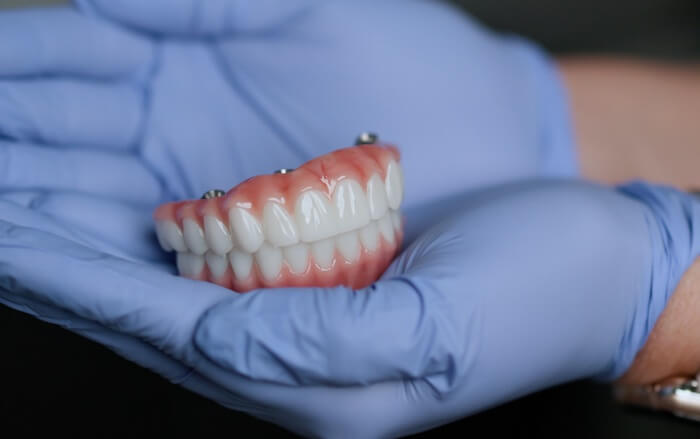
When multiple teeth are failing, replacing them one at a time can turn into years of crowns, root canals, extractions, and temporary solutions that never fully solve the problem. Full mouth dental implants replace failing teeth all at once with a fixed, permanent solution designed to restore your smile, bite, and long-term oral health.
These patients skipped years of temporary dental work and chose full mouth dental implants as a one-time solution for failing or missing teeth. Here’s what that was like for them.
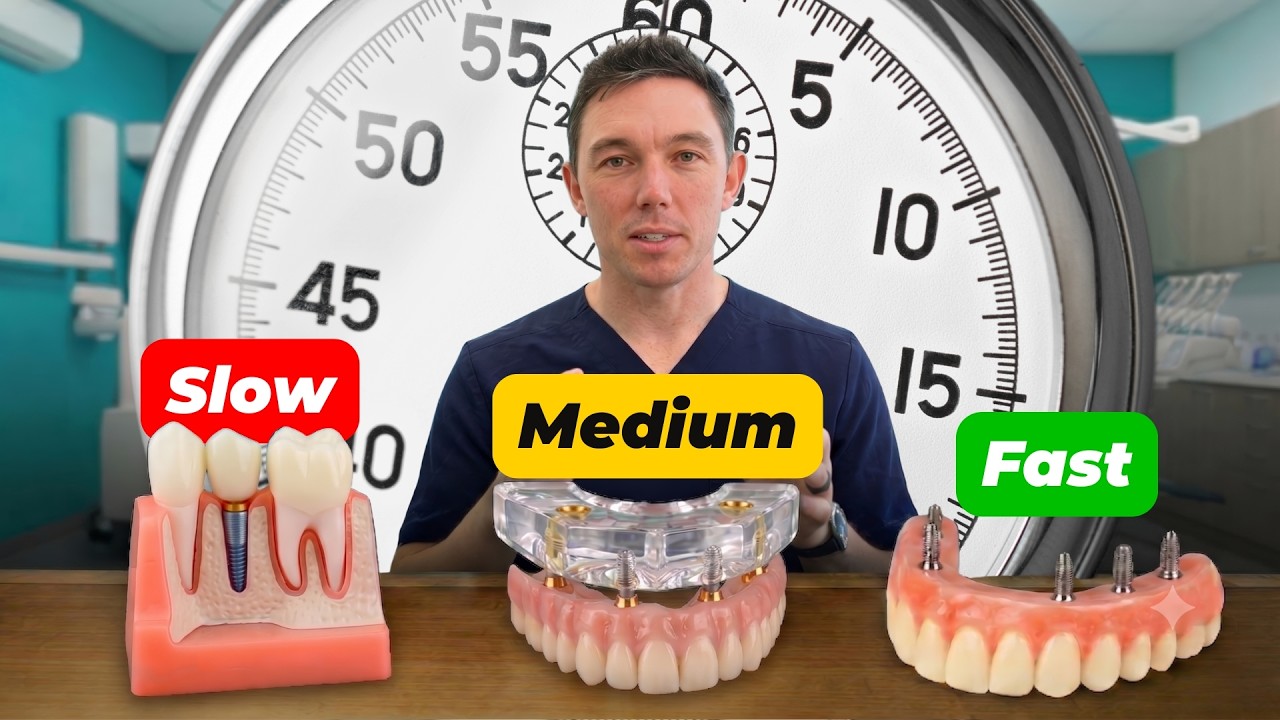
Choosing how to replace missing teeth can be really overwhelming. So let's clearly break down the differences so you know what's best for you. Starting with option number one, dentures. Dentures are removable prosthetic teeth that are usually made from acrylic and sit right on top of the gums. On the upper denture, the appliance usually covers the entire roof of the mouth so it can create suction. What this means is that it's usually blocking the part of your mouth where taste comes from. On the lower denture, there's no suction at all. As it's resting on your lower gums, it's easy for the lower denture to slip and even fall out, which makes lower dentures the most difficult to stay stable. With traditional dentures, patients can only generate about ten to thirty percent of their biting force. What this means is that it can be extremely difficult to eat things like nuts, apples, and even a steak. The main advantage of dentures is that they're usually the most affordable upfront, and they don't require surgery. The trade off is stability, chewing power, and taste. Also, since there's no implants in the bone, there's nothing stimulating the bone. That means that bone loss can still occur. For some patients, especially when health or budget is the main concern, dentures can still be the right option. They're just rarely the best long term option. Option number two is a dental bridge. Bridges are typically used when someone is replacing one or a few missing teeth, not a full arch. The bridge is anchored to the natural teeth on either side of the missing space. Those teeth have to be trimmed down to support the bridge. Unlike a denture, a bridge is not coming out, and sometimes a bridge can look good. The limitation with bridges is that the missing space has no root or implant, And what this means is that the bone is not being stimulated. That means that bone loss can still occur. But with an implant, the bone is actually being stimulated. What this means is that bone loss is less likely to occur. And if one part of the bridge fails, the entire bridge needs to be replaced. So bridges can work in the right situation, but they're not designed to replace a full smile. Option number three is an implant retained denture, often called an overdenture. This looks very similar to a traditional denture, but now we've placed implants into the jawbone. With these dentures, they snap right onto these implants, which provide for a more stable design. With this option, most patients have about fifty to sixty five percent of their biting force, which is a big improvement from traditional dentures. Since there are implants in place, they can help slow down bone loss in the areas that they're placed. That being said, this is a removable prosthetic, so you have to take it out to clean it. Also, the snap in components tend to wear down over time, needing maintenance and sometimes even replacing. On the upper arch, they tend to still have phalanges and cover part of the upper palate depending on the design. These can be a good middle ground option for patients who want more stability and something that's still removable. If this video is helping you so far, drop a like and consider subscribing to the channel. It'll help a ton so that we can reach more people like you so they can make confident decisions about their dental health. Option number four is fixed dental implants, also known as All On four or All On X. A full bridge of teeth is securely attached to multiple implants that are placed in the jawbone. Since the bridge is attached to multiple implants, the forces are evenly spread across all the implants. However, this option is not removable by the patient. These teeth are designed to function just like natural teeth. Most patients can eat, speak, and smile confidently. These materials can vary from acrylic to ceramic to zirconia. These can affect durability and long term performance. Just as materials can vary for offices, so can timelines for treatment. It's very important to understand that at many offices, the teeth that you get on surgery day are just temporary teeth. It can sometimes take months and multiple appointments to get your final teeth. It's very important to ask what kind of teeth you're getting and when, because teeth in a day can mean very different things. At Nuvia, our approach is a little bit different. Our goal is to deliver permanent teeth just twenty four hours after implant surgery. These are not temporaries. These are your permanent teeth. After implants are placed, we digitally scan your mouth and we start making your smile. Our in house lab works tirelessly overnight to start milling your teeth. That means you don't have to wait months on end and have extra appointments to get your permanent and final smile. This option isn't always right for everyone, which is why proper evaluation is always the first step. So what does all this cost? The reality is it varies between each option. Some options are cheaper upfront, but they require more maintenance over time. Others are meant to be long term solutions. If you're looking into dental implants and want a clear understanding on how cost is decided, we've put together a free dental implant cost guide that breaks this down clearly, and you can download that using the link below this video. Choosing between dentures, bridges, and dental implants all comes down to a few factors. Your lifestyle, overall oral health, budget, and long term goals. There's no one size fits all solution. Just what's right for you. We strongly recommend stepping back and looking at how many teeth are actually missing and what you hope to achieve by getting new teeth. For example, replacing one or two missing teeth is a very different solution than replacing an entire arch. The solution that works well for a small gap may not give you the stability, comfort, or confidence you're looking for when missing multiple teeth. It's very important to ask yourself, what truly matters to you? Whether that's being able to eat certain foods again, speak clearly again, not have to worry about something moving in your mouth, or to have something that truly feels permanent to you. When those goals are clear, it becomes much easier to determine which option makes sense to you and which ones fall short over time. If you're curious whether permanent teeth in twenty four hours is an option for you, we've made it easy. You can take our quick eligibility quiz in the link in the description and continue learning at your own pace. Thanks for watching.
The fact that I was told by a few dentists, not just the one who did the initial surgery, there was very little hope I was even able to get upper implants done. So my journey in twenty nineteen began when I went into the procedure to have my lowers and uppers done implant wise, all on four. Unfortunately, the uppers could not be completed because there was a lot of bone loss found and infection. I was disheartened, sad, just trying to find myself on what I was left to deal with, with that upper denture. I kind of accepted it and went through many years and I suffered greatly from that. So it led me to just be content with the denture for a while. I was told that there was very little hope without, you know, drastic procedures that I was even able to get, upper implants done. In a lot of ways, it's brought me to this moment where I'm leaning it on Nuvia with their expertise and their staff to get this completed. I'm really, really hoping with all my heart that this works out. Mike had two questions when he came in here. His first question was, Is he a candidate? And his second question was, How much will this cost? And that's the question that I get from most patients. So we put together a free cost guide. It discusses all the factors that influence cost for you. You can go ahead and review that so that you have a better idea of what you're looking at. Hey, how are you? Okay. You too. Very good. Thanks, Omar. Yeah. Excited. Thank you. Three, two, one. Live. Smile. Beautiful. And when you're not swollen, you'll see more of that beautiful smile. Amazing. You know? My life's back. It's good. Alright. So you heal up, and we'll see you again in two weeks. Okay? Sounds wonderful. Thank you. Okay. Yes. Of course. Hey. How are you? Good to be back. It's amazing. I can't believe I'm back, and it's it's it's finally done. Just when I thought, you know, all hope was diminished, know, like I said again, Nuvia renewed that and here I am. I can't tell you how I feel. I mean, it's a slow bump in the road after surgery, the swelling and, and you know not so much pain just the swelling and the bruising but that went away a quick two weeks. Doctor. Laor and the surgical team were just I have no word but short of amazing. The entire staff here at Nuvia, thank you guys. From the bottom of my heart, you know, you made it happen. When everybody told me there wasn't a chance to get this done, I didn't have enough bone, they made it happen. They found a way. There is hope out there. And for anyone having, you know, doubts, I would suggest giving Nuvia a shot. At least come in and and let them look over. And you may be told you're a candidate. Happened for me. It could happen for you.
I'm talking with doctor Anoni, a restorative doctor, about every major tooth replacement option. So doctor Anoni, how are gonna break this down for us today? Alright. Well, we're gonna start off with single tooth replacement, and we are going to go all the way to full mouth tooth replacement covering both temporary options and ones that are more permanent. Okay. Sounds good. So what is up first? Okay. So up first is these temp tooth wax beads. Okay. Okay? So these work by melting them, basically, and then you mold them into a tooth. So let's say that you have a tooth knocked out or a crown completely broke off and you need a quick replacement because you cannot access your dentist. It happened on a Saturday afternoon and you are in the wedding party, my friend. If you need a very quick fake tooth, you melt these down, you mold it to the area, then you put that back in water, like cold water, so it'll set, and then you can kind of put it in and out. Certainly not something that you can eat or function with, but really good for if you're in a pinch. Okay. Okay? And what is the cost range for something like that? This, I mean, online you could probably find something like this for like ten dollars to twenty dollars something like that. Okay. Okay? So super temporary at home, no dental work needed. Gotcha. Then we're moving on to a more permanent tooth replacement. Okay? So this here is a dental bridge. Now, you'll notice you have a natural tooth, missing tooth, natural tooth. The thing about a bridge is it replaces, I don't wanna extract anything here, it replaces a missing tooth with what's called a pontic. So it looks like a real tooth but there's no root connection. Okay? Pros, this can be done within, let's say a two week turnaround period. You go into your dentist, they shave down the teeth next to the missing space, they take an impression, whether that's a digital or a physical impression, they send that to the lab, the lab will create a ceramic bridge, and then two weeks later, that gets cemented on. Like I mentioned, I think the biggest pro for a bridge is turnaround time. Another case where a bridge might be a really good option is if this missing tooth has been gone for a very long time and the bone has shrunk down to where it's not thick enough to hold a dental implant, this might be a good option, okay? Additionally, if the patient has received any kind of head and neck radiation or has been on a medication called a bisphosphonate, basically if they have osteoporosis and they're taking injectable bisphosphonates, that might predispose the bone to not heal well with an implant. Okay, so this option is great. So let's use a practical example here. The anchor teeth are like these land masses. Okay? They do have to be prepared or shaved down in order to hold the bridge. Good. That fake tooth in the middle is this bridge. Think about the stability required for this. So we wanna make sure that the span of the bridge is not significantly greater than what these land masses are able to hold. So a three unit bridge, meaning there's one fake tooth and two real teeth or two land masses, that typically can hold with good stability, especially if it's a back tooth, if you're chewing, you have these stable land masses. The longer this bridge gets without reinforcing, the more at risk the bridge becomes. So if you have just these two anchor teeth, but in between you have three pontics, let's say, and you are putting a lot of pressure on that as you're chewing, that bridge is not gonna hold well and is at a high risk of fracture. So if you're replacing a single tooth, this could make sense. If you're replacing many teeth and you're looking to do this bridge part with just pontics and no other stability, you may wanna evaluate other options. Okay. So let's get these guys out of here and talk about a different replacement for a single tooth. So this is a dental implant. A dental implant is typically titanium screws, some of them are ceramic nowadays, but that implant goes in to replace a tooth root Like that. Now we have individual crowns if you need crowns on the surrounding teeth. Right? You have individual crowns there and you have an individual crown on that implant. Advantage here is as opposed to a bridge, you can treat these like individual teeth. Right? So whereas with a bridge, you're cleaning around this guy and you really have to make sure you get under that. Waterpik is a great tool for that. Here, you can floss and treat this like a really unnatural tooth. Okay? The other advantage to getting an implant placed is with a bridge, if something were to happen to either of those anchor teeth, the whole bridge is compromised. You have to replace the whole thing. Let's say you end up needing a root canal on this tooth. You have to drill through the bridge to get there, and that can compromise the whole thing. Wow. Okay. With dental implants, you don't have to shave down these teeth if you don't need to. And if anything does happen to either of these teeth individually, the rest of the teeth are not affected, right? So you do have to be a candidate for dental implant. And if you don't have enough bone in that area, there's always grafting options, meaning the doctor can place bone there, allow that to heal, allow your body to create new bone, then place a dental implant. But I will say a single dental implant oftentimes, especially if it's in the back, will take more time before you can have this final restoration. Okay. Because you do want it to heal and integrate completely before you're putting pressure on that implant, because you don't want to interrupt the integration process. Okay. So that is a bridge versus an implant. Any questions there? What does the cost comparison look like? Great question. So with a bridge, you're looking at typically between, let's say, fifteen hundred minimum, typically for the individual crowns, maybe a thousand here, but that ranges. I mean, I know providers who will charge two thousand five hundred dollars per crown depending on the work that's needed to be done underneath those teeth. So we could be looking at anywhere between, let's say, four thousand to seven thousand dollars depending on the work that needs to be done underneath these teeth, okay? For a dental implant, you've got the implant itself, which is the blue part. You've got the connector, which goes into the dental implant and allows for the crown to be placed, so that part sticks up over the gum. And then you have the crown. Honestly, the price range is gonna be pretty similar. We're looking at like between four thousand five hundred to maybe six thousand five hundred, depending on where you are. Geographically, that can differ. I've certainly seen implants go for less, but it is important to note what kind of implant is being placed, right? So you do want to make sure that you're getting an implant from a reputable implant company, not some knock off that's not going to integrate well and might give you problems down the road. So that's something that it's important to ask your provider about and really educate yourself on. Okay. And when would you suggest somebody getting an implant over a bridge? So an implant, in my opinion, is a better long term solution. Okay. With a bridge, you are looking at replacing it every ten to fifteen years. You've really got to evaluate if these margins along the tooth, so this margin here can sometimes have an opening and you might get decay in this tooth. And so regular x rays are really important. So yeah, a bridge lifetime wise might end up being more than an implant because you may need to replace it, you may need to expand An implant, once the actual implant itself integrates into your bone, that should last a lifetime, right? If you are taking care of this well, meaning you're flossing, you're water picking, you're cleaning at home, there's no reason it shouldn't last you a lifetime. Okay. So I think longevity wise, the implant makes more sense. But again, not everyone is a candidate for an implant, so it is really patient specific. I mean, the goal here is to go over all these options, educate you guys out there as well as you, for anyone who does need a tooth replacement, And then once you're armed with all of this information, you can make the best choice for yourself on what is going to fit best for your lifestyle, for your budget, for your goals. Okay. To provide a good example of what kind of bone may make a patient a good candidate versus not a good candidate, let's use a real world example. So an implant is much like a screw, right? So we've got a dental implant right here. That screw underneath this is that connector and then the crown on top. When you are doing carpentry, you can have different kind of wood. Right? We wanna make sure that that screw, to give us the best stability, is going into nice solid wood as opposed to wood that's very porous or soft. You know, it's not to say that an implant won't stabilize over time if it goes into softer wood or softer bone, if you will. But that we might wanna allot a little bit more healing time. What happens during the healing period is that implant is inside of the bone. Under a microscope, that titanium is actually porous. Okay? So your body has bone breakdown cells and bone buildup cells. Immediately when an implant is placed about two weeks later, the bone breakdown cells are in much higher concentration because your body is remodeling the bone around that implant. Between weeks two to about six or eight, the implant is actually weaker than it was when it was first screwed in. Then the bone buildup cells start coming into higher concentration, meaning that cell by cell, your body's creating new bone that grows into that porous titanium and actually integrates with the implant. Okay? So, that is why allowing more time in particular if the bone is weaker can still give us a really successful long term implant solution. It's just really dependent upon that quality of the bone. We'll talk a little bit more about how this comes into play when we're talking about full mouth solutions, because sometimes individual implants can be what's called immediate load, where your provider might make a temporary crown for that implant if it has really good stability and there's strong bone. Typically, you do want to wait for that integration to happen because the strength offered by one implant is not always enough to withstand the really strong forces of chewing or biting. Okay. Okay? So what if somebody is missing more than one tooth? What would you, you know, say would work best for them? That's a great question. So as we talked about with individual implants, sometimes patients might be missing two or three teeth. You can do more than one individual implant to replace missing teeth. Okay. You can also incorporate implants into a bridge. Okay? Not with natural teeth. They have An implant has a different relationship with bone than a natural tooth. But you certainly can place an implant. If you're missing, let's say, a span of three teeth, you can have two implants here. Crown, crown, pontic. So it's still a bridge, but now it's held together by implants. Right? So that's another option if someone's missing, like, let's say three teeth in a row or something along those lines. Individual implants or implant bridges. Right? So let's move on to removable solutions for multiple missing teeth. Okay. This here is called a removable partial denture. This one is cast in metal. This is a good solution if somebody wants something removable that is going to be more of a long term solution for them because this is all cast in metal, so it's much less likely to break on you. This removable partial denture is more of a temporary solution because you can see it's not cast in any metal. It does have these little metal clasps to fit around the teeth, but it's it's certainly much more of a temporary solution. A removable partial denture of this kind of quality and material, this plastic acrylic with no metal casting, can run you maybe several hundred dollars, let's say, between five to eight hundred and fifty. Okay. Something that is cast in metal is going to be in the low thousands range. Right? So let's say between fifteen hundred to three thousand dollars. Okay. And what would be maybe some pros and cons for these partial dentures? Sure. A pro for a temporary partial denture like this is, let's say you do get that individual implant, and you need to wait several months until you have your crown. A removable partial can help you replace that missing tooth so you can function and aesthetically look right, right, like you're not missing a tooth, until you're able to get that crown. It's also oftentimes a more affordable option depending on how many teeth you're missing than getting some sort of restoration. Okay. Okay? And again, if your bone quality is not one where you can receive permanent restorations, if you have had radiation for cancer of the mouth, if you have had bisphosphonates IV. It's not always an automatic disqualifier because now there are things like hypobaric therapy and different things that we can do to help revitalize that bone. But something like this may be a better option for someone who just isn't a candidate for dental implants. And what are some things that people should consider maybe before going this direction? So putting a prosthetic, a removable prosthetic in your mouth can be uncomfortable. Right? Anytime you put something new in your mouth, it's going to take some getting used to. But the thing about a removable prosthetic is that oftentimes, it's not the most stable. So you might be chewing and having some rocking. That can cause some sores or, you know, difficulty actually processing the food. Additionally, this kind of material wears over time. The amount of patients that I've seen come in who have had a partial denture for a couple of years and have had it repaired and cracked and broken and, like, the teeth pretty much worn down to just these flat little surfaces. That's, I would say, most patients with a removable partial denture. In my opinion, the proper and best use for them is as a temporary solution until you're getting to a more permanent solution. Of course, sometimes the financials make more sense for a removable partial denture for patients than they do for, you know, something more permanent. Everyone's different. Everyone has a different situation, so this is a really it can be a really good solution for someone who's looking to replace teeth but not able to spend a little bit more on something that's more permanent. Okay. That makes sense. Yeah. Well, what if you're missing even more teeth and you're looking for something maybe quick? Okay. So let's say that you have, a bridge on your front teeth and that bridge snaps off. You can't go see your dentist for a couple of days for some reason. This instant smile is available on Amazon for like twenty dollars. It's a really good solution for short temporary fixes like that, but it is a one size fits all type deal, and so it certainly might not be for everyone. Right? We actually did a video on this where my assistant and I tried these on and did a full blown review. We can put the link in the description below if you wanna check that one out. It certainly has its use case, But on me, I dare say it was borderline comical because I I have a unique smile in that I show a lot of gum when I do smile. And so for people who have that hypermobile lip like me, even if you are missing a few teeth, it's something that you have to be very mindful of because when you smile, you show the transition between the, you know, the the fake gum and your actual gum. Alright. Cool. What would you categorize that as? Like a veneer? Like a This product is similar to these kind of like wax beads in that you're dipping it in hot water, you're molding it to your teeth, it's something removable. This is very much exclusively aesthetic. You cannot function with this. Speech is gonna be really difficult with this. But again, if everything fails on you on the front, in particular, because this doesn't go all the way to the back. If everything fails for you on the front and you need to, you know, have something when you're interacting with people, great little temporary fix. Okay. Well, what if somebody is looking for a full mouth restoration? Can you kinda walk us through what those options are? Totally. So in this same line where something that you can buy online and then mold at home, This is an easy denture. Okay? This is similar to the instant smile that we just talked about because you can buy this online, hot water, mold it to you. This online will run you between two to four hundred dollars. Wow. Okay? But again, pretty decent solution if you have a full denture and it happens to break on you and you need something quick. Now cons to this is it is kind of a one size fits all. They do have a male or a female option, but as far as the arch size goes and the palatal anatomy or like the roof of your mouth, there's not a lot of variety here. So again, in my opinion, pretty decent temporary fix. But if you want something that's really customized, that's gonna stay in your mouth and have really good long term suction and fit for your face, this might not be where you wanna put that couple hundred dollars. Okay. Okay? As I was discussing that palatal anatomy or the roof of your mouth, some patients have what's called a palatal torus, right? That's a bony protrusion on the roof of your mouth. Okay. I have one. If you feel with your tongue, you may or may not have one. I do. I do feel it. Okay. Cool. So this would be rough for you. A traditional denture can account for that because your dentist is gonna be taking an impression of your whole mouth and then customizing the denture itself to that. Right. This is a replacement for a full arch of missing teeth, and on the upper, it's held in typically by suction. Okay? A full denture can run you anywhere from eight hundred to three thousand per arch, depending on the kinds of materials that are used, the kinds of individual teeth that are placed, and on, you know, the city you live in. Okay? A big con to dentures is the lifespan of this kind of acrylic plastic material is oftentimes not great because through chewing, through normal function, you are going to have breakages, wear on the teeth, and the need for replacement over time. Additionally, this full palatal coverage can be really difficult to get used to. Speech, even the way that food is chewed and tastes is going to be different because part of that experience of tasting food is your tongue kind of mashing the food up against the roof of your mouth. You even have something called palatal rugae, which are these kind of folds of gingiva or gum tissue behind your front teeth. So again, if you feel with your tongue, you'll feel kind of like a rough patch behind your front teeth. Dentists don't account for that, and so again, chewing changes a lot when you have these. Last thing I'll say is when there are no teeth in bone, what we see is resorption. So what is resorption? Right when you have teeth taken out, you still have bone height. Right? As the years go by, if there are no teeth and no implants or structure holding that bone level, what you start to see is that bone decreasing in height and in thickness. Right? After several years of that scenario, what you start to see is severe atrophy. Right? So here, we see bone loss after several years with no teeth, no implants holding on to this bone. The way I like to measure this is by looking at what's called the mental foramen. This is where a nerve comes out and it's on both sides of your jaw. Okay? As this bone starts to atrophy, we can see that it's getting closer and closer to this. I've seen patients where the bone loss looks like this. Wow. I mean, everything's completely gone. We have barely, like, millimeters, that's half of a centimeter of bone height. Okay? And the biggest culprit of that is not only not having teeth or implants holding that height, dentures on top of the bone not having anything to hold the height, every time you're chewing, it's putting pressure on the bone and it's causing it to resorb more. So oftentimes we'll see patients, maybe they've had dentures for like twenty years, and we take an x-ray, and they have no bone left. I mean, at that point, it's kind of, it's a disability. Like, you really, dentures won't stay in because there's not enough bulk of bone, and also it's very difficult to place implants to replace those. Now, there's advanced techniques for implant placement, like placing, you know, let's say the upper arch has no bone left. You can place implants that anchor into the cheekbones. Those are called zygomatic implants, and they are longer. But they offer us different options in implant placement that can still give these patients who have been told like, hey, you don't have enough bone for implants, okay, but what about these advanced techniques? Zygomatic, transnasals, pterygoid implants. All of these sound like complicated words. They are complicated procedures, but if you find a surgeon who is well versed in this, who, you know, does these kind of complicated implants day in and day out, that's the only thing they do, you're gonna be in good shape. There is still hope even if you've been told that you don't have enough bone for implants. Okay. So speaking of implants, there is kind of a hybrid situation between a complete denture and something that's fixed across the full arch, like an all on four or all on six. Okay. This is the snap in denture. Okay? Patients will have implants placed into their bone, but remember that connector that I was talking about here? That connects the implant from below the bone to above the bone restoration? The attachments or abutments that they will have above the gum correspond with little housings inside of a full coverage denture. So those will actually just snap right in. Okay. So with snap on dentures, you are still looking at a full palatal coverage denture for the upper. For the lower, it is also going to have a denture look to it because you'll have what's called the flange or the part that goes over the gum tissue to provide more stability. These can run you anywhere between, let's say, eight thousand to fifteen thousand depending on your provider and the amount of implants that are used to hold things down. The most common setup that I'll see of these is a complete denture on the upper, and then, like, two to four implants on the lower that a denture can snap into. Because on the top, your palate or the roof of your mouth can provide some suction to provide stability and staying power to the denture. On the bottom, you have your tongue, your cheeks, your lips constantly moving, and there's nowhere for the denture itself to suction to. And so what patients oftentimes see with a lower denture is like, when they're speaking or when they're eating, it will pop out on them. An option, of course, is denture paste, but the amount that you have to use to keep those in is pretty aggressive. So yeah, this option is available. I don't have a good scenario for why a patient would go with a snap in denture if they are able to get four implants in, because that's typically the minimum that we need for something that's more fixed or screwed into the implants. But again, everyone chooses their own adventure, right? Sometimes a patient might say, no, I wanna be able to take these teeth out. I want to be able to clean them. I want to be able to, you know, get underneath them because I don't have the manual dexterity to take care of fixed restorations in my mouth, then maybe this is a great solution for you. And what are some things to maybe consider with this option? Like a denture, it's made of acrylic, okay? Similar to what you have on your nails, yes. And acrylic itself is prone to breakage, especially through repeated use and function. So what I'll often see with patients who have these kinds of restorations is maybe the implants look fine, maybe the denture has been repaired like three, four times, and they're frustrated and they want something that provides more stability. Additionally, since the support for this kind of restoration is not only these implants, but also the tissue, what you can see sometimes is wear on the bone and tissue. What I mean by that is you recall the bone that we were just looking at, and I showed that lower arch with like the very large dip. When patients have just two implants on the front, and then the whole rest of the denture is hanging off on the back, These housings are not completely rigid. They have some move to them, and so when the patient is chewing, the denture is bouncing up on the bone and the tissue, and over time it can really wear away that bone. So you will see that like serious dip behind that mental nerve, which makes the bone a lot weaker. You know, I've seen, I guess in my years of practice, patients who have maybe had a pathologic fracture of the lower jawbone in attempting to get, you know, different restorations with providers who maybe are not prepared for that thin level of bone, or, you know, who have to keep getting these snap ins replaced over time because the anatomy changes so much in the bone. So, yeah, I think it's important to consider what all the options are and what they are available to you because some providers might only offer this kind of prosthetic as opposed to a fixed because they might not be well versed in fixed prosthetics, and that might not be something that their practice offers. So, you know, you're going to offer what your practice has available to them. So if that is something that you are considering, make sure that you get a couple of different opinions from different dentists on what options are actually available to you and what's going to be the best for you in the long term. Because if you're already investing that much money in something like this, you wanna make sure that it's gonna last you. Absolutely. Well, let's talk about the fixed solutions then. What do we have going on over here? Okay. So when it comes to fixed solutions, we are looking at a couple of different options. One of the options that's not pictured here, but I do have an example of, is called three on six. So I'll walk you through kind of the levels of restorative options. Okay? So this is what I would call an f p, fixed partial, one. Okay? Three on six. So that means three bridges on six implants. Okay. Okay? This option only replaces white tooth structure, not gum. So case selection is super important. You need to have enough gum tissue and enough bone height to be able to mimic what natural tooth size is going to look like in your mouth. What do I mean by that? If your bone level is up here and you've had a lot of resorption over the years, these teeth are not gonna look like that. Yeah. They are going to look like horse teeth. Okay? And also, the timeline for a three on six is very different than from an all on four or all on six. Because if you have an experienced provider who actually wants to help make this look like a natural restoration, they're gonna take the time to shape the gum tissue. That means several rounds of temporaries that expand the gum tissue to house all of these pontics. Remember we talked about the pontics? To house all of these pontics and scallop around them in the way that normal normal gum tissue would. A pro is if this is done correctly, case selection, both the patient and the doctor are willing to put in the time to properly shape the gums and the bone is stable enough to hold this setup, it can look very natural. It does, however, pose an interesting situation when it comes to cleaning because you think about the gum tissue, let's say it's right around all of these. You need to clean around all of these individual anatomies. Right? So when you are flossing, you are going up and down over them and in between all of these implants in order to make sure that you're not accumulating any plaque or bacteria underneath there that can cause inflammation to the gums. Additionally, over time, your gums starts to pull back if it's not properly stimulated. So another thing that these patients may or may not notice, depending on the design of the actual teeth, is the black triangle. So when the gum pulls back and you have kind of a hole in between Right. You may or may not have seen that, like, with, you know, in in your own life or with someone in your life. So you'll be able to kinda see through, and then it'll stop looking natural in the long term. Okay? So case selection is super important for an f p one. An f p two, fixed partial two, is similar to an f p one, except that it also replaces some of the gum level. So let's say we've got our teeth here. An FP two is going to replace some of the gum level. Okay? The amount of implants in an FP two can vary dramatically. Like, you can have some of setup like this or you can have more of an all on x type setup. I don't know many people who would be a great candidate for this because when you smile, if you show any level of gum, your smile is going to show where that transition line is between the the fake gum and your natural gum. And so, I guess if you have a smile that's like this, you could consider something like that. But again, it can pose difficulty for cleaning because you're still dealing with a lot of anatomy there. Okay. Okay? An FP three, fixed partials three, is going to be something like an all on four or all on x restoration. Okay? So this here shows all on four. Meaning, all of the teeth are anchored to four implants in the bone. Okay? Sometimes you'll see all on six or all on five. It really depends on the patient's anatomy and bone structure. So if someone has a really large arch, you may see more implants placed there because the goal is from the front to the back, like the front most implants to the back most implants, you wanna have good spread. What that's going to offer is great stability when the patient is chewing. Great stability for the implants because implants are wonderful devices for withstanding vertical forces. But once you start applying shearing forces to them where they're having to put pressure against that, you know, bone that's been integrated into them, in the long term, they might fail. So, yeah, that's kind of a little bit of theory behind that. But again, one of the big advantages here is when you're looking at the surfaces that you're cleaning, we go we start with f p one, all of this anatomy. We get all the way to f p three. It's flat surfaces that you're cleaning in between the implants. So in my opinion, the hygiene is a lot easier to maintain. Okay. Okay. So in talking about FP threes, let's look at the different options that are available to us. So let's talk about this that you have here. This is a temporary full arch. Okay? So when you hear things like teeth in a day or same day teeth or, you know, full arch options like that, this is usually what they're referring to. So once the surgery occurs and the implants are placed into the bone, they will put cylinders onto those abutments, right? Abutments. Okay. And then they'll take a denture like this that has been hollowed out in the middle, and they will attach this set of teeth to that using flowable acrylic. Okay? So that's why you see these different colors here. Remember that spread I was talking to you about from front to back? This particular case is a tough one because this spread is not not ideal. But but yeah. So so a patient will be sent home with something like this. Pros, it's done the same day in the chair. Cons, This technique was created in the nineties and was revolutionary when it was. One of the big problems with this is this acrylic and all of these margins that are in between the new acrylic and the, you know, the acrylic that's native to the denture, they are bacteria traps, food traps. And so it becomes really difficult to keep this area clean. It absorbs and attracts bacteria and plaque into its pores. So even if you have the ability to brush it out of your mouth, it's still going to be a trap for for bacteria. Now the implant survival rate for a temporary solution like this is not bad. I mean, it's somewhere between ninety to ninety five percent. But things that can complicate it are the microflexure that exists in something that's acrylic. Like we talked about, over the healing period, implants are integrating with your body. That process is called osseointegration. It is a delicate process. Your body's creating this new bone cell by cell. If anything interrupts that process, implant won't integrate, it will fail. What I had seen personally in my practice prior to my Nubia days is these can fracture at a pretty high rate. I was repairing things often in order for the patient to be able to just get through the healing period. After they're done with the healing period and these temporaries, then we start taking impressions and doing a wax try in, and it's several visits for the patient, and several months, it can be anywhere between six to eight, ten months even, depending on the kind of procedure that needs to be done for the patient, until you get your final teeth. Okay. Okay? And in between, between this very old method and the, I would say, most cutting edge method, is it'll still be same day, but as soon as the surgery is done, the restorative doctor will come in, take a series of impressions. Sometimes that will involve attaching something similar to this to the implants and then breaking it off. That can have a pretty negative impact on the survivability of the implants because when the surgeon places the implants into the bone, he or she is gonna be measuring how stable those implants are via torque value. It's important that we measure the individual torques of all of the implants as well as the cumulative torque in the whole arch. Okay? There's a minimum threshold that we wanna hit that will give us the green light to, you know, actually load it or screw the teeth in without compromising or risking the implants in the long term. And so if you're putting something on there and ripping it off or you're, really manipulating them a lot, it can compromise their survivability for sure. But in that model that I'm talking about, they'll take those teeth and then mill something out of a similar material, a temporary material that's not reinforced with metal, And then they'll screw that in later in the day. It is same day teeth but still a temporary version because several months later you're coming in and starting that whole process of a new prosthetic. Okay? With any prosthetic in the mouth, there's always a risk of a change in speech, difficulty chewing or closing your mouth in the proper bite, or just it feeling weird. I like to compare any of these to an amputee getting prosthetic legs. Right? That patient is relearning how to walk, sit, stand. These patients with these oral prosthetics are relearning how to speak, chew, swallow. If you're doing that with a temporary set and then several months later, you're starting from scratch with the final set. Right? So it it is it's multiple steps until you get to the place where you're like, okay. I feel good about this. Right. Okay? Now at Nuvia, we do something a little bit different. We actually deliver the final permanent restoration twenty four hours later from the surgery date. Like the final set? The final set. The set that is intentioned to actually last you a lifetime. Okay? So these teeth are often made from zirconia or a ceramic that's harder than metal. There are certain circumstances where we'll use a different material called g cam. The beauty of having these two options as final restorations is it gives us flexibility on what's best for the patient. Right? So if we're doing a single arch, like, let's say just the upper teeth and not the lower teeth, and the patient has natural teeth on the bottom, GCAM is oftentimes a great fit because it's more similar to the hardness of natural teeth. So we like placing like on like so nothing is damaging each other. Right? When you're doing the full mouth, so, you know, upper arch over lower arch, or if you're doing a single arch and you have crowns or other ceramic work on the bottom, 24Z might be a great fit for you because it's not at risk of grinding away or deteriorating anything that is softer than it, okay? The way this works is a patient will come in for their evaluation. We, as restorative doctors, will take a ton of measurements, we'll take digital imagery. We combine all of that into the design process, and then the next visit is surgery day. The patient will come in, be put comfortably to sleep, and we will be taking our measurements after the surgery to fine tune our design that we already started. The lab works tirelessly overnight, and the next day, the patient has their final permanent restoration. What does this mean? You don't have to get used to multiple different sets Right. And retrain your mouth, your tongue, your lips to to something new over and over and over again. The tongue is a muscle. As with any muscle in the body, if you wanna train to do something new, it doesn't happen overnight. But having the ability to start from start from zero and get to the finish line in one go is really valuable to the patients. The other thing that is really of note in the ability to deliver the final teeth the next day is the strength offered here. In my experience, it's actually really helpful to the healing of the implants, right? So we talked about that osseointegration, right? We're already experts there. We're already experts there, right? Osseointegration. What happens is when there is microflexure or breakage of a temporary, the implants get impacted, of course. When you have this super resilient cross arch stability from the beginning, they're not getting forces applied to them that could be negative in the long term, right? So that leads to my next point here, which is our success rate in comparison to the national average. At Nuvia, our success rate is actually over ninety nine percent when it comes to implants. Wow. And I attribute that to this super rigid cross arch stability that's given from the beginning. So, you know, everyone has different options, but from my experience, you know, in having treated literally thousands of these, I've seen really great success with this kind of option for patients who are wanting to get dental implants and find a solution that is going to presumably last a lifetime. Can I actually test those out, see how strong they are? Oh, absolutely, my dear. You know, we've run over them with a literal car before. Oh my gosh. Yeah. That's actually crazy. Yeah. So how much would something like this cost in comparison to some other stuff we talked about? That's a great question. So once you start getting into this range, the cost varies dramatically. I've seen studies that have said that an average person is going to spend somewhere around ninety seven thousand dollars on their teeth in their lifetime. Wow. Whether you choose any of these options. Okay. Replacing these over and over again, you know, getting individual crowns, like patchwork all over your mouth, or getting full mouth of dental implants. The cost of Nubia's in particular is certainly well below the national average, which is great. But for more details on the actual pricing, Nubia's created a cost guide that actually breaks everything down and answers so many questions that we've heard over the years of this treatment, and that is available in a link in the description. So hopefully that's really helpful for you. Awesome. So what you're saying is you could either be replacing stuff over time, or you could go ahead and go with a permanent solution and then Correct. This is certainly much more of a one and done type scenario, and so, you know, I see this often. Patients come to me and I look at their x rays, and I'm like, man, you've been living at the dentist your whole life. They're tired of going back and forth. They want something that is going to last them, and that they know, you know, the investment I'm putting in here, I'm not gonna be continuing to take care of like one fee here, one fee here, a single crown here. That's what I'm doing for myself, for my health, for my longevity, and my my functionality. And so it is a really, really great option for people who are candidates. Awesome. And as I mentioned before, not everyone is a candidate for dental implants, but an easy way to kind of take one step and find out if you could be a candidate is to take our sixty second quiz. We can also link that in the description, so if you're interested in finding out more, definitely check that out.
Dental implants. I want to kind of go over the different types of dental implants. So the first kind of dental implant that you'll see is just single tooth, right? So, hey, I've got one bad tooth and doc says, hey, need to take that tooth out and they may either bone graft it and you may, the treatment plan for that is kind of like okay we'll take tooth out we're either going to bone graft and wait and then go ahead and put the implant in or you can get what's called an immediate implant which is where if the jawbone is available and we can get the implant into a favorable position we can take the tooth out and put an implant in the same day. That's gonna kinda cut down on the treatment time. It's also gonna save some of the gum tissue. A really challenging thing in the world of single tooth dentistry, right, is making sure, especially in the front teeth, those are always the hardest, is making sure that the gums line up with the teeth next to it. I'm sure everybody has seen somebody that's like smiled and they got one tooth that's significantly taller than the next. And that can be a significant challenge in the world of dental implant, single tooth dental implants. And so so that's why immediates can be favorable. So if your doc is kind of treatment planning an immediate implant, you know, and they have confidence in their ability, it's not a bad thing to do. But, you know the implant you can see it's shaped like a tooth root you know essentially just a little screw right we you know we place a screw in the jaw we put it you know we won't put a tooth on that immediately because of the way that dental implants heal it's kind of like a broken bone right you go you break your bone they're going to put you in a cast. You need that to be stable. You know, you don't want any movement over the time of healing. So if we were to put a tooth immediately on a single tooth implant, right, those forces, you know, when you bite, not only do you have up and down forces, but you have some side to side forces. That will cause little micro movements in the implant and reduce its stability, and that will affect the healing, and it may cause it to fail. So that's the reason why you'll hear places like, teeth in a day, and then you'll go in, oh, I've got to get a single tooth. You realize this can take a lot longer than this style of treatment and it's just due to these implants are all attached together by a set of teeth so that kind of prevents their movement this one being a single tooth that tooth will still move and that implant can move We've got to let that implant heal in the bone before we can put a tooth on it. The other style is a dental implant bridge. This would be something that gets treatment plan. I mean most people know what a dental bridge is where you got two teeth they prep them like crowns and then that you know these three teeth would go on natural teeth well the other option and this kind of goes back to that that partial denture that we were talking about too this can even take the place of that partial denture you can put a couple dental implants in there and then you would just put three, four, five teeth on those two to three dental implants and that would act as a bridge and that's just going to kind of replace a section of teeth that are missing in your mouth right and so same thing though These have to go in. They have to heal for four months, and then we come back, retake impressions, and then replace that section of teeth that go on there. Both of these are wonderful options. Like if you're if you're only missing one tooth, you're missing a couple and the other teeth are really healthy, these are really wonderful options because as a doc, I don't have to prep another tooth. So, don't have to take a burr, you know, and remove any tooth material to put a bridge on it. It kind of saves your natural teeth. This also acts more like a natural tooth. Know you're not you're not having to worry about that space that's there. You're not having to sacrifice another tooth in order to get that one tooth back. So it there it's a great treatment plan for people that are only missing you know a couple teeth here maybe one tooth maybe a little section of tooth here. Now to kind of get into what we do here at Nuvia and this is what we we have treated thousands and thousands of patients and this is called All On X. You might hear All On X, All On Four, Teeth in a Day, Next Day Teeth, Next Day Smile. Mean there's there's hundreds of ways to talk about this prosthetic in the name of it and the reason is we call it On X or On four is we need four to six dental implants and we place those in the jaw in very specific spots and then we put a brand new set of a full arch so generally it's first molar to first molar ten teeth, twelve teeth, and that would take the place of somebody that if you needed to have all of your teeth removed, this is a great option for that. You know, it's similar to the denture, but this is fixed. So meaning that it doesn't move. So, and in a lot of cases, when those implants go in, those teeth can go on either the same day or the very next day. We here at Nuvia, we deliver a permanent solution the very next day for ours. Then that just means that you have fixed teeth, nothing's moving and your chewing forces and your chewing function gets rehabilitated to ninety to ninety five percent of what it was before you walked in through the door. Alright, I kind of want to talk about some of the major pros of dental implant treatment. Dental implant treatment is more of a permanent solution. Know as long as you're healthy you know you take good care of it you know you do your hygiene everything needs maintenance in life right like these can really last a long time and hopefully the rest of your life depending on you know obviously it really depends on you taking care of it. They prevent bone loss. Like I talked about earlier in the video where the body really needs something to stimulate and tell it to keep the you know use the energy to keep that jaw bone around. They will act kind of like a tooth root in an instance that the body will realize okay something's there something's pushing force on that I need to continue to keep this bone around because it's being used to support a structure. It does restore full function so you know it in terms of denture, talked about about thirty percent chewing force, right? A, you know, a full arch of dental prosthodontist, dental teeth or even, you know, a bridge, you're getting back into that ninety five, ninety eight, ninety nine percent function. You know, you really would have to really struggle to find somebody says they can't chew what they want to chew with a with a set of dentures and in a lot of cases patients can actually chew harder with with this set of teeth and we have to kind of build that in when we make these because with our natural teeth like if you guys were to you could feel a little human hair you can feel a little piece of paper right that feeling does kind of go away with this and then also if you were like squeezing your teeth real hard say you're sitting in your chair watching this video and you your body is saying like hey like stop. There's that pain response that's telling me like hey you don't need to squeeze this hard right? Well with full arch and dental implants they don't have a nerve ending so they do lose that feeling right? So patients can squeeze hard. They can chew hard and so a lot of times we are retraining people like hey you don't have to chew as hard. Food's already cooked. You don't to kill that cow too. The burger's already ready and cooked for you. You don't have to go after it. And then also if you're healthy, you don't smoke, you don't have any other predisposed conditions, an implant's a ninety seven percent success rate. At Nuvia, we actually have ours a little more. We're right now over the years that we've collected our data, we're at ninety nine percent success rate, meaning that the implants we place are still in those patients today. All right. I kind of want to review a couple of different timelines. So I kind of review the timeline of if you were to visit a provider that's non Nuvia provider and then kind of go over in the next slide what would be your timeline if you were to come to a Nuvia office. And this is talking about full arch on four, on X. This isn't necessarily even talking about the single or the bridges anymore. Now we've kinda shifted our focus to those full sets of teeth on four to six dental implants. So as we call it, the traditional teeth in a day method. And so you're always going to go through your initial records appointment and that's going to happen on surgery day whether you visit a provider that's us or whether you visit one of our offices. You're going to go through there we're going to get medical history we're going make sure you're safe. The patient safety is always priority. It should be a priority at every office you visit, right? We want to make sure you're healthy enough to undergo a procedure like this. But we're also at that point in time, as a restorative doc, we're looking at where your teeth currently are. And A, we always ask the patient like, Do you like your teeth? Right? Because some patients come to us and their teeth are in a pretty good spot. They're just in bad shape. And it's like, What do you like about your teeth? And some patients are like, Look, I want to have a set of teeth just like I have right now. And then some people are like, Hey, give me the Hollywood white smile. So that appointment is really your opportunity as a patient to let those docs know what your expectations are what you want what your dream smile looks like right and so that all happens kind of before surgery. We'll also take a ton of measurements get a bunch of x rays and we'll you know because then the planning portion of it goes in. Then on surgery day so that's when we come in teeth will come out if you have teeth remaining if you've been in a set of dentures that's when we go in and we just kind of place the implants and you know the traditional manner that's been done for a long time we'll either take a denture which you may have your own or one may be made for you and we'll do what's called a conversion on that denture and that's where we actually take that denture and we reshape it and attach it to the implants and that kind of acts as your prosthetic during the healing phase. You're gonna wear and then some other some other offices will print. They'll call it a printed PMMA where it goes through a three d printing process and they'll attach that. And so there's a number of different ways that these, that teeth in a day can be temporized. Every office has a little different workflow. It just depends on what the docs are comfortable using. And if they're using a lab, what the lab is comfortable doing. During that time, you're gonna wear those temps for, you know, four to ten months and that's going to be it's going to do a number of things. We're going check how the implants are healing, make sure the speech is there, phonetics are there, make sure everything that you're happy with those teeth. Only you know one of the kind of the downfalls that a lot of times these temporary teeth these you know these acrylics these printed they're flexible materials and so they can lead to some breakages over the time I mean it doesn't always happen but it is something that can that can be a part of that process in getting a true temporary set of teeth. So they go through four to ten months and then when you're done with that four to ten months and you've been wearing this temporary you're going to go through the process again to remake that final. You can go through a similar day of your records you know taking the implant positions understanding where the teeth are we go through what's called another wax try in kind of like an indenture appointment we were describing before and making sure that those teeth are in the right position for you and you're happy with them and also honing in on that you know making sure your bite is stable. So I mean in a traditional timeline where traditional teeth in a day it can take anywhere between four to six to twelve. I've had some of my own patients when I did it before the way we came up with here at Nuvia I had some of own patients in eighteen months still in temporaries as we were just trying to kind of hone the process and then get things to fit right. So it can take a little bit longer by going this route. It's not a bad route, but it can definitely take some time. Alright. So we just talked about our traditional timeline. Now I kinda wanna talk about what sets Nubia apart and kinda go over the the Nubia timeline. Your so we we deliver a true permanent set of teeth in twenty four hours. You will always go through that first records appointment. When you visit one of our offices, we're going to do a consult, we're going to do a restorative appointment in the same manner as you would go over here. And that's the same thing as to go over your pricing, understand if you're really a candidate because once again, not everybody needs to have all their teeth removed. Like a lot of people have healthy teeth just because it's it is a treatment option doesn't mean it's your only one. It's it's worth your time to I mean, also, it's a great treatment option but if you feel like, hey, I've got some healthy teeth, don't always understand that hey if somebody wants to take them all out visit a couple providers and you know and have them give you a couple different opinions right but so in our process you're going go through a restorative records appointment first same thing meeting with your docs understanding you know what your expectations are you know where do you want your teeth what do you want your smile to look like right. We take all those records beforehand that'll go to our lab so that's a big difference too is that like our labs we also develop our own prosthetics we're not working with you an outside lab. Then on your day of surgery you'll come in, teeth will come out, implants will go in, our restorative docs will do a records appointment after we wake you up from surgery we'll do a number of different records. All of that will go to our lab overnight and that's where my current team is as you know I say I run the lab now they work overnight and deliver you a true permanent set of teeth and so you will get those delivered the very next day We don't go through a temporary process. We developed a way to make sure that the teeth are in the right spot and they're going to function really really well for you from the get go and so you don't have to worry about having a little softer material placed in your mouth or worried about those breakages over time. So our total time from you know the year day of surgery to your permanent teeth is roughly about twenty four hours. We still do see you for follow ups it's not like hey you come to a newbie office twenty four hours you're good to go we let you go right we still want to make sure that hey we see you you know a couple weeks later make sure your gums are healing great make sure the implants are looking good right and then we want to see we also see you at four months we want make sure you understand how to clean it make sure once again those implants have healed really really well you're happy with everything that we've done for you so it's not this hey we see you twenty four hours and then you're done like we do want to establish that relationship and make sure that you're okay for the entire time but in terms of what we do that's different no temporaries get that final set of teeth and then you're back to living life. All right I kind of wanted to talk about some of the costs of different dental implant treatment. So if you're looking at a single tooth you're looking anywhere between you know three to five ks and as we said earlier in the video mind you these costs are not absolutes every office is going to have a little different fee so we're just kind of giving you guys the ranges. Your All NX, the style that we you know the treatment that we offer here at Nubia, this is going to offer you know this is going to vary case by case and that includes providers, locations even within our own centers because whether you're a patient that just needs a top arch you just need a bottom arch if you need a more advanced surgery the costs vary by those right and so to help you guys out Nubia has kind of we created our own cost and information guide and if you're interested you can just look in the link below. So naturally one of the biggest questions and most frequent questions we get right is like how much does this cost? We can't tell you that over the internet right we can't give you a price because we've got to see your individual case that's why we encourage people to come into a Nuvia office. Well, we're going to take some x rays, that's going be reviewed by a doc and they're going to look at your specific situation and we don't have any hidden fees. Everything is included in our cost that we give to you, but we want to make sure that your case is diagnosed correctly and that you're getting the treatment that you both need you know and deserve when you're you know when you are visiting one of our offices. Alright so as we did previously in the video I want to talk about some of the cons or challenges that you know can come about with dental implant treatment you know they can it can happen just the same as it does with dentures right so once again I don't love the word cons because this is still an investment in your health right but these are some of the challenges that you know can be brought about by undergoing dental implant treatment so the investment, it probably, and it may be higher than most of the other options. Cheaper is a wrong word to use here, right? Because a denture is still a great treatment option. If that's where you have to go and that's where your dental journey takes you, that can be a wonderful treatment option and you don't have to feel bad about having to make that choice. But dental implants, it can be a little bit more expensive, right? The one thing everybody hates to talk about, implants can fail. This is any medical procedure. There are there can be complications with them. You know, we even in the best of patients, my own patients, you know, I've like I said, I don't even know how many thousands I've done at this point in time. Lost track at it, right? Like, the healthiest people sometimes implants fail. Most of the time that's not a big deal. We you know we take the implant out. We can put it in a new spot. We can graft things and let it heal and then we can come back later and replace it. There are some cases where it can be challenging but we will be honest with you. I always tell my patients like if they came to me and a patient has waited years and years and years and they've had a ton of bone loss and I only have one shot at the surgery I'm gonna tell you that. Like I'm gonna sit down in chair. I wanna be real with you because I I want the patients to understand like not only is this a challenge for me and a challenge for them, like I want them to have the true honest opinion and and the true honest potentials, right? It's you know, it's it's not, it would be, it would be not truthful of me to not tell a patient like, hey, like, we have one shot at this and this is, you know, and and we gotta make sure that you take care of it. I'm going to do the things to the best of my ability but like, look, if an implant does fail, we may have to get back into a set of dentures and so but we will tell you that like that that's we we you deserve that as a patient we want to make sure that you're informed but overall you gotta remember implants and non smokers people who are healthy get ninety seven percent success rate right? There are very few medical procedures out there that are ninety seven percent success rate and at Nuvia once again ours is even higher than that. We're at ninety nine. So if we tell you things that can work out and we feel like and you're willing to partner with us because remember this is a partnership it's kind of like buying a car you can't just drive it off the lot and not put oil not put tires not take care of it right? You still got to clean these. You still got to visit us for follow ups like all those things are the maintenance of this it still requires maintenance and that's all part of the treatment And then when you do visit a provider that's a non Nuvia provider remember that you can be in a long treatment timeline. You can be four, six, ten, twelve months or even longer. That's kind of the benefit of coming to a Nuvia office is that you can get that permanent set of teeth the very next day and after our follow ups you're on your way and you're back to living life. Alright so I know I just talked about hey implants can fail if you guys have any questions about that we did actually make a video which you can check out right here.
See how patients replace broken, failing, or missing teeth with a full set of permanent teeth.
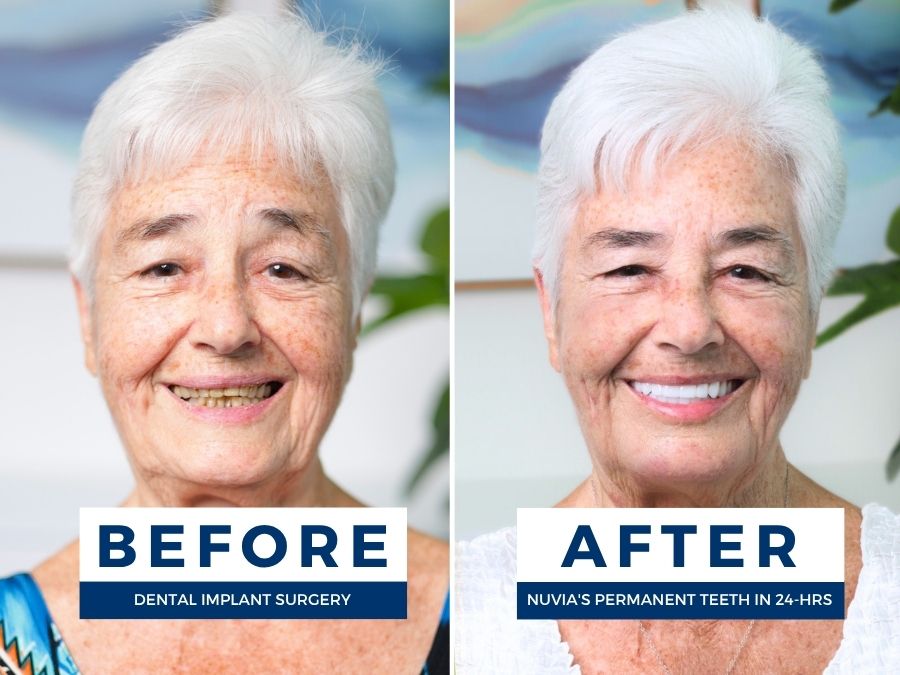
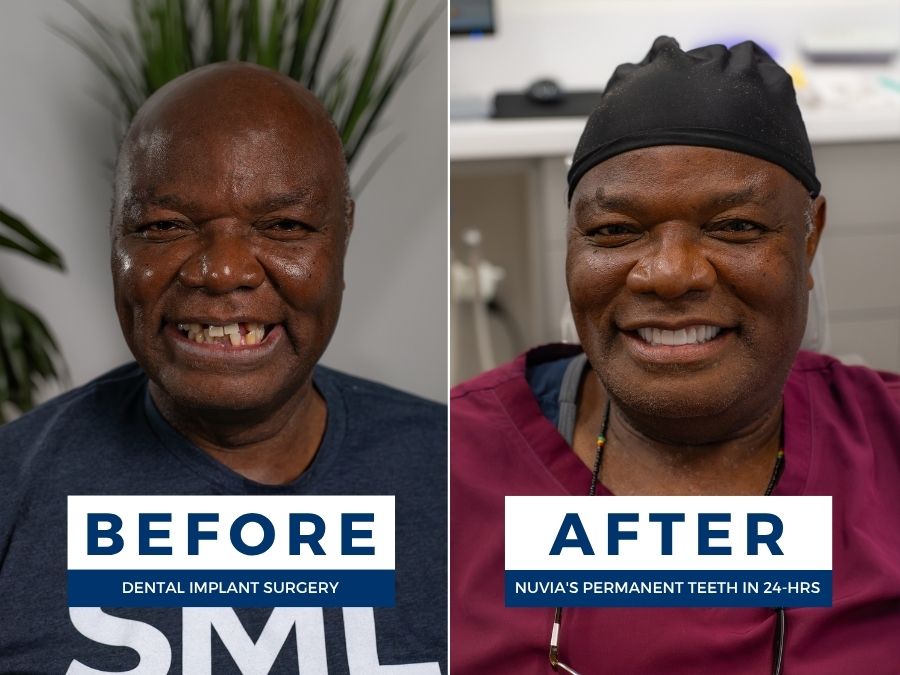
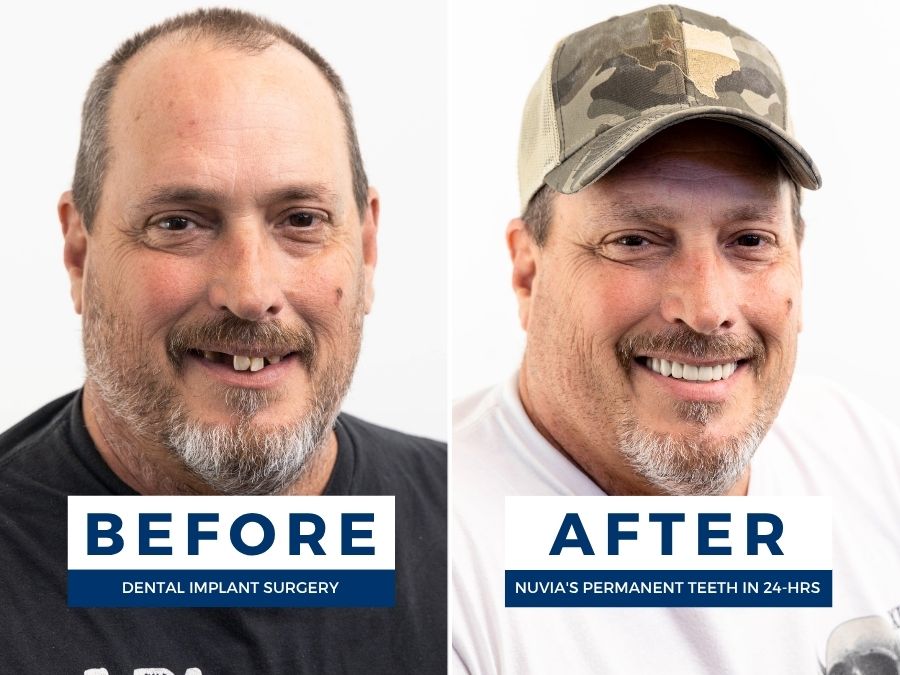
These conversations feature patients who spent years managing dental problems with short-term solutions before finally deciding they wanted something permanent. Find out what changed for them and what they would have done differently:
I was honestly saying to myself, let me go in here, do this. And though they're going to tell me, no, I probably can't afford it. Hey, friends, it's Ricky and Sharona here. And today we're going to answer some questions about dental implants in our journey to help you with your journey. Hi, guys. And I'm sharona, also a newbie, a patient, and ready to start these questions and give you a little bit inside of our stories. Hey, sharona, what was the root cause? Your oral health declining, and what do you think it all started? My journey. I would have to say it started in my adulthood growing up. My parents really didn't take us to the dentist and kind of low income. So I really didn't take my. I mean, I did my daily brushing, but we didn't. I don't recall. Just like going to the dentist. So as I got older, I began to notice in my to in front of my teeth, that my teeth were starting to decay. And then it started going to a process where I was having a lot of toothaches and then just doing that journey of getting older. I just started when I would eat something, I could feel them like breaking when I would eat food. And then it kind of started where it started out declining. And how about yourself? Well, I have to say kind of the same lines that was adopted in my parents' were born in the 20s and they didn't have any teeth at all. They probably didn't get dentures until the late eighties, early nineties, and of course they were horrible. They didn't fit well, so they never wore them. So since they didn't put a lot of stock in their own dental hygiene, they didn't put a lot of stock in us following through with our. So as time went on, it just kind of, you know, you think they're going to be there forever. But, you know, you quickly find out that they're not. And just like you said, when you're eating food, they'll fall out or they'll break and you think it's a popcorn in the butter bacon ice cream. And really, it's your freaking teeth that you're chewing on, so. Oh, that never works out. Well, not at all. So day to day for me, as I was growing up and crucially as I got older into my late 20s and thirties, it was difficult because with your teeth and you're talking to people or you meet people sometimes in their you're in the dating scene and stuff and it makes it very hard whenever your teeth aren't up to par. So you're kind of embarrassed. You don't really know what to do. You know, if I liked the dentist, I wouldn't have been in that situation. So it was one of those things where. I just had to always either. You didn't smile. You always had your mouth closed when you smile. People always think you're mad all the time and upset about stuff when really weren't upset or mad at all. So I don't know how it was for you, but yeah, I can definitely relate. I can even think just listening to you. I didn't know how bad my teeth were really affecting me and how was taking me into a depression that I would shy away from speaking in public or just even thinking about it. Job opportunities, stuff I knew I really wanted to do, or like training and working with people I shied away from because just had them behind my teeth and I didn't want anyone to see them or even want to laugh. I would laugh. I had trained myself to laugh like this. So yeah, they were talking to people like exactly the I didn't really on my end. It wasn't until a little bit later where, you know, you lose all these, but your first ones were still OK. So you know how much you could smile, how much your mouth could open and stuff. And now I've got to control myself with the smile I've got to control to make sure I still don't open it real wide. Because it's just like your cheeks hurt so bad from smile. I don't know. I love it. I'm here now. I'm like, yeah, but I love going through what I've been through. It's a humbling experience, so I wouldn't change this decision for the world. My biggest part was, was the eating part. I think, like I didn't have a problem eating. I ate whatever I want, wanted, but I would be at banquets and stuff and like I told you earlier, I'd be eating steak. And it's not that I couldn't eat the steak, but depending on how it was cooked, I couldn't chew it enough to make sure that I swallowed it without somebody doing the Hamlet maneuver on me. And nobody wants that. So that was I said, I need to do something. And so here we are, absolutely cool. When did you decide it was time to take control of the situation? What was your rock bottom on your turning point? I had actually gotten it to a point in my life, I said. This is my season. I'm going to step out on faith and I'm just going to see. I was just laying in bed, maybe like one or 2:00 in the morning. I'm just flipping through my phone and I came across the New view. Like an infomercial on the phone. And I'm like, I'm just going to fill out the consultation and just see. Now, mind you, I've known for years that I needed to do something about my teeth, but I've never researched anything because I have. In the back of my mind, I was like, I can't afford it. But that night I filled out the consultation. They called me. The next day I was like, Oh my god, I've gotten into this now. I just got to stick it out. So I remember the part of his name. I think his name was Tristan. So Jason called me. It was like, hi, Sharon, I see you filled out the consultation and I would love to talk to you and give you more information. And from there, I was like, I'm a procrastinator. But once I did that, I was like, there's no turning back. I have to do it now. So it was like, when can we set up an appointment? And I was like, OK, I need to go ahead and do it because me and my mind, I'm a procrastinator. So if I push this out, I'm not going to do it. So I set it up maybe like that next Friday, I was in and that's how my journey started. And I knew was that time and it was that moment, right? That's awesome. How about you? Well, I lived in College Station when my wife was in school, and I one Sunday. I was eating something. And one of these. Teeth right here. Broken half. And I had a pair of pliers and a screwdriver in my mouth. It was the worst pain and I've had some pretty crazy pain before. It was the worst pain ever felt. And I couldn't get stopped. And I had a screwdriver and a pair of pliers and I'm trying to bust this thing out of my mouth and pull it myself. And it's Sunday. So nobody's open. She finally. And I'm laying on the couch. Just not doing real well. And she called Dennis, and he was going to come up there. He met us, and he had shorts on and a t shirt, and he just got came from somewhere, and he took me in there, stuck some neat shorts in my mouth and pulled that tooth out. And while the pain stopped. And of course, you know, once the pain stops, I was like, oh, I'm good, you know, who cares? And as time kept going on, the rest of them, just because once you lose one and everything else just starts going to heck. So you write about. They just started breaking and things like that. And I, I've never had the screwdriver and pliers in my mouth again. But yeah, whenever I decided that it was finally time because I'd been to probably seven different places. Oh, Wow. Yes, I've been to I went to regular dental people, a few of them, and I went to some other places that said that they were, you know, cost effective, things like that. And a lot of it. And I just couldn't I couldn't because I was still doing OK. All right. I hadn't hit that point where I was like, it's time. You know, all the presses were pretty much close to the same. And it but the way they did stuff, I was just like, OK, this isn't going to be fun because I had all those fears that I made up in my head. And one day I was said, you know what? I need to do this. And I was fixing to sign the paperwork at this place that I've been to three times. And I said, so what? What am I going to leave here with when y'all pull all my teeth? And they said they brought this denture out. She took the scalpel. Cut the top of it out right there. Whoa and she goes, we're going to drill holes where the screws going to go, and you're going to leave with this. And I had seen the new movie, a commercial on the way to this place. And while I was waiting and I was watching the videos and I was like, wow, this place looks pretty, pretty legit. Wait, so you're at one place watching the video for new movie? So because I wanted to make sure that I was going to make the right decision, I had already been to this place three times and they Drew me up the contract and I'm fixing to sign it. And it's raining outside. And she brings that thing out and she scalpels it out and she says, this is what we're going to put in your mouth an awesome interest in my brain. I said, what's the difference between that and what Nuvia does with the teeth and 24 hours? So I said, you know what? I'm going to wait on this. Let me show it to my wife and then I'll come back. And I'd already procrastinated for several years with these people. And I called Nuvia. I said, when can I get an appointment? And they said, if you can be here by noon. And I got there and I found out the difference between them putting that scaffold up denture in my mouth and what newbie actually does and what they're going to put in their mouth. And it was totally, totally, totally different. Like, I was shocked right then. I made the decision. And when they were going to make sure I was asleep, all the other places wanted me to be awake. Now that was module. I was like, already don't like the dentist. Exactly I don't want to be awake for this. So because I'm going to be helping you and if I'm going to be awake, I'm as well get the pliers in a screwdriver and do all the rest of them myself. So but that was what made me go to Nuvia. And what made me decide was I said, hey, this is it right now. And I didn't sign the papers. I went there and they were super legit. So this decision. What did you expect at the scheduling of your consult with nuvia? Well, actually, I went in with a lot of emotions. I was honestly saying to myself, let me go in here, do this. And know they're going to tell me, no, I probably can't afford it. So I was walking in and when I walked in and walked into the building and before I could even say anything, they was like, home is guy. And I was like. They know me. And from there it's like, Hello. And something from there just came over me. Like a sense of peace. Like, I knew I was supposed to be there on that day, at that time. So when I got in and I waited, I was like, really nice there. Can I get you something to drink and show me where the ladies rooms were? Just making me feel real comfortable and I wasn't embarrassed about my teeth is like nobody was looking at my teeth. They were more concerned that I was OK and making me feel comfortable. I was like, OK, smooth. I was like, yeah, what's the gimmick here? I'm still sitting there waiting on myself, you know, to go to the back. I'm like, I know it's come be a no, so go ahead and go to the back and get out of here. So that's pretty much how my journey started in my consultation and all the staff, the doctors, everyone just made me feel at home. Like family. Like family. Absolutely what was your experience like? I told you before, I told them and I drove over there from where I was that. I walk in. It was a newer place. It was in the same little sinner thing that my sister my sister's been doing orthodontics for 26 years and she has beautiful teeth. And of course, I never had real pretty teeth, so. I go in there. And the one a lot of pictures on the wall. So my expectations, I was going, why are there no pictures on the wall? What is the place look like? They just rented this and I'm coming in here and I was like, so I was a little nervous. You're already nervous as it is. But I was like, have they not been in business very long? Have they did they just, you know, open the doors and throw their name on the thing? And so I asked I said, I want to know why you don't have any pictures on the wall, because I want to feel like I'm somewhere established. Stay tuned for episode two to hear what happens next in Ricky and Sharon. His journey.
When I first heard about it, my initial reaction was, How could they do this? Wow, what if they don't fit right? What if I come out looking completely different? Well, you did end up going through with it, obviously. You know, what actually happened? You know, what really went down? Emily. Emily. Emily. The appointment process was one that even my friends couldn't imagine. Six months ago, Alvin got his twenty four hour permanent smile. And today, he's walking us through the top fears that people have about this quick process and if they actually came true. You ready, Alvin? I am ready. Awesome. Well, let's get started with one of the biggest fears that people do have about this process. You know, when they hear about permanent teeth in twenty four hours, their first thought might be, Is this a scam? Is it even legit? So when you first heard about it, what was your initial reaction? Well, when I first heard about it, my initial reaction was, how could they do this? And I thought, this is so innovative. And if this is true, this is what's going to benefit me. Because I have heard stories where people have gone for months on end after getting one implant, and I'm talking about getting a full upper and lower implant. So, when I first heard it, I certainly didn't think that it was a scam. And reason being because Nubia is very good about putting themselves out there. And so, by putting themselves out there, I went to where they were and I started following Facebook. And that's where I started building my knowledge, about Nubia and what they could possibly offer because it wasn't testimonies I was reading. I was listening to real people tell real stories in real time. Wow. Okay, great. Well, you did end up going through with it. Obviously you're here today. You look incredible by the way. Thank you. Thank you. I can't stop smiling, so thank you. And I won't. Exactly, as it should be. But I want to hear, you know, what actually happened? You know, what really went down? Can you walk me through that kind of first appointment to the day you got your new teeth? Was it twenty four hours? Let's hear about it. Well, I have been contemplating getting this done for, or getting something done to make me a healthier person, you know, and deal with the issue of my teeth. It probably for three or four years, but it was December of when I noticed that my teeth had started to get weak and I have a podcast and so I'm talking all the time. And so my dentist had told me, Alvin, eventually you're going to have to get an implant. So I knew all that, but it was December of when I found Nubia and started looking at everybody online in the community there. And I thought, these people are real, so I gotta do something. And later in December, I caught a flu. And that's when one of my teeth, I didn't have many left, it just completely fell out. And I thought, oh, wow, I don't have many options here. So I'm going to call Nubia. And that was probably the first part of my fear, making the call and getting the appointment. I took a quiz before calling to see if I, you know, just what they did and if I was, how I should go about making the appointment. And one sentence really got me when they said, if you are a candidate. And I think that's when my whole heart just fell to my stomach because I thought, what if you're not a candidate, a good candidate? What, you don't, you don't have a plan B. So anyway, I called and I made the appointment and I went in and the nuclear people act as if they knew me. I was like, you know, I mean, you know, every, you know, customer service was like at a, at a twelve. And I thought, okay, okay, that that's, that's, that's comfortable. And then they turned me onto a rep that, oh my God, I can't It was a gentleman. I can't think of his name right now and I'm so sorry. But he walked me through the whole process and, you know, what the next steps were, me getting, taking the x-ray and all of that. Then getting us to the conversation of, okay, I'm a turn this over to the surgeon and they're going to let you know if you're a candidate. I'm telling everybody, I don't know about you, but I sat in that room for five minutes thinking, What if I'm not a candidate? That was the worst feeling of the entire process for me. Only to have someone come in the room and say, you are a candidate. And I went from slump to happy. And, you know, I It was just Now I can deal with the reality of what comes next. Payment, scheduling, all of that. But when you don't know that based on one little thing, yeah, it's very stressful. But that was the most stressful of this whole process. Oh, that, that says a lot in itself. Yeah. That was the most stressful. Wow. So, okay. You had your consultation. And then what was the next step? Did you get it going for your smile design? Was that the next step after that? The appointment process was one that even my friends couldn't imagine. I have a friend who I stayed with when I went to Port Lauderdale, who is a dentist. And so I told him I was going to Newby. I explained the whole process. And this is how I know this is very serendipitous that I should have been there because we go out to dinner on Sunday and there was this biscuit that I just had to bite into. I wanted it. So I've been into the biscuit and this was a Sunday, my appointment was on Monday and one of my teeth came out in the biscuit. Wow. And I said, I'm supposed to be here. The tooth that came out didn't allow my denture to be in at all. I said, I'm supposed to be here. So on Monday, I went in, got my x-ray, got my smile test, if you will, picked out my teeth. Ladies and gentlemen, I picked out all of these. I had a hand in picking them out, which, come on, come on. I mean, again, I had, I played a part in that too. And so my only, fear was, wow, what if they don't fit right? What if they don't, you know, but they assured me that they will. So after I picked up my teeth, that was Monday, the next day they said, okay, well, your surgery is tomorrow, Tuesday. They gave me a prescription for medication to prepare for it. I go in on Monday at eight o'clock in the morning, and I don't even recall it happening. And when I finished, I knew that something was happening, but I felt no pain. Now that could be pain medicine. Everybody experienced pain differently. I didn't feel any pain. But I went in the bathroom and could see the implant in my mouth. They do not put the teeth in that day. They give the implants a chance to settle and you go home and you ice yourself and you take your pain killers and whatnot. You have to ice your face every twenty minutes of which, again, I'm living with the dentist. My best friend goes with me. So they're in the room every two hours or whatever, putting ice on my face. Then the third day, Wednesday, I go back at a time given to me and I was swollen. And I'm going to share with Emily some pictures you guys, and I'm going to give her permission to show you how I looked like a keller tubby when I did it. And the swelling was so overwhelming, said, well, how can you put these teeth in my mouth? And they assured me, oh, they'll go in. They put the teeth in my mouth and I went home. That was a Wednesday. And I kept icing myself. And then Thursday didn't have to come back, you know, it was, you know, a day of rest. And Friday I had to fly out to fly back in the evening. So I went in that morning, they did a final check and everything was setting well. They give you explicit instructions on how you should care for yourself and the things that you should do and not eat. And you have to, have to, have to go by the instructions. There's no way you should deviate from that. And I literally felt no pain. When I got on the plane, my best friend was like, Are you sure you're going to be okay because of the altitude? I do that, blah, blah. I said, Well, give me a Tylenol. Let's do it. But right now, I said, I feel nothing. Wow. I felt nothing. And so the whole innovation X aspect behind that, I don't know how Nuvia got to this, but I am so glad I'm here talking to you, Emily, to share that I am living proof that what they say is what they do. Wow. Yep. Twenty four hours later, you had your teeth. Friday, you were headed back home. And please tell me, are those the same teeth that you still have in your mouth today? These are the very same teeth. I call them Mercedes and Rolls Royce on a given day. These are These are my same teeth. You did touch a little bit on pain here, and I wanna get to talking more about that. But first, if you are watching and you're also wondering something that Alvin wondered before getting this done, am I a candidate? There is that sixty second quiz that you can take in the description below. It's a great place to get started, so you can check that out there. So, Alvin, you mentioned, you know, you weren't really experiencing much pain. And I know this is a big fear of people because, you know, it's a surgery. Right? So something happening this fast, isn't it gonna hurt? So did you initially have fears before you went into this about the pain aspect? My fear was only about, I'm gonna pick out these teeth, but what if I come out looking completely different, which in some ways I do look different from how I looked, which that's another conversation, how I had to prepare myself for the possibility of that. But I had no fear. Again, the Facebook page that thousands and thousands of people who have had this done, it was so reassuring to me to be a part or listen to the community now and be a part of the community and listen to their stories. I mean, very age groups, young, diverse backgrounds. I'm not a rich man, and I don't know anyone else's walk, but my impression was these weren't like people who were super wealthy, who were getting this done. These were people normal like me. And I thought there's some truth here. So no, I had very little doubt after I did my homework and Wow. I honestly have to say I was not, I was ready. I was ready to do That's great. I think that's great though. Going in with less fear is always a good thing. So whenever you did come back in that next day after surgery to get your teeth placed, did that itself hurt? What did that feel like? -: I'm gonna Oh, actually, you know, it felt like I was still on pain meds, so let me put it that way. So But there was a, and I would just, oh, I wish I could look at my phone right now and her name would be there because Nubia Port Lauderdale, I have everybody's name in my phone that helped me, But the technician that put my teeth in my mouth, she was so precise and, you know, they didn't give me anything to numb me or anything like that. It was perfect. Wow. It was perfect. Considering now you have these gums that have just been through something that was super duper traumatic, and they're not healed yet. You're not healed. The gums still have to get accustomed to all the work that has taken place. But putting the teeth in didn't take away from that. It was part of the process, part of the whole healing process. So no pain. To be sitting here with you right now, so much better than I was when I was, you know, first had it done, it is really a blessing. Wow. So I'm Everyone is so different when it comes to, you know, the recovery and stuff, but it's great to hear that you didn't really experience much pain, discomfort, and I'm surprised. I'm always surprised by it because it's such, it's a surgery. It's a big surgery. And so it also does make sense that there are some adjusting moments. Right? You know, learning how to talk with them. And I'm sure eating is a whole other situation you gotta get used to because it's a foreign object in your mouth. Right? Yes. How long do you think it took to kind of adjust to this new your new smile? Are you still you're still adjusting or are you? I'm still adjusting, but I would say I came home on the seventh. I would say by the sixteenth of March, you could see the swelling going down. And I remember going to church somewhere around the twenty third or twenty second of March where the swelling had gone down, but people were looking at me like there's something different and we don't know what it is, but I have not felt any pain ever. Wow. I hope everyone, and I know everyone's different, but I have not felt any pain. I am so glad. I am so glad. Oh, man. Wow. I still can't believe it. That is incredible, though. I do wanna get to another big concern people have, and we kind of you kind of touched it earlier, which is, you know, what if it doesn't turn out how I expected? I'm sure that's a fear a lot of people have going into this. What if I spend this money, and it's not what I imagined, right? So can you talk a little bit more maybe about that fear you had going into it? So I don't know how to even answer that, anymore because I went in there very optimistic. And again, I don't look exactly the same as I did. That's because I have a full rack of teeth up and down, top and bottom. But I wouldn't change this for nothing. This experience has just been, as my boss would say, Bravo Zulu. Okay. Just fantastic. Yeah. So I wanna hear more about what's made this so great for you. What has really changed even on like day to day life? Can you talk more about that? Well, well, Emily, Emily, Emily. A couple of things that are very significant that are very impactful. First of all, my health. A lot of people don't understand that I know that a lot of health concerns that people have is because of poor dental hygiene. And by me having this surgery, it corrected or I was able to deal with some hygiene issues that I didn't even know that I had. And it has corrected that. So my health has been better. I'm a very health conscious person anyway, but if I may, Emily, getting to this point, I have been HIV positive for thirty five years. And so I knew I'm one of the people when HIV first hit the, our world. And so I was taking medication and this is the reason why my gums got weak. I was taking medication that was very strong, you know, until we got to this point where now there's medication that allows people to live with HIV. And so I know that that had a very big reason for my gums getting weak because I've been going to the dentist all my life. And so that's a huge part of it. So my health was a a big part of why I did it. I also have gained I have a talk show and I've noticed how people at first I used to just think, well, maybe, you know, I want people to just hone in on the talk show and not hone in on the person who's putting on the talk show too much. But I'm gonna say that I believe that my ratings have gone up because my smile presents another side of me that maybe, well, I couldn't show because I didn't have it. And thanks to Nubia, that smile is like there. Then the last piece, because I've been smiling since I got it, you know, I have gained this beautiful relationship with someone that saw my smile online and said, wow. And I've asked them, I said, so did you like hit me up because of my smile? And they said, yeah. He said, yeah. And I said, Wow, wow, wow. Okay. Well, you know, ding, ding, ding, ding, ding. And so I The benefits of all that and the value of all that has pretty much impacted my life. And the reason I'm here and I'm grateful for you all giving Emily, you giving me this opportunity and Nubia giving me this opportunity is because even in posting on the page, you all have seen something from me that probably said to you, Hey, let me consider this guy to come on the show and tell his story. So thank you for that. So there's been tremendous value in getting this new smile. Yeah. I am so beyond happy for you and excited for you. You're just six months after this, right? I'm sure there's still much more to explore about yourself and your -MIKELLE: Mm -MIKELLE: What are you excited about? Well, first, I was excited about eating a piece of chicken. I mean, I love chicken from the air fryer. I ate a piece of chicken, a chicken wing a couple of weeks ago. Emily, it It was as if I had gone to the best restaurant in the whole world. I went almost a year and a half without biting into a hamburger. Because I was afraid to, you know, to eat because I had to make all these adjustments. Yeah. Yeah. Wow. And it's the little things like that, right, that are such big things. Little teeny things like that are like huge. To even, I love celery. I couldn't bite a celery stalk. Little things like that are very important to me and have been important, and a lot of that is because of me taking the plunge and having the surgery. Absolutely. And you did that for yourself. I love Like, you took the leap, and here you are. Like, you should be so proud of yourself. I am. I am. And I know we haven't touched on it, but I wanna tell people You cannot put a cost on your hell. Totally. Yeah. And and since these six months, I know it's still early. But have your teeth felt reliable? Do they feel strong? Are you ever worried about something happening to them? What about that? Very good question. I will always be worried about something happening to my Rolls Royces. I will always And so, I don't I used to love to smoke a cigar every now and then. I will not I'm not smoking a cigar at all. So there are things that you have to adjust to. I don't I'm not worried because I feel like I'm doing what I'm supposed to do. There might be a time when it's cold outside, it's been like during the winter, I think I felt like a little tingle in my mouth because it was cold. And I don't know that for sure, but I put it in my journal to say, Hey, it was cold outside and you felt this tingle and this is the first time you've ever felt something like this, but I've never had this in my mouth. And so, but I've never, I don't have any doubt that the work was done improperly. I think it was done to the best of the ability based on the need that I had and the situation that I had with my mouth to have it done. So I know I take care of it. I mean, I went through the flossing thing, know, Waterpik is like your best friend. I will say when I go to dinner though, I have to take flossers with me. I make sure that I, you know, pay attention to them when I'm out, you know, so. Just a thing that I want to get used to. So I have flossers in my car. Have flossers in like, if I have a backpack, know what I'm saying? I might've slipped a couple in my wallet, you know, to make sure that I, if I'm out and I got to do that. But those are things that you have to do once you get this done because it is truly life changing. Absolutely. And you want to keep them that way. Yeah. Yeah. So second to last question. Do you feel supported by Nubia after the fact? I'm gonna say I feel supported by Nubia. You know, after you have it done, there's a two week follow-up and then a four month to reconnect with them and have them to look and check things out and make sure that things were set right. That was another wonderful experience. And the professionalism that this company has, incredible. It is incredible. And if I can encourage someone to at least look into having this done, I have a feeling that you won't turn back, especially if you put some things in perspective. And I'm not the kind of person that necessarily puts cost at the first reason why I'm going to take care of myself. A lot of it, you know, for me is the time that it's going to take for whatever I need to have done, and if I can get it done. You know, because if I can't get it done, money or anything else is not even going to be, you know, shouldn't even come up in the conversation. So I'm, I'm happy. Good. Yeah. Well, I was going say my last question is looking back, do you have any regrets this far? Oh my gosh, Emily. No. No, no, no. I don't. You know, I really don't. Not. I am so happy to hear that. Thank you. I'm happy to tell I can't say enough. I'm just grateful that you had me here to tell my story and to shed light on Nubia and the Nubia team and family. I mean, top notch. I could go on and on and on and on and on, but it has been a very big wild factor for me. I hope that I can encourage someone else to do that if they need to. Totally. Well, Alvin, I want to thank you so much for joining me today. Thank you. Your story is proof that fears can be real that people have, but so are the results. And you were here today showing us that the results are real, right? So for those watching, if you are ready to see if you could be a candidate for this twenty four hour permanent smile, don't forget to take that sixty second quiz in the description below. And until next time, keep smiling.
Hey, I'm Derek. I've had my Nuvia dental implants for about six months now and I'd love to talk to you about the good and the bad. And you're probably here wondering about the cost and we'll get to that. We'll talk about that later. So bad number three. Before I got my implants my teeth were horrible. I had broken teeth, rotten teeth, gone in for root canals and ultimately over the lifespan it made me very sick which compromised my health. I was in and out of the dentist, I had broken teeth, I had recessed cavities that were giving me heart problems, I was on antibiotics a lot, and that was causing me a lot of discomfort throughout my life and that affected my business. I was dealing with customers every day being a motel owner and I couldn't see myself being in my current condition lasting the next fifteen years dealing with the public. My good number three: I did a lot of research just like you're doing a lot of research. For example at the other implant center they wanted me to come back six weeks after my initial consultation for my surgery. After my surgery they wanted me to come back three to four to five months later for my permanent teeth and being a motel owner I just don't have the convenience of closing the motel down and making trips wasting days away from my business that is my primary business. At Nuvia I did get my permanent teeth in twenty four hours just as they had promised. I didn't feel like a number I felt like family. They treated me with the utmost respect I felt like everything was a one on one and the communication was amazing. They told me ahead of time what was happening so there were no surprises and I knew exactly what to expect. In my consultation they told me what my cost was going to be. I didn't look at it as a cost, I saw it as an investment in my future and my health. I knew exactly what the payment was going to be and I was very happy with that. And everyone wants to know what that cost is going to be. Everyone's procedure is going to be different. Some people may need uppers, some people may need lowers. So if you're curious what that cost is going to be check the cost guide below and that'll tell you everything you need to know. Bad number two: soft food diet. I'm not gonna beat around the bush it's not fun. Eating soft food for four months you have to do it. A lot of mashed potatoes, a lot of mac and cheese, a lot of yogurts. The best part about it is I've lost weight and I'm looking good. And how do I know this? Because everyone tells me it's a small sacrifice with a big reward. My good number two is if you hate dentists as much as I hate dentists let me tell you Nuvia is not a dentist. They told me as soon as I walked in the door that they do only one thing and they do it very well and that is permanent teeth in twenty four hours. One of my biggest fears of going to the dentist was being awake during all their procedures. Listening to all the sounds of them drilling just gives me really high anxiety. Going to Nubia is completely different. They have an anesthesiologist right there, they knock you out completely, it appears to be over shortly after it started. So this procedure is night and day different between Nuvia and a dentist. My bad number one: being a business owner it's impractical for me to close my business to go to appointment after appointment after appointment. And with Nuvia I had my appointment on Wednesday, I had my surgery on Thursday morning and by Friday afternoon I had my permanent teeth and they sent me home with a beautiful smile. So my good number one is with the modern technologies that we have today can you believe that we can get permanent teeth in twenty four hours? My furnace went out and I couldn't even get a repair guy in twenty four hours. I mean think about that isn't that kind of ridiculous? Think about this all my life I've dealt with poor teeth all the pain all the suffering all the painkillers that I've had to take and just think within twenty four hours all of it can come to an end. I want you to do this. I want you to paint a picture of exactly how long you have been suffering with this and can you imagine what could happen to you in twenty four hours with this procedure? This is truly life changing. If you would like to know more about the cost, this video right here.
Hi. I'm Kendra. I've had my dental implants in for about two weeks now, and I wanna talk about three good things and three bad things that I have experienced personally with the implants here at Nuvia Dental Implant Surgical Center. So one of the things we're gonna talk about is cost, and we're gonna get to that a little bit later. I told you I was gonna talk about three bad things. So the first bad thing that I'm gonna talk about, soft foods. Can't express it enough. You've gotta stick with soft foods while your implants are adhering to the bone. Very important. We're gonna go through a couple things I really think are great to have here with Nubia. One of them is the environment. You walk in, you don't feel like they're prejudging you. They're here to help you. They're here to, you know, make you comfortable. You're not hearing all the surrounding noises of the drills and the suctions and the, you know, the guy in discomfort or the clanking of all the tools. All of that was building up anxiety for me to go to a dentist. When I came in here, there was nothing like that here. I literally laid there and let them work on me because of how they made me feel. Nobody here was here to mock anybody. It was true, sincere feeling, how can we help you? And that's what was so important to me. Second bad thing, the maintenance. I got to this position because of what I did or didn't lack of doing, and now it's made it so much simpler. It's a rinse. It's a quick brush. It's a water pick. Things are gonna be easier for me. Things are getting better for me. I can't wait till I can get into a crunchy taco and fried chicken. It's gonna be there. Trust me. And the maintenance? I don't ever have to worry about things being stuck between my teeth. It's gonna be a smile. You're gonna be happy. You're gonna have so much more confidence. Okay? So just hang tight. It will get better. The second thing I had that was really a good experience for was knowing that I was gonna have my confidence back. Knowing that I was gonna have teeth. To know I could smile and people weren't looking at me like, Oh. It was there. It was me wanting to come back to life. It was me wanting to make more friends. I didn't wanna have to hold that piece of paper in front of my face where I met somebody, or not be able to give a good smile and feel good about it. You feel good. There's no other way of putting it. The third thing is, of course, the cost, which, if you click on the link below, you'll understand exactly what I'm talking about. Because what that's gonna do, it's gonna put it into one lump sum for you rather than the next five years of you getting dental work, of you going to the doctors for the bacterial infections that you're getting from your teeth. It's all gonna be incorporated to get it in one shot, get it done, you're gonna be so much happier. I promise. So my third good thing, and I promised you I would give you three. The third good thing is I got my permanent teeth in twenty four hours. Now granted, I went home the first night after my extractions without teeth, and that was okay, Because I was anticipating my teeth that are gonna be installed the very next day, and here they are. My same teeth I got twenty four hours later are the same teeth I'm gonna have moving forward. And that means all the world to me. I hope I've been able to help somebody out there. I hope you realize that permanent teeth in twenty four hours is different than teeth in a day. I hope you realize that the good definitely outweighs the bad. And what you're about to do is an investment in yourself, and you are the most important. If you can't take care of yourself, you can't help anybody else.

Your dental implant consultation starts with a full evaluation of your teeth, gums, and bone structure. Whether your teeth are breaking down from health issues, missing altogether, or becoming harder to save, you’ll get a clear understanding of your options.

When multiple teeth are compromised, repairing them one at a time can turn into years of appointments, added costs, and more frustration. Full mouth dental implants replace the entire system at once instead of patching individual problems.

You’ll receive a detailed cost breakdown before making any decisions, including financing options that can make treatment more manageable through monthly payments.

24 hours after your procedure, you’ll return to receive your custom set of permanent teeth that the Nuvia lab will have created overnight. Traditional approaches often can involve multiple procedures sometimes spread across months or in extreme cases, years before reaching a final result.

Eat more comfortably. Smile without thinking about missing teeth. Stop wondering which tooth may fail next. For many patients, one of the biggest reliefs is finally feeling like the problem is solved instead of managed.
Learn more about treatment timelines, costs, candidacy, and why many patients choose full mouth dental implants instead of continuing temporary repairs.
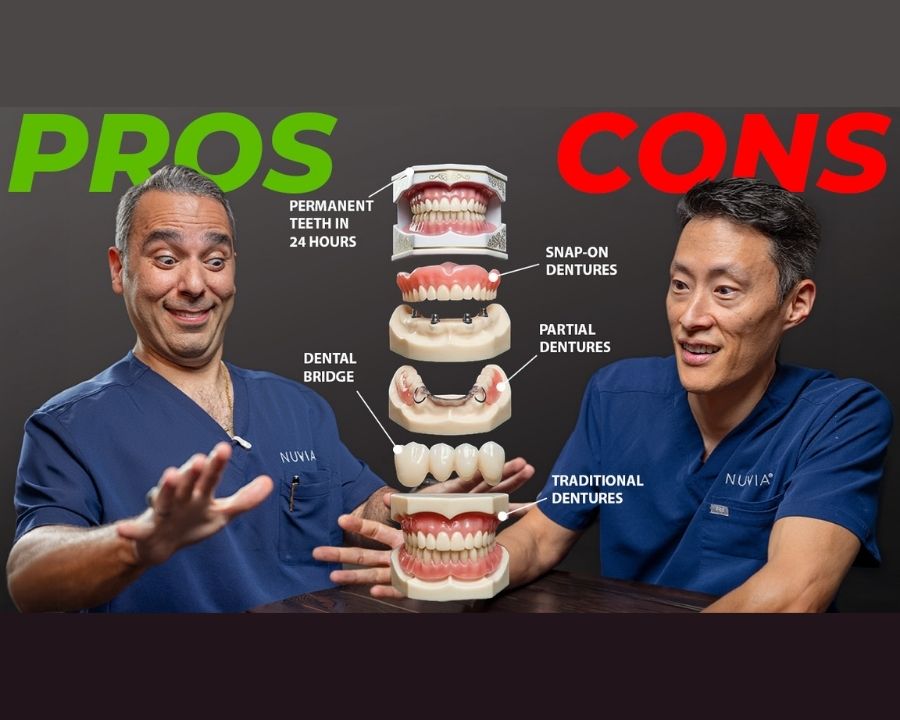
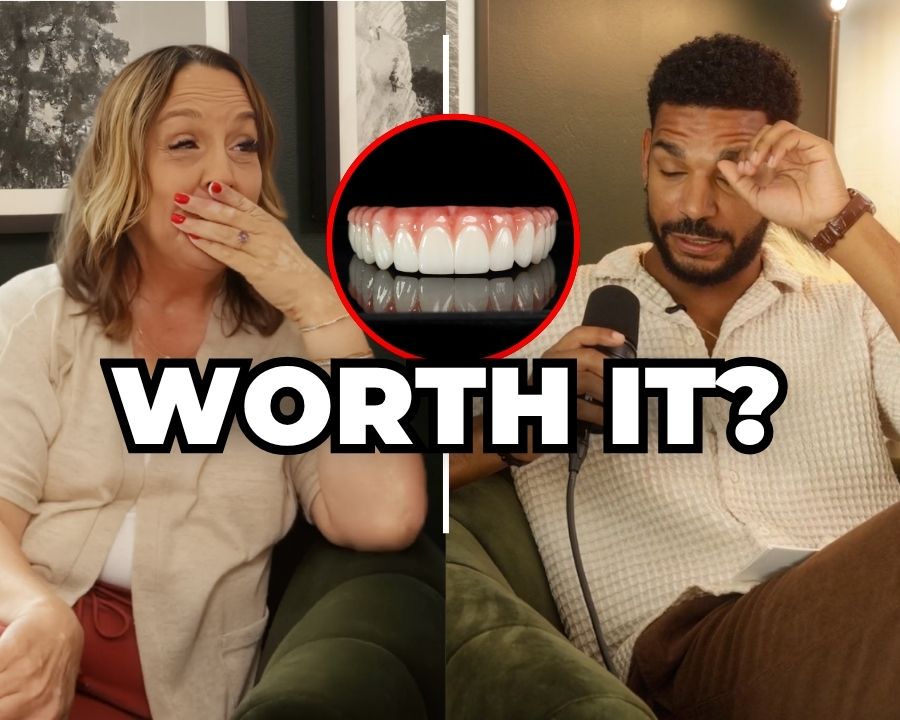
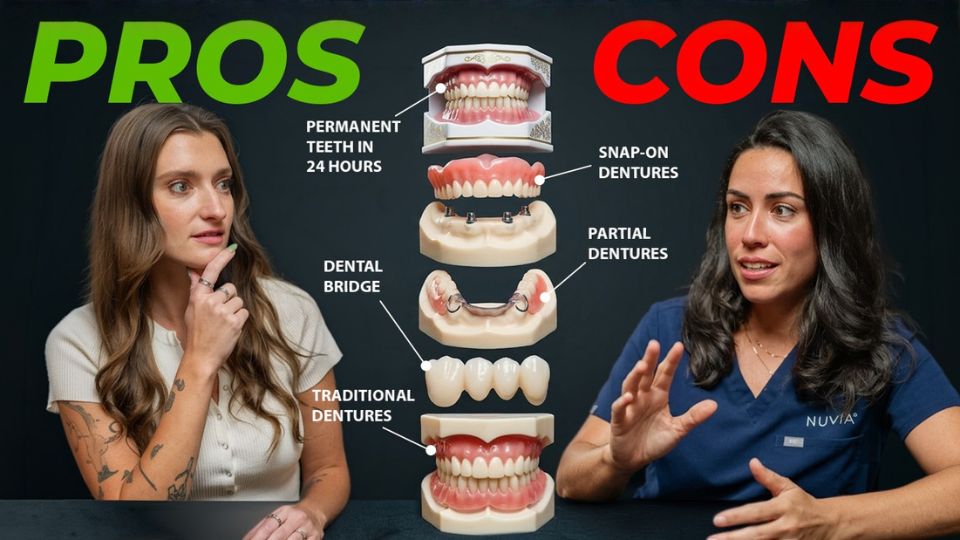
.jpg)
.jpg)
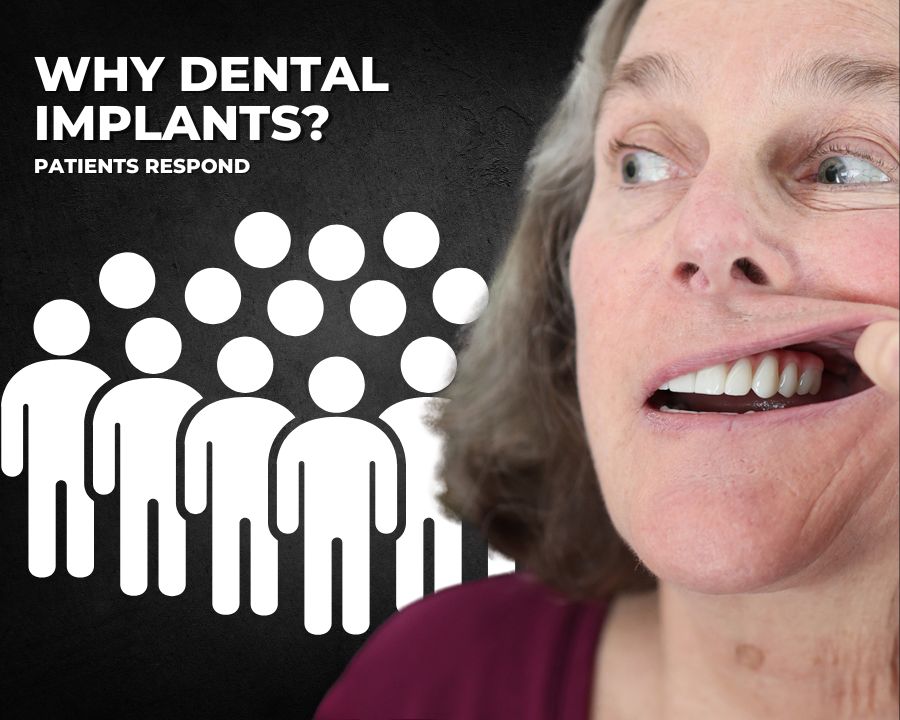
.jpg)
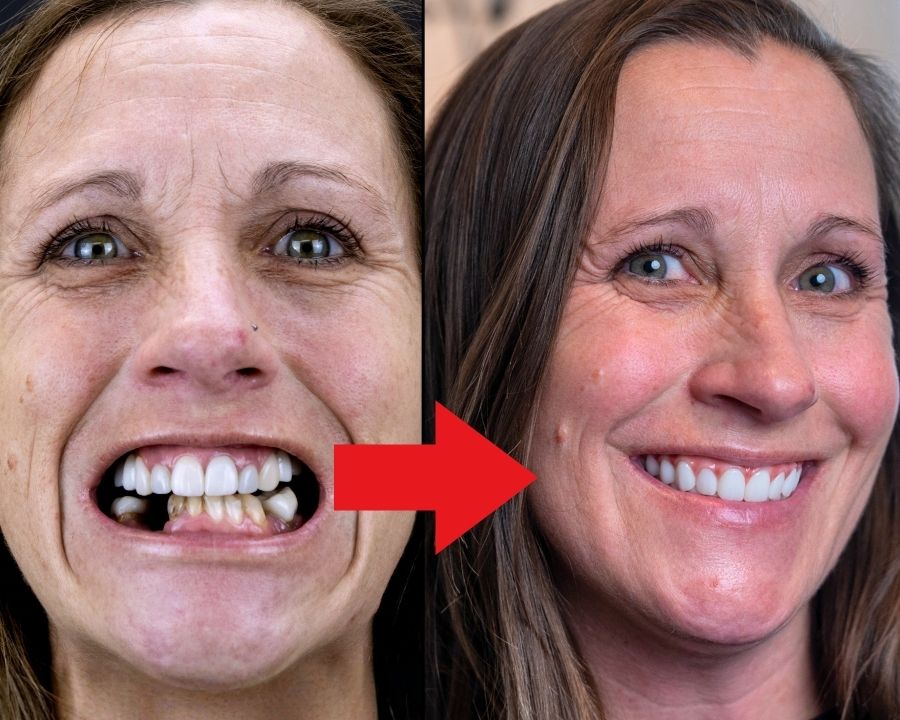

Fill Out The 60-Second Quiz Below


This guide is designed to walk you step by step through the dental implant process and each dental implant type with their associated costs.
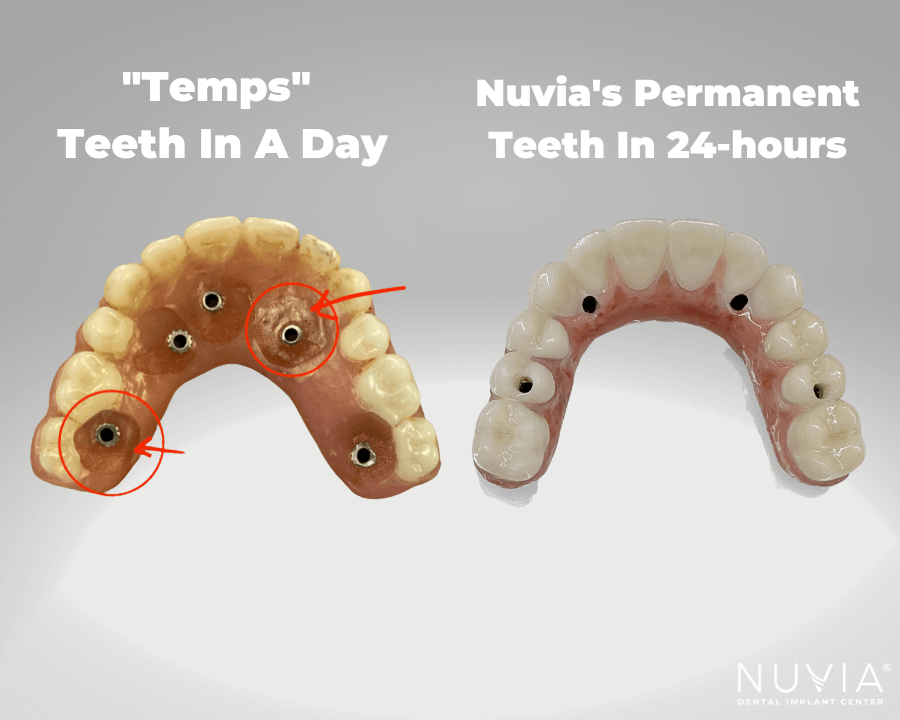
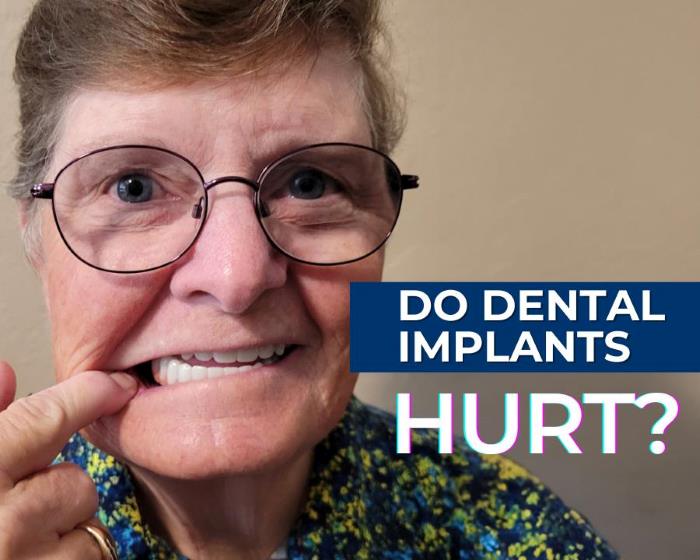
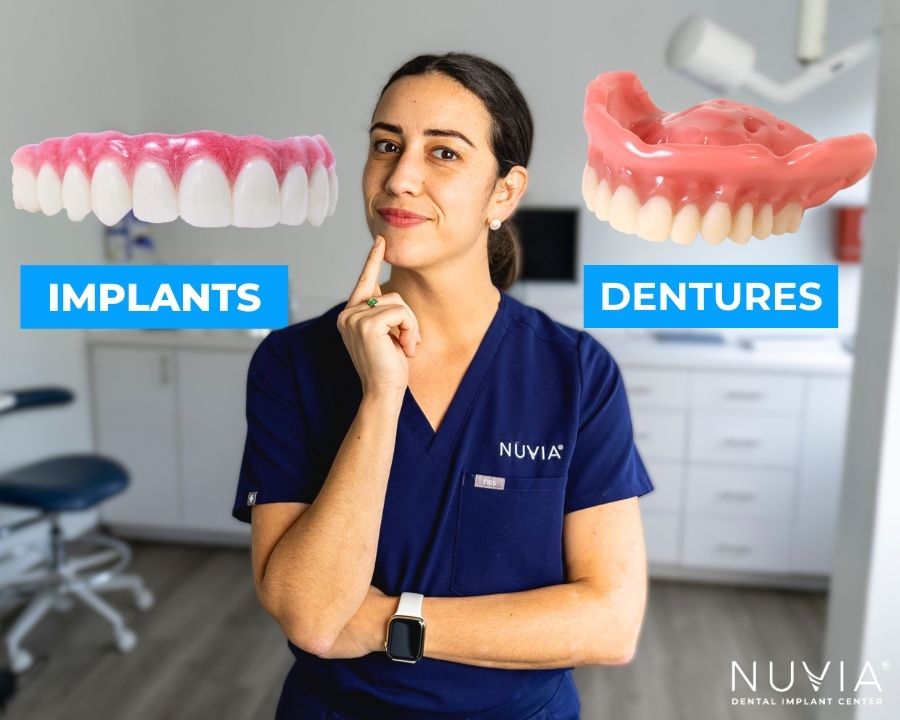
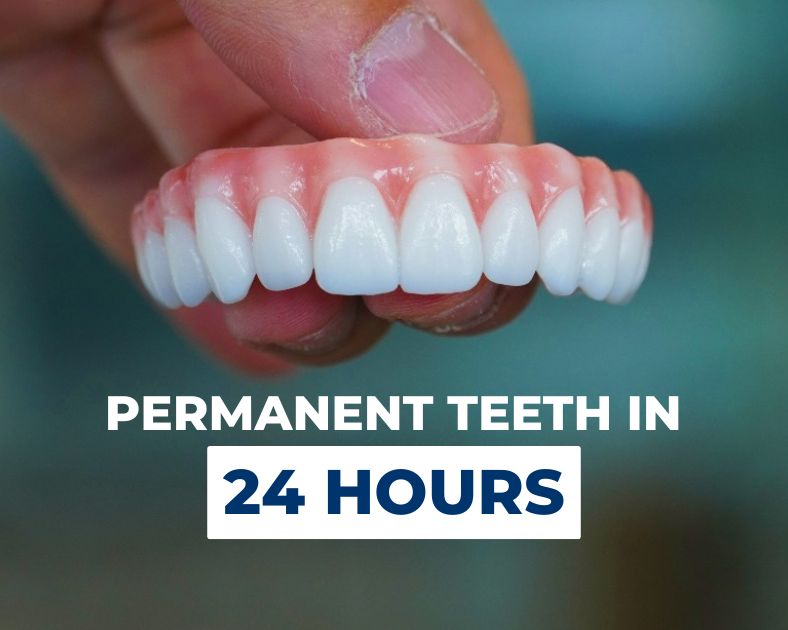
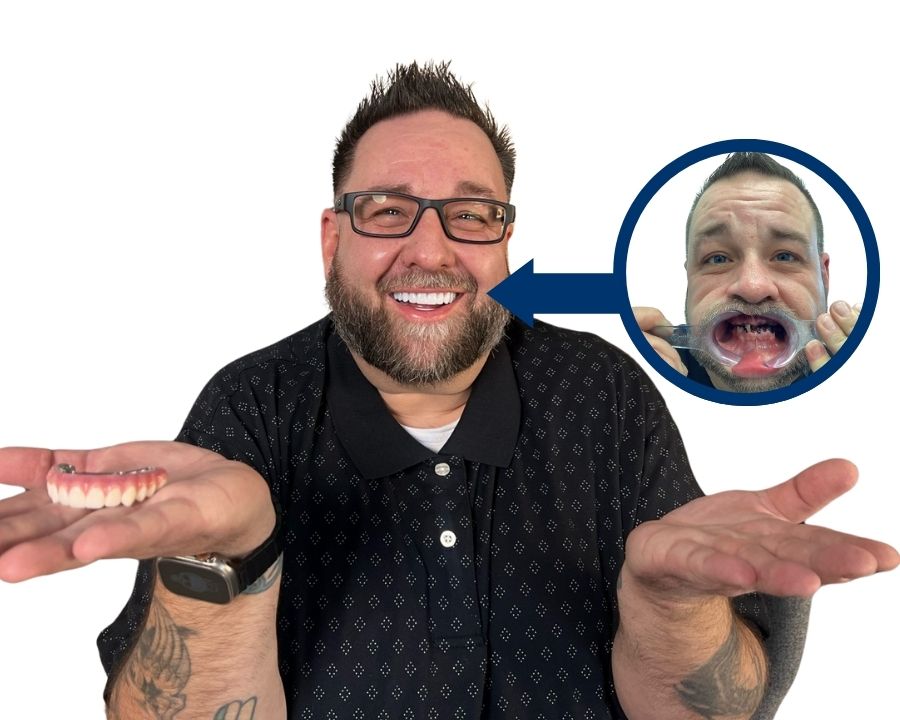
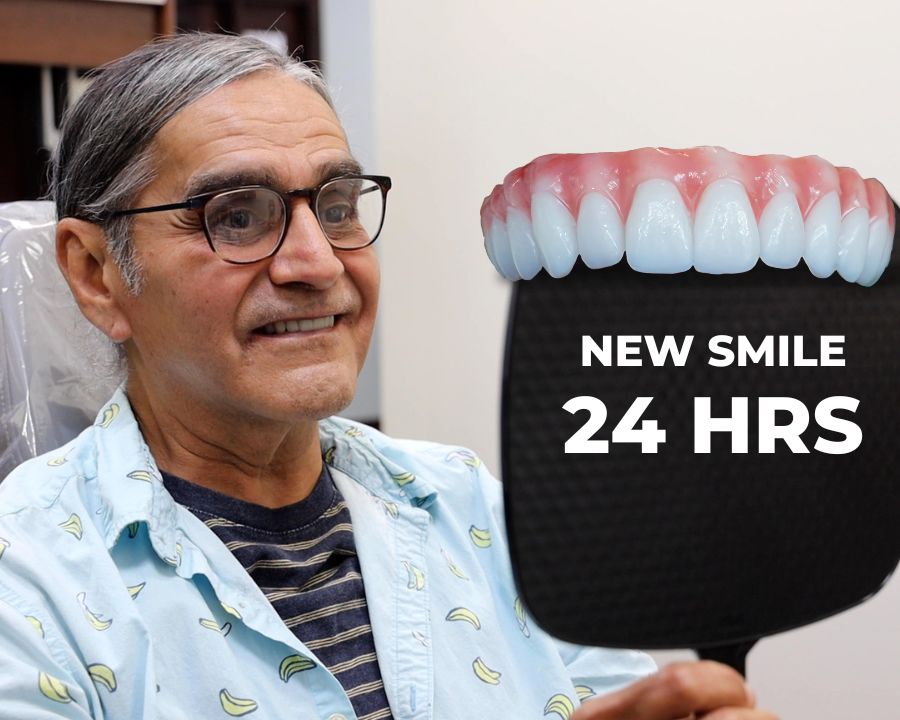
.jpg)